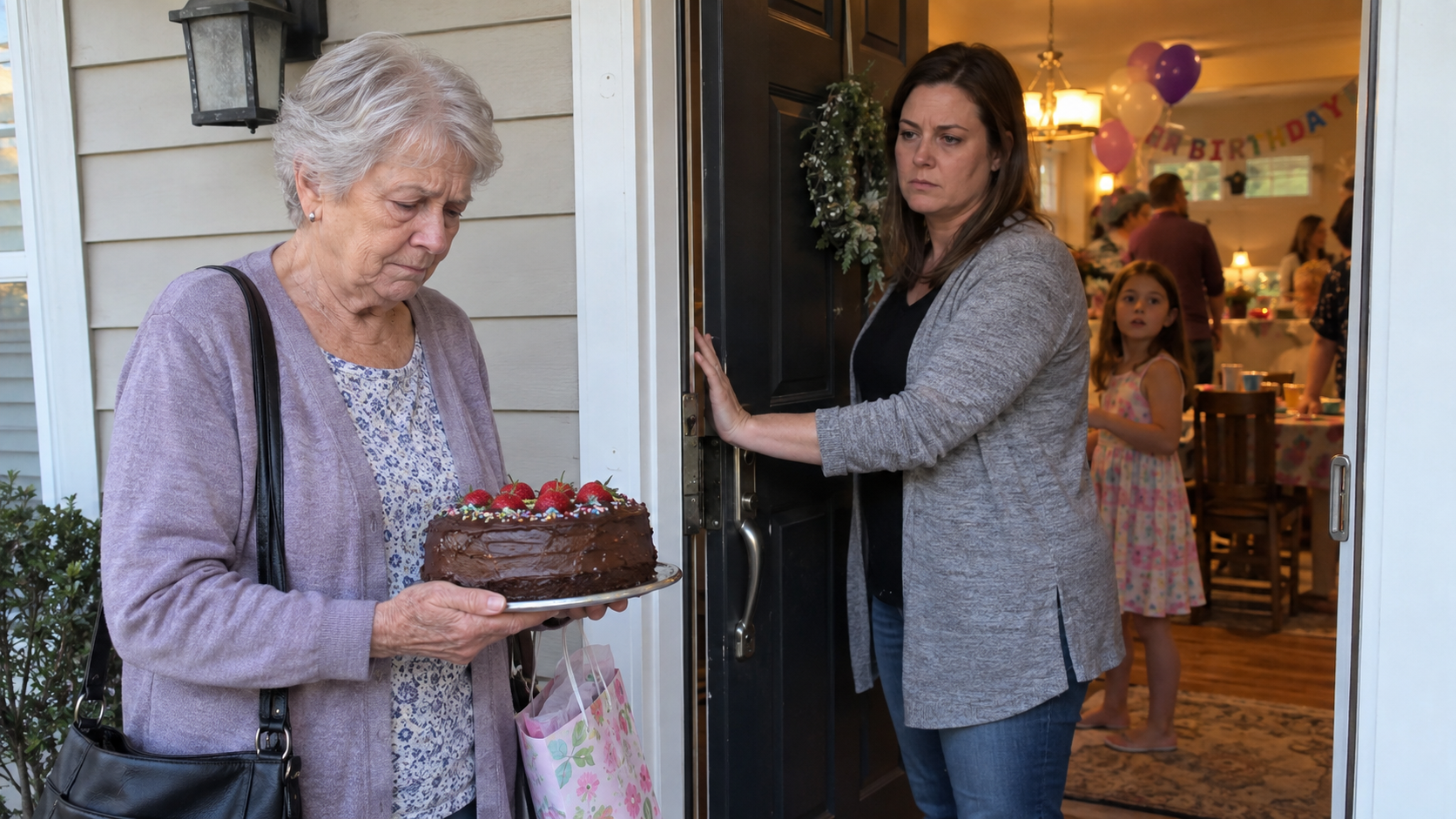
Margaret was still holding the birthday cake when the door began to close.
Behind Claire, she could see balloons in the living room.
Children were laughing.
Someone was carrying paper plates toward the table.
Her granddaughter’s tenth birthday party was already happening.
Margaret was standing outside.
“I brought her cake,” she said.
Claire looked down at it.
“Just leave it. I told you not to come.”
Margaret didn’t argue.
She simply held the cake a little tighter.
“She asked me yesterday if I’d be here.”
Claire lowered her voice.
“She doesn’t need to know you came.”
Then someone inside the house called out.
“Grandma?”
Ten-year-old Sophie appeared behind her mother.
She looked at the cake.
Then at Margaret.
Then at Claire.
“You said Grandma didn’t want to come.”
Nobody answered.
Sophie stared at her mother.
“Why did you lie to me?”
The question was simple.
The reason Claire had kept Margaret outside was not.
The Cake Had Been Ready Since Early That Morning
Margaret had started before breakfast.
Chocolate sponge.
Vanilla filling.
Strawberries around the top because Sophie had asked for them every birthday since she was six.
It was not a professional cake.
Margaret had never pretended it was.
The icing wasn’t perfectly smooth.
One side leaned slightly more than the other.
But Sophie knew who made it.
For years, Margaret had brought a homemade cake to nearly every family birthday.
This year felt different.
She had not received a formal invitation.
Still, Sophie had called the previous afternoon while visiting her father.
“You’re coming tomorrow, right, Grandma?”
Margaret had paused.
She knew things between the adults had become uncomfortable.
But she couldn’t tell a ten-year-old that.
“If you want me there, I’ll be there.”
Sophie had answered immediately.
“I do.”
That was why Margaret finished the cake.
And that was why she drove to the house the following afternoon believing there was still a place for her inside.
Grandma Used to Be Part of Almost Every Week
Margaret had not always needed an invitation.
When Sophie was younger, she spent two afternoons a week at her grandmother’s house.
Margaret picked her up from school.
They made grilled cheese sandwiches.
They did homework at the kitchen table.
Some evenings, Sophie stayed until Daniel and Claire finished work.
Margaret knew which cereal she liked.
Which stories she wanted twice.
Which stuffed animal had to stay on the left side of the bed.
She was not an occasional relative.
She had been woven into Sophie’s routine.
Then, over the previous several months, the visits began disappearing.
First one afternoon was canceled.
Then another.
Phone calls became shorter.
Invitations stopped arriving.
Margaret noticed.
Sophie noticed too.
But each seemed to be receiving a different explanation.
And neither of them realized that until the birthday.
The Problem Had Started Between the Adults
Daniel and Claire’s marriage had been under strain for months.
They had not announced a separation.
They had not told Sophie everything.
For a while, Daniel spent several nights each week somewhere else.
Claire wanted to keep the situation private until they knew what they were going to do.
Margaret understood that.
She did not want Sophie dragged into an adult argument.
But one afternoon, Sophie asked her a question.
“Is Dad leaving us?”
Margaret did not give details.
She did not criticize Claire.
She only told Sophie that both of her parents loved her and that whatever happened between them was not her fault.
When Claire learned they had spoken, she was furious.
She believed Margaret had interfered in something that should have remained between parents.
Margaret believed she had simply reassured a frightened child.
Neither woman changed the other’s mind.
After that conversation, visits became increasingly rare.
Sophie Was Given a Much Simpler Explanation
Sophie never heard about the argument.
Instead, Claire told her Grandma was busy.
Then that Grandma needed some time to herself.
Later, when Sophie asked why Margaret wasn’t coming over anymore, the explanation became even shorter.
“Grandma has her own things going on.”
Sophie accepted that for a while.
Children often accept the explanations adults give them because they do not know there is another version.
But she kept asking.
Could Grandma come to dinner?
Could she sleep at Grandma’s house?
Would Grandma attend her school program?
The answers were usually vague.
“Maybe another time.”
“We’ll see.”
“Not this weekend.”
Eventually Sophie stopped asking as often.
Margaret noticed the silence too.
She assumed Claire wanted distance.
So she tried not to force herself into the family.
That made the misunderstanding worse.
Because to Sophie, Grandma’s absence slowly began looking like a choice.
Margaret Almost Stayed Home From the Birthday
The morning of the party, Margaret received a message from Claire.
It was short.
Please don’t come today.
Margaret read it twice.
She considered putting the cake in the refrigerator and staying home.
That would have been easier.
But she kept thinking about the phone call from the previous afternoon.
“You’re coming tomorrow, right, Grandma?”
For Margaret, that changed the question.
This was no longer about whether Claire wanted to see her.
Her granddaughter had directly asked her to come.
Margaret decided she would not start an argument.
She would bring the cake.
Give Sophie her small gift.
Wish her happy birthday.
Then leave if that was what the adults wanted.
She rehearsed that plan in the car.
Five minutes.
No confrontation.
No family drama.
But when she arrived, Claire did not even allow her those five minutes.
“Just Leave It”
The front door opened only partway.
Claire remained between Margaret and the room behind her.
Margaret could hear the party.
She could see decorations.
She could see people Sophie loved standing only a few metres away.
“I brought her cake.”
Claire did not move.
“Just leave it. I told you not to come.”
Margaret’s first instinct was embarrassment.
Not anger.
She looked down at the cake in her hands.
Then she said the one thing she thought Claire might not know.
“She asked me yesterday if I’d be here.”
Claire knew.
That was what Margaret understood from her expression.
There was a pause.
Then Claire said quietly:
“She doesn’t need to know you came.”
Margaret stopped speaking.
That sentence changed the situation.
Claire wasn’t simply asking her to leave.
She intended Sophie to believe Margaret had never shown up at all.
Then Sophie Walked Toward the Door
The girl had heard voices.
At first, she probably expected another guest.
Then she saw Margaret.
“Grandma?”
Her face changed instantly.
Margaret tried to smile.
Sophie looked at the cake.
Then the gift bag.
Neither looked like something brought by a person who had chosen to skip the birthday.
“You came?”
Margaret nodded.
Before she could say anything else, Sophie looked at Claire.
“You said Grandma didn’t want to come.”
Claire froze.
The room behind them became quieter.
Daniel, Sophie’s father and Margaret’s son, had heard enough to walk toward the hallway.
He had been told something different too.
Claire had told him Margaret wasn’t attending because she wanted some space from the family.
Now Margaret was standing at the door with a birthday cake.
Sophie asked:
“Why did you lie to me?”
This time, more than one person wanted the answer.
Claire Had Been Trying to Keep Grandma Away on Purpose
The truth had begun with the argument about Sophie.
Claire believed Margaret had crossed a boundary by talking to Sophie about tension between her parents.
Margaret believed leaving a frightened child completely unanswered would have been worse.
But instead of keeping that disagreement between adults, Claire had started limiting contact between Sophie and her grandmother.
She told Margaret that Sophie needed space.
She told Sophie that Margaret was busy.
She told Daniel that his mother had chosen to step back.
None of those explanations was completely true.
Claire later admitted that she was angry.
She felt Margaret had taken Daniel’s side during a difficult period in their marriage.
And she did not want Margaret near Sophie while emotions were high.
But Margaret had never told Sophie to choose a parent.
She had never told her that Claire was responsible for the marriage problems.
She had told her only that both parents loved her.
Daniel listened in silence.
Then he asked Claire one question.
“Did you tell Sophie my mother didn’t want to see her?”
Claire didn’t answer immediately.
She didn’t need to.
Daniel looked toward his daughter.
“Whatever is happening between the adults,” he said, “she should never have been made to believe Grandma stopped loving her.”
The birthday party had suddenly become about something no cake could fix.
The Door Finally Opened
Sophie reached for Margaret’s hand.
“Are you staying?”
Margaret looked at Claire before answering.
She did not want to walk into the house simply to win an argument.
Daniel stepped forward.
“Mom, please come in.”
For several seconds, nobody moved.
Then Claire stepped away from the doorway.
Margaret carried the cake inside.
There was no dramatic reconciliation.
Claire and Margaret did not suddenly forgive each other.
The disagreement between them was real.
So were the problems between Claire and Daniel.
Those things would require conversations long after the balloons came down.
But one rule changed that day.
Sophie would no longer be used to carry messages between adults.
If Margaret could not visit, Sophie would be told why in an age-appropriate way.
If Claire needed distance, she would say that herself.
And if Sophie asked whether her grandmother loved her, nobody would answer for Margaret again.
Later that evening, Sophie finally cut into the slightly uneven chocolate cake.
She gave the first piece to Grandma.
Margaret had arrived expecting to stay five minutes.
Instead, one question from a ten-year-old exposed months of silence.
“Why did you lie to me?”
Adults can spend weeks building explanations around hurt feelings.
Children often cut through them with a single sentence.
The hardest part for Margaret was not being left outside a birthday party.
It was learning that Sophie had been inside believing her grandmother had chosen not to come.
And for Sophie, the most important thing she discovered that afternoon was much simpler.
Grandma had come.
She had been standing on the other side of the door the entire time.
Editor’s Note: This is a fictional story created with AI for storytelling and entertainment. The characters, dialogue and events are fictional. It explores family conflict, grandparent relationships, communication, adult boundaries and the impact that unresolved disagreements can have on children.
