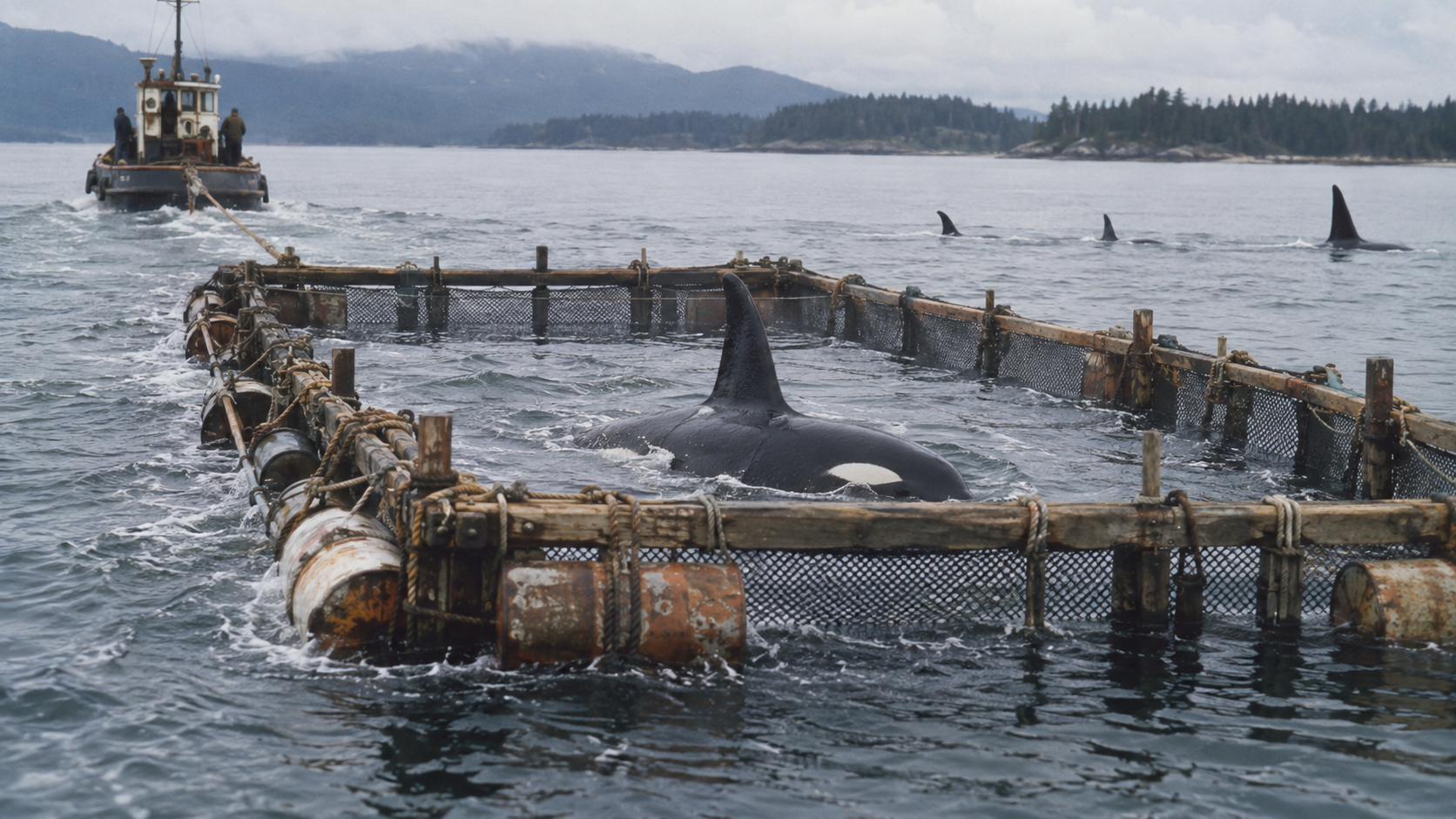
The strangest part was not the whale.
It was the cage moving through open water.
In the summer of 1965, a large male orca was being transported south through the coastal waters of British Columbia and Washington.
His name was Namu.
He was not swimming freely beside the boats.
He was inside a hastily built floating sea pen being pulled toward Seattle.
The journey would take days.
Boats struggled with the enormous animal, changing weather and a structure never designed for an ordinary voyage.
Then something else began appearing behind them.
Black dorsal fins.
Sometimes close.
Sometimes farther back.
And they did not disappear as quickly as anyone expected.
Who were the whales following Namu’s pen?
The answer is what turned an already extraordinary capture into one of the most haunting episodes of early orca captivity.
1. Namu Was Never Supposed to Be in the Net
The story began near the small community of Namu, British Columbia, in June 1965.
A fishing net had become entangled around a reef.
When fishermen returned, they discovered orcas caught in it.
Historical accounts describe an adult male and a younger whale initially trapped by the net.
The larger animal managed to find a way out.
But instead of simply disappearing, he returned.
Eventually the younger whale was gone.
The adult remained.
That animal would soon be given the same name as the place where he had been caught:
Namu.
At the time, public attitudes toward killer whales were very different from today.
They were still widely feared and poorly understood.
Keeping a large, living orca in captivity was an enormous logistical challenge.
But one Seattle aquarium owner wanted to try.
2. Ted Griffin Paid $8,000 for Him
Ted Griffin operated the Seattle Marine Aquarium on Pier 56.
He had spent years fascinated by killer whales and had previously tried to obtain one.
When word reached him about the trapped animal in British Columbia, he traveled north.
Griffin eventually purchased Namu for $8,000.
But buying the whale created an immediate problem.
Namu was enormous.
There was no truck waiting.
No specialized marine transport system existed for what Griffin wanted to do.
Seattle was hundreds of miles away.
And somehow, Namu had to arrive there alive.
3. The Solution Looked Almost Impossible
Griffin’s team built a floating pen.
PBS describes it as roughly 40 feet by 40 feet, supported by dozens of bright oil drums.
Netting kept Namu inside while the entire structure floated on the sea.
Then boats began towing it south.
It was an extraordinary sight.
A large black-and-white orca moving through coastal waters inside what looked like a floating cage.
Namu could surface.
He could move around inside the enclosure.
But the pen moved wherever the boats took it.
There was no established manual for such a journey.
Almost everything had to be figured out as it happened.
4. The Journey Became a Story of Its Own
The trip toward Seattle took 19 days, according to historical accounts.
The flotilla dealt with mechanical problems, rough conditions and the basic difficulty of towing a huge marine animal inside a temporary structure.
At one point, an additional tugboat was needed to help move the pen.
Namu also had to be fed enormous quantities of fish along the way.
The journey became public spectacle.
News reports followed its progress.
Crowds gathered along parts of the route.
When the flotilla passed through Washington waters, thousands wanted a glimpse of the orca being brought south.
But the people watching from shore were seeing only part of the story.
Something unusual had also been happening around the pen.
5. Other Orcas Began Appearing Around Him
Historical accounts describe other killer whales approaching Namu during the journey.
At times, they came close to the floating enclosure.
HistoryLink records that other orcas surrounded the pen during parts of the voyage, complicating the trip and apparently affecting Namu.
For the people aboard the boats, the encounters were remarkable.
Remember what the public believed about killer whales in 1965.
Many people still thought of them primarily as dangerous predators.
Yet here were wild orcas approaching a captive member of their own species.
They were not simply passing once and vanishing.
Some continued appearing as the pen moved south.
And observers began wondering why.
6. Namu Was Becoming Famous Before He Even Reached Seattle
News of the strange voyage spread quickly.
Namu became a celebrity before reaching his destination.
People came to bridges and shorelines hoping to see the floating pen pass.
His arrival was eventually celebrated in Seattle.
After reaching Elliott Bay on July 27, 1965, Namu was displayed at Griffin’s private Seattle Marine Aquarium.
Crowds came to see him.
He became nationally known.
His relationship with Griffin also helped change public perceptions of orcas, which many people had previously regarded as little more than dangerous “killer whales.”
But decades later, one part of Namu’s journey remains far more emotionally powerful than the celebrity that followed.
It concerns the whales behind the pen.
7. The Black Fins Did Not Behave Like Random Passersby
One encounter with another pod would have been interesting.
Repeated appearances were harder to dismiss.
Ted Griffin later recalled a female and younger whales following Namu’s cage.
Other historical accounts similarly describe an adult female and two young orcas staying near Namu and following the pen during part of its southward journey.
They surfaced close enough for people aboard the boats to watch them.
Then they disappeared beneath the water.
Then the fins returned.
At the time, observers interpreted what they were seeing through the limited understanding of orca social structure available in the 1960s.
But later knowledge of how orca families live made those encounters look very different.
8. The Whales Following Namu Were Likely His Family
Modern understanding of orca social structure suggests that the adult female repeatedly seen near Namu was likely his mother.
The younger whales were likely younger siblings.
The exact family relationships were not genetically confirmed at the time, so they should not be treated as absolute fact.
But historical observers repeatedly described the same striking pattern:
an adult female and younger orcas remaining near Namu after his capture and following the floating pen as it was moved south.
That changes the meaning of the images completely.
The black fins behind the cage were not simply an exciting wildlife encounter.
They may have been members of Namu’s own family continuing to follow him while humans slowly carried him away.
Eventually, the voyage continued beyond them.
Namu reached Seattle.
The wild whales did not.
9. Namu Reached Seattle—But His Story Changed How People Saw Orcas
Namu arrived at the Seattle waterfront on July 27, 1965.
He became enormously popular.
People watched him interact with Griffin.
A film was made around him.
For many Americans, Namu was among the first orcas they encountered not as a monster from stories, but as an intelligent and social animal.
His life in captivity was short.
Namu died on July 9, 1966, less than a year after arriving in Seattle.
His captivity would also become part of a much larger and increasingly controversial era of capturing orcas for marine parks.
But one image from his original journey remains unusually difficult to forget.
A temporary pen floating through cold coastal water.
One captive whale inside it.
A boat pulling him farther from the place where he had been caught.
And behind him, black dorsal fins continuing to surface.
In 1965, many people watching the journey saw an astonishing spectacle.
Knowing what we now understand about the lifelong social bonds of orcas, the same scene can look very different.
Namu was being taken toward the life that would make him famous.
The whales behind him were swimming in the opposite direction of that future.
And for a while, they followed anyway.
Editor’s Note: Namu’s capture and transport to Seattle in 1965 are documented historical events. Historical accounts report other orcas, including an adult female and younger animals, following or approaching his floating pen during the journey. Their exact biological relationships were not genetically established at the time; modern accounts generally describe them as likely members of his family. Any AI-generated images or videos accompanying this article are visual reconstructions and are not original footage from 1965.
