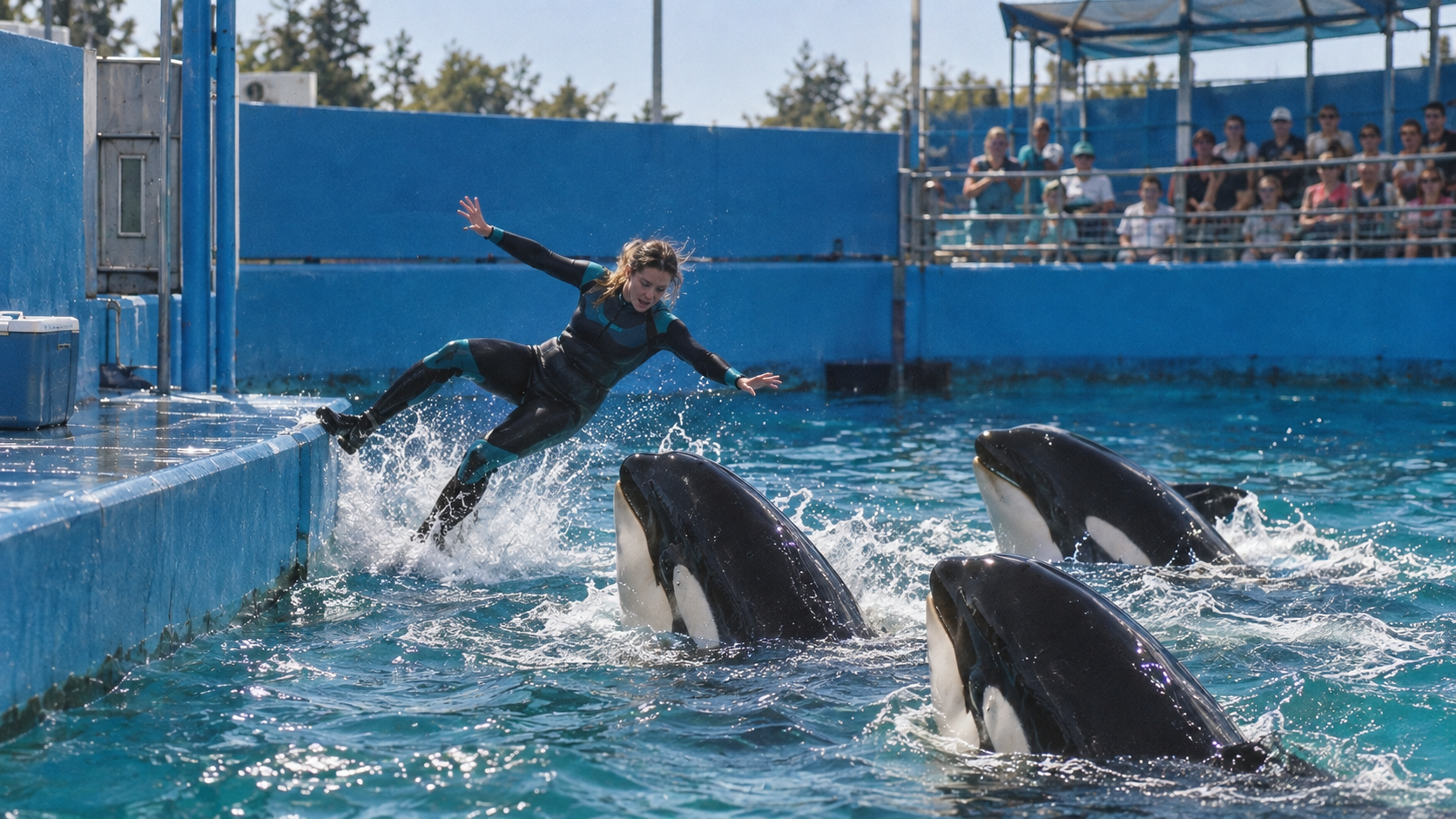
The show was almost over.
Spectators were still nearby.
Three killer whales moved through the blue water at Sealand of the Pacific.
Near the edge stood a young trainer.
Her name was Keltie Byrne.
She was only 20 years old, a marine-biology student and a part-time trainer at the small marine park near Victoria, British Columbia.
Nothing about the scene initially looked unusual.
The whales were in the pool.
The trainer was outside it.
The audience had just watched another performance.
Then Byrne lost her footing.
What happened during the next several minutes would eventually become one of the most important incidents in the history of captive killer whales.
But to understand why, there is one detail that matters before anything else:
At Sealand, trainers were not supposed to be swimming with these whales.
Sealand Was Very Different From the Orca Shows Most People Remember
When many people imagine killer-whale performances, they picture trainers diving into pools, riding on whales or swimming beside them.
That was not how Sealand normally operated.
Its trainers generally worked from outside the water.
According to a later PBS Frontline account, Byrne was not even wearing a wetsuit that afternoon because entering the pool was not part of the performance routine.
That changes the meaning of the scene completely.
The pool was not simply another part of her workplace.
There was a boundary.
Trainer on one side.
Three killer whales on the other.
During an ordinary show, that boundary made the situation appear controlled.
A signal could be given.
A whale could respond.
Food could be delivered.
The performance could continue.
But the moment a person entered the water, all of those assumptions changed.
And there were three animals inside that pool.
Tilikum Was Not Alone
One of them was a young male named Tilikum.
Years later, his name would become known around the world.
But in February 1991, he was only one member of Sealand’s three-orca group.
The other two were females named Haida II and Nootka IV.
All three shared the same main pool.
That detail becomes important because later retellings often focus almost entirely on Tilikum.
The official record was more complicated.
Years later, a federal SeaWorld safety case reviewed Byrne’s death as part of the history of human fatalities involving killer whales.
It described Byrne as a 20-year-old part-time trainer who slipped and fell into a sea pen containing three killer whales, including Tilikum.
Witnesses were not initially able to say with certainty which whale became involved first.
What they could see was that the situation changed almost immediately.
The Show Had Ended Only Moments Earlier
February 20, 1991 began like a working day at a marine park.
An afternoon killer-whale show had just finished.
Byrne was helping around the pool area afterward.
Then she misstepped.
Accounts differ slightly in how they describe the exact first seconds, but the central fact is consistent:
She ended up in the water.
For the people watching, that alone would have been startling.
A trainer who normally stayed outside the pool was suddenly inside it.
At first, there was still an obvious objective.
Get her back out.
The edge was close.
Staff were nearby.
The animals were trained.
The situation might still have looked recoverable.
Then one of the whales reached her.
And from that moment, the problem was no longer simply that a trainer had fallen into a pool.
Rescue Was Much Harder Than It Looked From the Stands
Marine-mammal training is built around predictable responses.
A trainer gives a cue.
The animal performs a behavior.
The animal receives reinforcement.
That system can look extremely powerful when everything is working normally.
An emergency is different.
Staff reportedly used recall commands.
They offered food.
They attempted to distract the whales.
A life ring was moved toward Byrne.
Other rescue tools were brought to the pool.
The problem was that the whales did not simply move away and allow the rescue to happen.
Every attempt had to occur while three large killer whales were still moving freely in the same enclosed water.
A person in that situation cannot match their speed.
Cannot match their strength.
And cannot control when they surface or dive.
The pool that had looked manageable during a performance suddenly became extremely difficult to enter safely.
The Audience Was Watching Something the Show Had Never Prepared Them For
This is one of the reasons the incident remained so powerful in later accounts.
It happened in front of people.
There was no darkened stadium.
No missing stretch of time.
No mystery about whether an emergency was unfolding.
Witnesses could see Byrne trying to get out.
They could see staff attempting to help.
They could see the whales repeatedly interfering with those efforts.
A later federal court decision summarized the event bluntly: the whales prevented Byrne from exiting the pool.
That sentence sounds simple.
In reality, it describes the collapse of almost every safety assumption surrounding the performance.
The trainer knew the animals.
Staff knew the animals.
The animals had been conditioned to respond to cues.
There were people around the pool.
Yet none of that guaranteed control once a human was in the water.
And the minutes continued.
There Was Another Detail People Often Miss
Keltie Byrne was not someone who simply could not handle herself in water.
Contemporary accounts described her as a strong competitive swimmer.
That makes the event more difficult to reduce to a simple drowning accident.
This was not merely a person who fell into deep water and could not swim.
The danger came from the interaction between a human swimmer and several powerful marine mammals in an enclosed space.
Every time Byrne tried to move toward safety, the animals could reach her faster.
Every time staff attempted a rescue, they had to work around animals weighing thousands of pounds.
The basic geometry of the pool favored the whales.
They could accelerate beneath the surface.
Change direction.
Approach from below.
Move a person away from the wall.
The edge was visible.
But reaching it was not the same thing as being allowed to leave.
Then the Rescue Effort Changed
As the situation continued, staff tried increasingly direct methods.
Accounts describe attempts involving a reaching pole, flotation equipment and a large net.
The coroner’s material later noted that distraction attempts were unsuccessful and that rescue attempts using equipment also failed.
The staff faced an impossible contradiction.
They needed to get Byrne out.
But entering the same water could place another person at risk.
They needed the whales to move away.
But the normal training cues were not producing the response they needed.
So the rescue became less about controlling the animals and more about trying to create any opening at all.
By then, the audience was no longer watching a performance.
They were watching a workplace emergency unfold in real time.
And eventually, the question changed.
It was no longer:
Can they get her out quickly?
It became:
Can they get her out at all?
The Coroner’s Finding Finally Explained the Outcome
Byrne did not survive.
The British Columbia coroner’s inquest listed the medical cause as drowning, with forced submersion by killer whales identified as the underlying circumstance.
The later federal SeaWorld safety case also described the whales as preventing her from exiting the pool until her eventual death.
It was a landmark event.
Byrne’s death became the first widely documented fatal human incident involving captive killer whales.
But even then, the story resisted the simple version that would later become popular.
It was not just:
“Tilikum attacked a trainer.”
There were three whales in the pool.
Witnesses struggled to identify which animal did what at every moment.
The official record described the whales collectively as playing roles in keeping Byrne in the water.
That distinction matters.
Because what happened at Sealand was not simply the story of one dangerous animal.
It was also a story about an environment that became impossible to control once a person crossed the edge.
What Happened to the Three Orcas Afterward?
The incident changed Sealand permanently.
Later in 1991, the three killer whales were put up for sale.
SeaWorld subsequently sought permission to import them.
Both females were pregnant at the time.
Tilikum would eventually be moved to SeaWorld Orlando.
There, his history followed him.
SeaWorld developed special protocols governing how trainers worked around him.
Years later, evidence presented in the federal safety case showed that Tilikum was treated differently from other whales and was largely restricted to drywork rather than routine deep-water interaction with trainers.
That makes the Sealand incident even more important in retrospect.
It was not forgotten by the industry.
It became part of the reason professionals changed the way they approached one particular whale.
And eventually, it became part of a much larger debate over whether killer whales and humans could ever be made predictably safe around each other in artificial pools.
Why This One Moment Still Matters
The most striking part of the story is how ordinary the beginning looked.
A trainer near the edge.
A finished show.
Spectators watching.
Three animals in familiar water.
Then one lost step.
That is why photographs and reconstructions of the scene can be so unsettling.
The danger is not obvious because nothing initially looks violent.
The whales do not need to charge.
The trainer does not need to panic.
The pool does not need to look chaotic.
For a few seconds, everything can still look almost normal.
Then the physical relationship changes.
A person who was safely above the water is suddenly inside it.
And every advantage shifts.
Years later, Tilikum would become connected to other major incidents and one of the largest debates in marine-park history.
But before Orlando, before the court cases, before documentaries and worldwide controversy, there was Sealand.
There was a 20-year-old trainer.
There were three killer whales.
There was an edge that had separated them.
And on February 20, 1991, that boundary disappeared.
