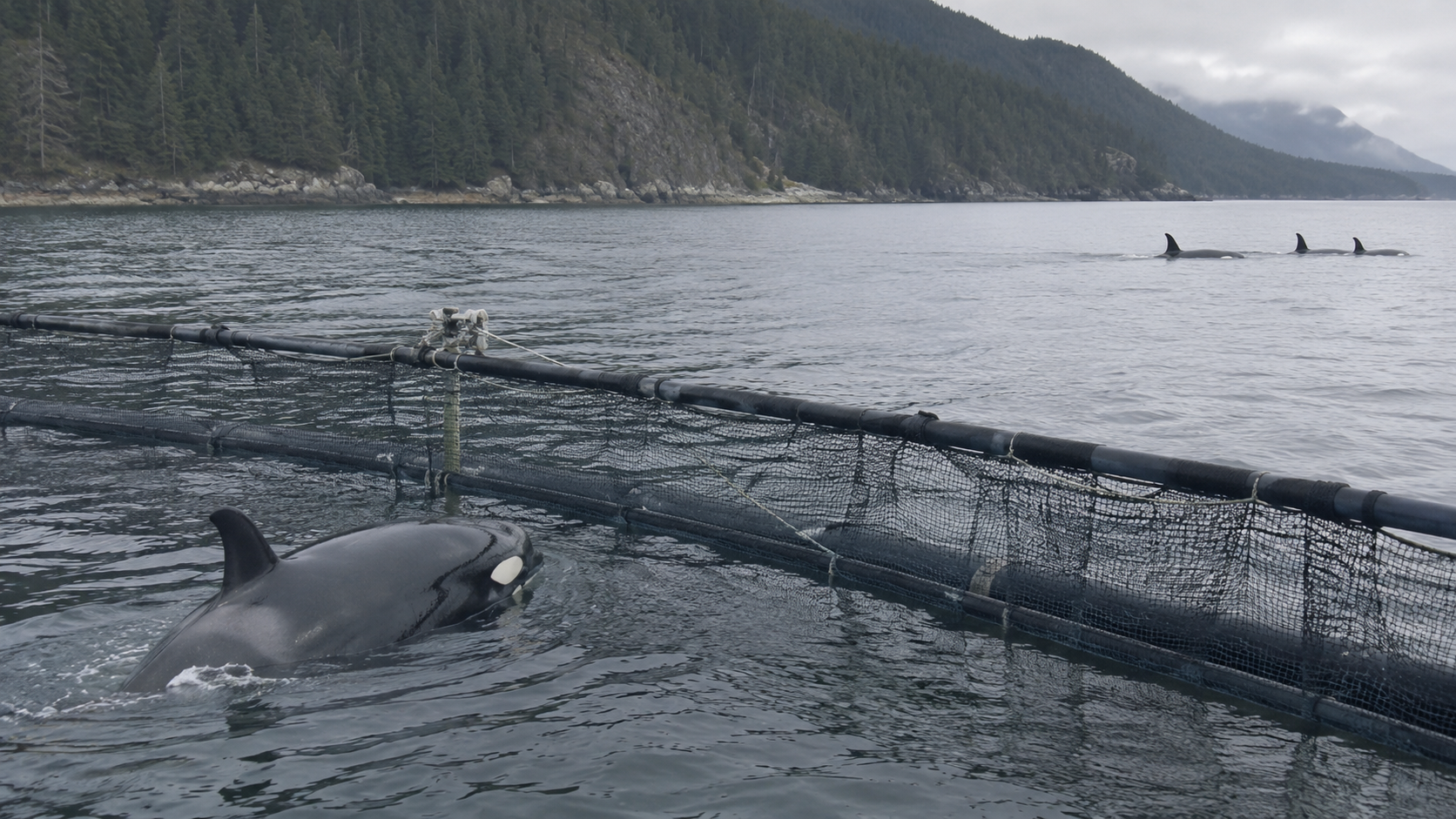
When the young orca heard other killer whales beyond the net, something changed almost immediately.
Springer had just completed a long journey north and was recovering inside a temporary sea pen near Hanson Island, British Columbia.
Then wild orcas appeared nearby.
According to NOAA Fisheries, Springer responded excitedly to whales from her own pod swimming near the enclosure.
Her name was Springer.
She was barely two years old.
And only a net now separated her from whales belonging to the family she had been missing for months.
But reaching this moment had required something almost unprecedented.
Six months earlier, Springer had been found alone roughly 300 miles away in Puget Sound.
She had health problems.
She had begun approaching people and boats.
And nobody could simply tell her which direction home was.
The entire operation had been built around one question.
Could humans return a young wild orca to her family—and would that family still accept her?
A Young Orca Alone in the Wrong Sea
The story began on January 14, 2002.
A juvenile female killer whale was spotted alone in central Puget Sound in Washington State.
Researchers estimated that she was only 18 to 24 months old.
That alone made the sighting unusual.
Orcas are intensely social animals.
They normally travel within family groups rather than spending long periods completely alone.
But there was another problem.
This young whale did not belong to the Southern Resident population normally associated with the region.
Researchers identified her through photographs and distinctive markings.
She was A73, a member of the Northern Resident killer whale population.
She would become known around the world as Springer.
Her normal family waters were far to the north, between mainland British Columbia and Vancouver Island.
NOAA estimated that they were roughly 300 miles away from where Springer had appeared.
That created an extraordinary mystery.
How had such a young orca ended up so far from her family?
Researchers believed Springer had already been alone since the likely death of her mother sometime before summer 2001.
The precise sequence that carried her into Puget Sound could not simply be reconstructed.
But one fact was obvious.
Springer was now alone in waters where she did not belong.
And she was beginning to attract attention.
She Could Catch Fish—But Something Was Wrong
Springer was not helpless.
She had been seen feeding.
That was enormously important because it showed she had some ability to survive without humans providing every meal.
But researchers were still concerned about her condition.
Springer was dealing with medical issues that included parasitic worms and a skin rash.
There was also another problem that could become more dangerous with every passing week.
She was becoming interested in people.
And boats.
For a wild killer whale expected to return to a pod, that was not harmless curiosity.
If Springer began associating humans or vessels with food, attention or companionship, returning her successfully to wild orca society could become much harder.
By April and May, officials were increasingly worried about that behavior.
She was also living around a busy shipping area.
Doing nothing carried risks.
But capturing a free-swimming killer whale carried enormous risks of its own.
Authorities had to choose between two uncertain futures.
Leave Springer where she was and hope she survived alone.
Or attempt something that had almost no precedent.
The Plan Was Not Simply to “Rescue” Her
NOAA Fisheries began consulting with scientists, veterinarians, Washington State officials and Canada’s Department of Fisheries and Oceans.
An independent panel of whale scientists reviewed Springer’s behavior and medical test results.
Their recommendation was extraordinary.
Springer should be rescued, rehabilitated and moved back toward her family in Canadian waters.
But that did not mean turning Springer into a captive whale.
The exact opposite was required.
Every part of the operation had to preserve her ability to live wild.
She needed medical treatment.
She needed time to regain condition.
But she could not learn to depend on the humans providing that care.
On May 24, NOAA announced that it would attempt the rescue.
Multiple government agencies, researchers, conservation organizations and members of the public became involved.
Seven conservation organizations even established an Orphan Orca Fund to help support the effort.
Still, plans on paper were only the beginning.
First they had to capture Springer safely.
Then they had to determine whether she was healthy enough to survive release.
And after all of that, they still needed to find the whales she belonged with.
On June 13, Springer Entered the Net Pen
The rescue operation took place on June 13, 2002.
Springer was successfully moved into a floating net pen on Washington State’s Kitsap Peninsula.
Now researchers could finally examine her more closely.
She measured approximately 11 feet long.
She weighed about 1,240 pounds.
Veterinarians performed tests and began treating her health problems.
But the way she was cared for mattered almost as much as the treatment itself.
Humans tried to stay out of sight whenever possible.
Remote video cameras were used to monitor her behavior.
Even feeding was designed around the possibility that she would soon return to the wild.
Live salmon were placed inside the enclosure so Springer could catch them herself.
Researchers did not want her learning a dangerous lesson:
people bring food.
NOAA later highlighted this deliberate effort to minimize human contact during her approximately 30 days in temporary care.
Springer began improving.
Her ketosis disappeared.
Her skin condition improved.
She received medicine to eliminate the parasitic worms.
And she gained weight.
After roughly one month, Springer had added about 112 pounds.
She now weighed around 1,350 pounds.
The first stage had worked.
But Springer was still inside a net.
Her family was still hundreds of miles away.
The Hardest Part Was Still Ahead
Getting Springer healthy enough to travel did not solve the central problem.
Returning a killer whale to “the ocean” was not enough.
Springer needed to return to the right ocean.
Near the right whales.
That distinction mattered enormously.
Northern Resident killer whales have strong social relationships, and Springer had been separated from hers for months.
Officials could transport her north.
They could place her in familiar habitat.
But they could not force wild orcas to appear.
And they certainly could not guarantee what those whales would do if Springer was released among them.
NOAA has since identified several elements that made Springer an unusually strong candidate for reintroduction.
She was young.
Her time in human care was short.
Human interaction had deliberately been minimized.
Her health had improved.
And she could successfully catch live fish herself.
Even with all of those advantages, one enormous uncertainty remained.
Would her family actually be there?
On July 13, that question began moving from theory to reality.
Springer was lifted from the Washington net pen.
She was placed aboard a transport vessel.
Then the young orca began the long journey north toward Johnstone Strait.
One Orca, One Boat, Hundreds of Miles
Springer travelled by vessel from Washington toward the waters between Vancouver Island and mainland British Columbia.
The trip went smoothly.
Her destination was Dong Chong Bay on Hanson Island.
There, teams placed her inside another temporary net pen.
This was not simply another rehabilitation enclosure.
This one sat in the waters where Northern Resident killer whales could actually appear.
Springer recovered quickly from the transport.
NOAA described her as appearing quite excited to be in the area.
For months, the problem had been distance.
Now that distance had almost disappeared.
Somewhere beyond the pen were the waters used by the population Springer belonged to.
The rescue team had done nearly everything humans could do.
They had identified her.
Monitored her.
Captured her.
Treated her.
Kept her from becoming dependent on people.
Fed her live fish.
Transported her hundreds of miles.
Now they had to wait for wild orcas to complete the equation.
And they did not have to wait long.
Then Orcas Appeared Beyond the Net
On July 14, Springer was still inside the enclosure near Hanson Island.
Then killer whales from her pod appeared in the surrounding waters.
This was the moment the entire operation had been moving toward.
Springer reacted.
NOAA’s chronology records that she responded excitedly to whales from her pod swimming near the net pen.
Months earlier, Springer had been an isolated juvenile in Puget Sound.
Now whales connected to her own family were swimming outside.
There was still a physical barrier between them.
But the distance that once measured hundreds of miles had become little more than the width of a net enclosure.
Officials from the Vancouver Aquarium and Canada’s Department of Fisheries and Oceans watched what was happening.
They now faced the decision that everyone had known would eventually come.
Keeping Springer contained meant keeping control of the situation.
Opening the pen meant surrendering that control completely.
Once she entered the open water, the next decision would belong to Springer.
At approximately 2:45 p.m., officials made their choice.
They raised the gate.
Opening the Gate Was Only the Beginning
Springer was allowed to swim free.
But release was not the true measure of success.
A gate opening could happen in seconds.
A successful return to wild orca society could only be proven with time.
Would Springer remain in the area?
Would she join Northern Resident whales?
Would she return toward boats and people?
Would she survive the following winter?
There was no way to answer those questions on release day.
The rescue team could only watch.
Then, over the following seasons, the evidence began arriving.
Springer was seen with her pod.
In July 2003, she returned with them again.
Then she continued appearing in later summers, healthy and active among Northern Resident killer whales.
The young whale had not simply survived her release.
She had returned to the society humans had spent months trying to reach.
NOAA would later describe Springer as the first killer whale calf to be rescued, rehabilitated and released.
But even that was not the final proof of how extraordinary her story had become.
That would take another decade.
Then Springer Returned With Someone Beside Her
On July 4, 2013, researchers saw Springer again off British Columbia.
This time, something was different.
A calf was beside her.
The young orphan scientists had once struggled to return to a family had become a mother herself.
Her first known calf became known as Spirit, A104.
Then, in 2017, Springer appeared with another calf.
The second was named Storm, A116.
The meaning of those sightings went far beyond simple survival.
Springer had reintegrated well enough into wild Northern Resident life to grow into adulthood and reproduce.
Twenty years after the original rescue, researchers received another remarkable reminder of that success.
On July 21, 2022, retired Fisheries and Oceans Canada scientist Dr. John Ford photographed Springer near Telegraph Cove, British Columbia.
She was swimming with both Spirit and Storm.
Ford reported that the three appeared to be doing well.
It happened almost exactly as people were gathering to mark the 20th anniversary of her rescue.
The whale once found alone hundreds of miles from home was still there.
And she was no longer alone.
Why Springer’s Story Still Matters
Springer’s rescue was not a simple formula that could automatically be repeated with every stranded or sick killer whale.
Her circumstances were unusually specific.
Researchers knew who she was.
They knew which population she belonged to.
She could catch fish independently.
She responded to treatment.
Her time in temporary care was limited.
And her caretakers worked deliberately to prevent her from becoming dependent on humans.
Those details helped make an extraordinary reunion possible.
The operation also left researchers with experience they later applied when responding to other killer whales in trouble.
NOAA scientists have specifically said that techniques and expertise developed during Springer’s rescue helped inform later emergency responses.
But perhaps the simplest way to understand the success of the operation is to return to the image of the net pen.
Inside was a young whale who had spent months away from her family.
Outside were wild orcas from the pod she belonged to.
Humans could bring Springer that far.
They could treat her body.
They could transport her north.
They could even raise the gate.
But they could not manufacture what happened afterward.
Springer had to return to wild life herself.
She did.
Years later, she returned with a calf.
Then another.
And two decades after people first wondered whether this young whale could ever truly go home, Springer was photographed swimming those same British Columbia waters with a family of her own.
The barrier between Springer and the other orcas lasted only until someone raised a gate.
The consequences of that moment have lasted for decades.
