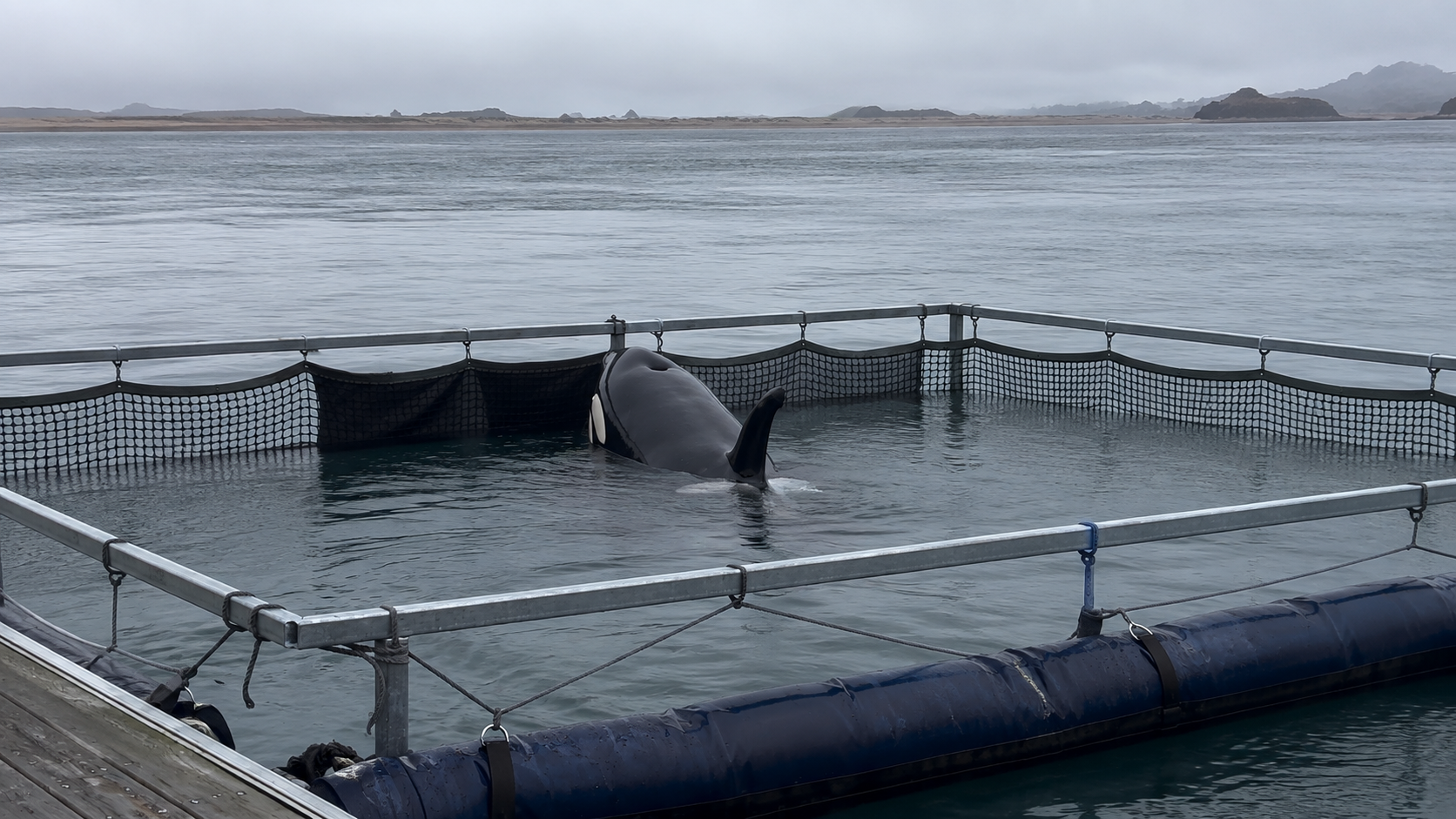
When the young orca was returned to seawater, something changed almost immediately.
After spending time in a temporary pool beside the coast, the calf was moved back into a sea pen at Plimmerton Boating Club in New Zealand. According to the Department of Conservation, as soon as he was back in the sea, he began calling and moving quickly around the enclosure.
His name was Toa.
He was only a few months old.
And somewhere beyond the temporary enclosure was the one thing rescuers could not provide for him: his family.
For nearly two weeks, teams searched the coast for the pod he had been separated from.
The question hanging over the operation was painfully simple.
Would they find Toa’s family in time?
A Tiny Orca Found Among the Rocks
The story began on July 11, 2021, near Plimmerton, north of Wellington.
A young male orca became stranded on rocks near the coast. He measured less than about 2.5 metres and was believed to be only two to six months old.
At that age, an orca is nowhere near independent.
Young orcas remain closely connected to their mothers and typically are not fully weaned until much later. New Zealand’s Department of Conservation noted during Toa’s care that orcas generally do not wean until they are around one to two years old.
So saving him from the rocks was only the beginning.
Even if rescuers could keep Toa alive, fed and stable, they still faced a much harder problem:
they had to find the orcas he belonged with.
A large response formed around him.
The Department of Conservation led the operation with help from Ngāti Toa Rangatira, Orca Research Trust/Whale Rescue, veterinarians, volunteers and members of the local community.
The calf was given the name Toa, a name associated with strength and with the local iwi, Ngāti Toa Rangatira.
Soon, thousands of people were following what happened next.
The Search Was Much Bigger Than the Pen
Toa could be cared for in one place.
His family could be almost anywhere.
That made reunion extraordinarily difficult.
New Zealand orcas are capable of travelling enormous distances. During the search, DOC said they could move as much as 160 kilometres in a single day.
That meant a pod seen in one region could be far away by the following day.
Search teams asked people across the country to report orca sightings and, whenever possible, provide photographs or video. Individual orcas can be identified through distinctive markings, giving researchers a chance to determine whether a reported group might be Toa’s family.
Reports came in.
Possible pods were investigated.
Aircraft and boats were prepared when conditions allowed.
On July 23, a reported sighting along the Kāpiti Coast was being investigated by both air and sea.
At the same time, Toa remained at Plimmerton.
Waiting was becoming its own race against time.
Why Toa Could Not Simply Be Released
The obvious question was why rescuers could not simply take the calf into open water and let him go.
For such a young animal, that could have replaced one danger with another.
Toa was still dependent on a mother and pod. Releasing him without knowing where his family was could leave a very young calf alone in an enormous ocean.
The goal throughout the operation was therefore not simply release.
It was reunion with his natal pod. DOC later described that as the objective the team had pursued throughout the response.
Meanwhile, Toa required constant care.
Weather complicated the operation. At times, worsening conditions meant he had to remain in a temporary pool rather than the sea pen. Teams monitored his feeding, behaviour and physical condition while preparing for changing wind and swell.
The situation was delicate from the beginning.
He was alive.
He could swim.
But he was still a baby orca without his mother.
Then He Returned to the Sea Pen
By July 22, veterinarians had decided that returning Toa to the larger sea pen was in his best interests.
He had injuries involving his pectoral fins and tail fluke, as well as an inflamed eye. Officials also reported that he had become more lethargic and was vocalising less than he had earlier. The deeper salt water offered more space for movement and was considered better for his condition.
The transfer went smoothly.
Then came one of the most memorable updates of the entire operation.
The following morning, DOC reported that:
“As soon as the calf was back in the sea, he started calling and zooming around the pen.”
For anyone following his story, it was difficult not to attach meaning to those calls.
Was he searching acoustically for other orcas?
Was he responding simply to being back in natural seawater?
Could a nearby pod hear him?
Scientists cannot know what Toa intended with each vocalisation, and it would be misleading to translate an orca’s calls directly into human emotions.
But one fact required no interpretation:
his family had still not been located.
Orcas Are Not Built for Solitary Childhoods
Orcas live in some of the most socially complex societies found in the ocean.
A calf does not merely travel beside its mother. It learns where to move, how to forage, how to communicate and how to function within a social group.
That dependence made Toa’s age particularly important.
He was not an adult animal temporarily separated from companions.
He was an unweaned calf.
DOC’s later review described him specifically as a young, unweaned orca who was cared for while teams tried to locate his pod.
Humans could provide food.
They could monitor his injuries.
They could strengthen a pen against bad weather.
They could search the coastline by boat and aircraft.
But there was one role they could never truly replace.
His mother.
Every Report Could Have Been the One
As the days passed, reports of orcas elsewhere carried enormous significance.
A sighting was not simply another wildlife observation anymore.
It could potentially be Toa’s family.
Teams had to consider geography, travel speed and identifying markings. The search stretched across a wide area, including the lower North Island and upper South Island, while sightings from elsewhere in New Zealand were also requested.
That uncertainty made the operation both hopeful and brutal.
An orca pod could be close.
Or it could already be more than a hundred kilometres away.
The next report could solve everything.
Or it could belong to completely unrelated animals.
And while humans searched the coastline, Toa’s biological clock continued moving.
The Longer He Was Away, the Greater the Risk
By the final days of the operation, officials understood that separation itself was becoming increasingly dangerous.
DOC Marine Species Manager Ian Angus later explained that the team had always known that the longer Toa remained in captivity and away from his mother, the more likely his health was to deteriorate.
That was the cruel contradiction at the heart of the rescue.
Keeping him contained allowed people to care for him.
But keeping him contained could never substitute indefinitely for returning him to his pod.
On July 23, the search was still active.
Plans were being made to take advantage of a favourable weather window.
Toa had responded well after returning to the sea pen.
His family had still not been found.
And then, that evening, his condition changed rapidly.
Toa Never Got the Reunion Everyone Was Waiting For
Toa deteriorated suddenly on July 23.
Veterinarians rushed to help him, but the young calf died in the sea pen at Plimmerton Boating Club.
He had survived for nearly two weeks after becoming stranded.
But the reunion never happened.
The following morning, around 70 people gathered at dawn to farewell him with karakia and waiata before Ngāti Toa Rangatira took him for burial.
No necropsy was performed.
That means there is no single confirmed post-mortem explanation establishing exactly why Toa died.
What is known is that he had already faced the physical trauma of stranding, required intensive care, developed several health concerns and remained separated from his mother throughout the operation.
More than 40 national and international experts had provided advice during the response, alongside veterinarians, DOC staff, researchers, iwi, volunteers and the local community.
They had managed to get him off the rocks.
They had kept him alive.
They had searched for his family.
But they could not make the ocean return the pod they needed.
Why Toa Is Still Remembered
Wildlife stories often become memorable because of extraordinary action.
Toa’s story was different.
Its power came from what was missing.
A calf was alive in a small patch of sea.
People surrounded him with care.
Beyond the enclosure stretched thousands of kilometres of coastline and open water.
Somewhere in that space were other orcas.
But none of the searches managed to reconnect him with them.
That is why the image of Toa in his sea pen remains difficult to forget.
Not because he was completely alone—he was surrounded by people trying desperately to help him.
But because the one connection a young orca needed most was the one humans could not recreate.
His story lasted only 12 days in human care.
Yet it became one of New Zealand’s most closely followed marine rescue efforts, and years later, Toa is still remembered by the researchers and communities who tried to bring him home.
For all the technology, boats, experts and volunteers involved, the central problem never changed:
Toa needed his family.
And despite an extraordinary search, they never found one another in time.
