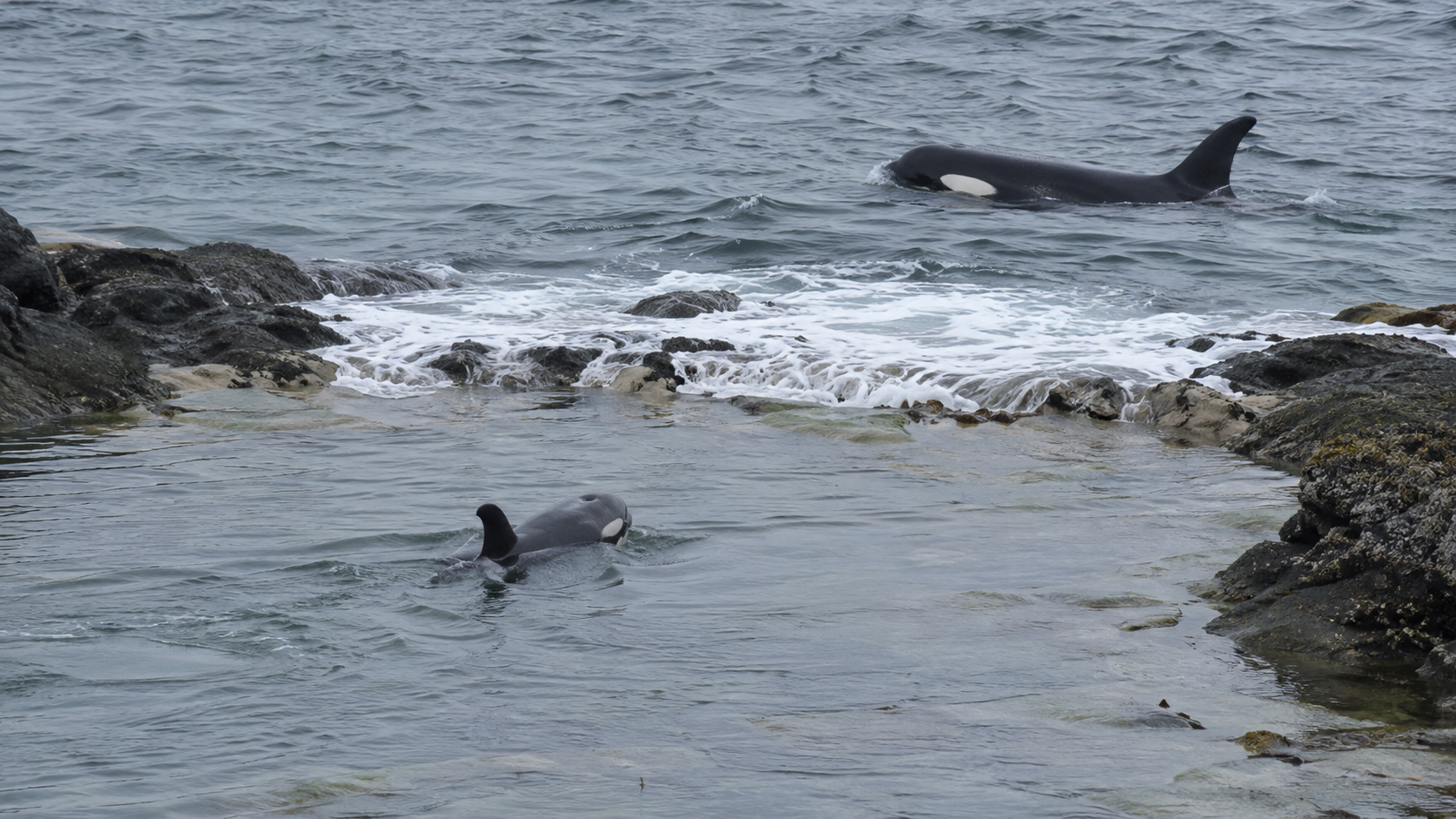
Nera could see her mother.
That was what made everything worse.
The young orca was inside a narrow tidal lagoon along a remote northern coastline.
Her mother was outside.
Between them lay less than 30 meters of water.
But as the tide fell, those 30 meters became almost impossible to cross.
A shallow ridge of rock and sand had emerged between the lagoon and the deeper sea.
Nera could still swim.
Her mother could still hear her.
They could even surface within sight of one another.
But neither could simply cross the strip of water separating them.
Then something changed.
A larger wave rolled toward the rocks.
For several seconds, water covered the barrier again.
Nera turned toward it.
Her mother did the same.
And suddenly, for the first time in hours, there appeared to be a way through.
Was the water finally deep enough?
This is a fictional wildlife reconstruction inspired by real orca social behavior and the hazards created by rapidly changing coastal tides.
The Lagoon Had Looked Completely Safe
Hours earlier, there was no obvious trap.
At high tide, seawater had covered most of the rock shelf separating the small lagoon from the ocean.
For a young orca following an adult through coastal water, the entrance would not necessarily have looked unusual.
Nera followed her mother toward shore.
The water remained deep enough for both animals to move normally.
Small waves pushed through the entrance.
The lagoon filled and emptied with every surge.
Then the tide began to fall.
At first, the change was almost impossible to notice.
A few dark rocks appeared.
Then another.
Water that had previously flowed freely over the shelf began concentrating into several narrow channels.
Nera was still inside when her mother moved back toward deeper water.
The calf followed.
But the route they had used earlier no longer looked the same.
The mother crossed first.
Nera did not.
When she reached the shallowest section, her belly came dangerously close to rock.
She slowed.
Another small wave lifted her.
For a moment she moved forward.
Then the water disappeared beneath her again.
Nera turned back toward the lagoon.
Her mother surfaced on the other side.
They were now separated.
And the tide was still falling.
Her Mother Did Not Leave
The adult female could have moved offshore.
She did not.
Instead, she began traveling slowly along the outside edge of the rock shelf.
Nera mirrored her movements from inside.
When the mother moved left, the calf followed from the lagoon.
When she turned back, Nera turned too.
The barrier remained between them.
At its narrowest point, the distance looked almost insignificant.
But orcas are enormous animals.
A channel that appears passable from shore may still be too shallow for an animal whose entire body must remain supported by water.
The mother had the deeper side.
Nera had the lagoon.
Neither animal could change the tide.
Several times, Nera approached the same narrow channel.
Each attempt ended similarly.
She moved forward.
The water became shallower.
Her speed dropped.
Then she backed away.
Her mother remained outside.
Waiting.
Nera Kept Returning to One Place
After several failed approaches, the calf began concentrating on one section of the barrier.
It was not the shortest route.
It was the deepest.
A narrow depression between two rock formations still allowed a small amount of seawater to move through.
Every incoming wave temporarily deepened it.
Every retreating wave exposed the rocks again.
Nera seemed to notice the difference.
She began returning to that exact point.
She would approach.
Wait.
Then move away.
Minutes later, she came back.
Her mother began doing something similar from the opposite side.
The two whales were now repeatedly meeting at the same section of the barrier.
Only the rock shelf remained between them.
At one point, Nera surfaced and gave a short call.
Her mother answered from outside.
The distance between the two sounds was tiny.
The physical distance was even smaller.
But the route between them was still too shallow.
The calf could not simply jump across.
And attempting to force herself over exposed rock could leave her stranded completely.
Waiting was safer.
But waiting created another problem.
The tide had not reached its lowest point yet.
The Water Kept Disappearing
Over the next period, more of the lagoon entrance became exposed.
The dark strip of water separating rocks became thinner.
Small waves still entered.
But each one seemed to bring less water than the last.
Nera remained able to swim inside the lagoon.
For the moment, she was not stranded on land.
That distinction mattered.
As long as there was enough water beneath her body, she could breathe normally and continue moving.
But escape was becoming harder.
The mother continued patrolling outside.
Occasionally she moved farther away into deeper water.
Each time, Nera became more active.
Then the adult returned.
The calf settled again.
There was no dramatic rescue.
No sudden leap.
No way for the mother to physically lift a young orca across a rock shelf.
The only thing either whale could do was remain near the opening.
And wait for the coast itself to change.
That meant waiting for water.
A Young Orca Depends on More Than Air
Being separated from an adult orca is not simply a problem of navigation.
Young orcas learn by staying close to their family.
They travel with adults.
They follow movements through unfamiliar coastlines.
They learn where prey can be found.
They remain part of a social system built around repeated contact.
Nera could breathe.
She could swim.
But she was still a calf separated from the animal she normally followed.
The mother’s repeated returns therefore mattered.
From inside the lagoon, Nera continued orienting toward her.
The adult remained the one moving reference point beyond the rocks.
As daylight changed, the lagoon looked increasingly isolated.
The ocean was visible.
The mother was visible.
The route between them was visible.
Yet Nera could not use it.
Then the wind shifted.
Farther offshore, the surface became rougher.
A new line of waves began moving toward the coast.
The First Larger Wave Changed Almost Nothing
The first wave reached the outer rocks and broke across them.
White water pushed over the shallow shelf.
Nera immediately turned toward the opening.
The mother approached from outside.
For several seconds, water covered rocks that had been exposed moments earlier.
But the surge disappeared too quickly.
Nera reached the entrance just as the water drained back toward the sea.
She stopped.
Another wave arrived.
This one was slightly larger.
Again, water rushed across the barrier.
Again, Nera approached.
Her mother was now almost directly opposite her.
The calf entered the beginning of the narrow channel.
Then the wave retreated.
The rock beneath the surface became visible again.
Nera backed away.
But something was different now.
The waves were arriving more frequently.
The barrier was no longer remaining dry for as long between them.
For the first time, the problem was beginning to change faster than the tide itself.
Nera returned to the same channel.
And waited.
Then a Much Larger Wave Covered the Barrier
It arrived from farther offshore.
The wave did not look enormous in the open sea.
But when it reached the shallow coast, its shape changed.
Water rose against the rock shelf.
Foam spilled through gaps that had been nearly dry minutes earlier.
Then the surge reached Nera’s channel.
The exposed rocks disappeared beneath moving water.
The narrow passage suddenly looked deeper.
Not deep.
But deeper.
Nera reacted almost immediately.
She turned her entire body toward the opening.
Her tail strokes became faster.
On the other side, her mother changed direction at almost the same moment.
The adult moved toward the same channel.
For the first time since the separation began, both animals were swimming directly toward each other.
The distance closed quickly.
Twenty meters.
Then less.
Nera reached the beginning of the flooded shelf.
Another wave was already approaching behind the first.
She continued forward.
Her head crossed into the narrow channel.
Then her upper back.
The water beneath her was moving violently across the rocks.
If it remained deep enough for only a few more seconds, she might pass.
If it drained too quickly, she could end up in an even worse position.
Nera kept moving.
The Next Few Seconds Were Everything
Her mother stopped just outside the shallowest section.
She could not safely come much farther.
Nera now had to cross the remaining distance herself.
Another surge pushed into the channel.
It lifted the calf slightly.
She accelerated.
For a moment, almost her entire body was surrounded by deeper water.
Only a short section remained.
Then the wave began retreating.
Water rushed back beneath Nera.
The calf slowed.
Her mother turned alongside the outer edge rather than moving away.
Nera continued pushing forward.
A second incoming surge reached the rocks before the first had completely drained.
That overlap made the difference.
Instead of becoming shallow again immediately, the channel remained flooded for several more seconds.
Nera moved through.
Her body passed over the last section of the shelf.
Her tail cleared the rocks.
And suddenly there was deep water beneath her again.
She had crossed.
Nera Was Back Beside Her Mother
The two whales did not perform a dramatic reunion.
There was no jump.
No spectacular breach.
They simply came together in deeper water.
Nera moved immediately alongside the adult.
Her mother turned away from the rocks.
The calf followed.
Within moments, both animals were traveling parallel to the coastline.
The lagoon that had separated them began shrinking into the distance behind them.
For hours, the entire problem had been contained within a few dozen meters.
Nera had never been far from her mother.
She had never lost sight of the sea.
But distance alone had never been the real obstacle.
Depth was.
A changing coastline had transformed a safe route into a barrier.
Then a brief sequence of larger waves transformed it again.
The opportunity lasted only seconds.
Nera used it.
And once she reached deeper water, she did exactly what young orcas normally do.
She stayed close.
Why a Situation Like This Is Plausible
Nera herself is fictional.
The specific event described here is not presented as a documented wildlife incident.
But the physical ingredients behind the story are real.
Orcas regularly travel through complex coastal environments.
Tides can transform channels, reefs, sandbars and shallow entrances dramatically within hours.
Marine mammals can also become temporarily trapped or stranded when water levels change faster than expected.
For a large animal, a surprisingly small reduction in depth can turn a usable passage into an obstacle.
That is what makes tidal environments dangerous.
From above, the route may still appear open.
For the animal moving through it, there may no longer be enough water beneath the body.
And a mother cannot simply remove that obstacle for her calf.
Sometimes the safest response is exactly what Nera and her mother do in this reconstruction:
stay close,
keep moving,
wait,
and use the next window when the water returns.
For Nera, that window lasted only a few seconds.
It was enough.
