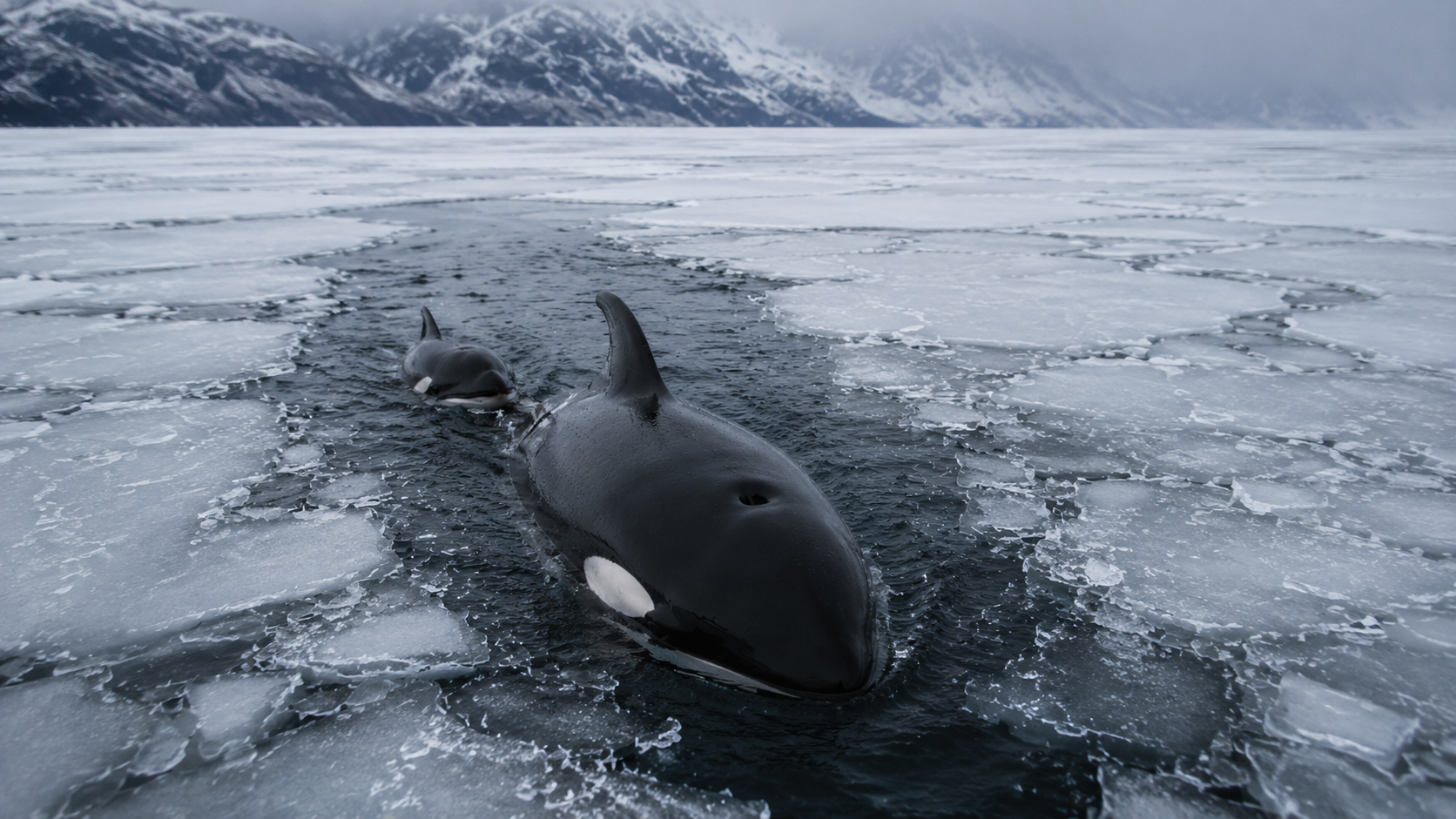
The temperature over the remote Arctic fjord had plummeted to a bitter sub-zero threshold overnight.
When marine researchers aboard an ice-strengthened research vessel peered through the heavy morning mist, the calm, open waters from the previous evening had vanished.
In their place lay a jagged, rapidly expanding sheet of fresh sea ice.
And right in the center of the narrowing gap of open water was a sight that stopped the entire crew in their tracks.
A massive female killer whale was systematically surfacing, using the dense bone structure of her head to shatter the thin crust of newly formed ice.
Directly behind her, clinging to the tiny pocket of open water her movements created, was a newborn calf relying on its mother for every single breath.
The Silent Threat of Arctic Flash-Freezes
In high-latitude coastal waters, environmental conditions can shift with terrifying speed.
When wind speeds drop and temperatures plummet rapidly, the ocean surface undergoes a process known as flash-freezing.
A delicate layer of grease ice quickly consolidates into a continuous, rubbery sheet known as nilas.
For air-breathing marine mammals like killer whales, an unexpected freeze inside a narrow fjord is a life-or-threatening trap.
In northern indigenous terminology, these ice-trapping events are known as savssats.
When a pod or an individual cetacean becomes surrounded by fast-moving ice sheets, their accessible breathing surface contracts by the minute.
If the ice thickens beyond their ability to break it, the animals face a grim fate: suffocation beneath a frozen ceiling.
A Continuous Battle Against the Ice
The drone and camera footage captured by the research team documented an extraordinary display of maternal drive and physical endurance.
The adult female did not attempt to swim away into deeper waters to save herself.
Instead, she remained positioned at the precise spot where her young calf was stuck.
Every few minutes, her massive black body would rise slowly from the dark depths.
She would intentionally position her rostrum against the underside of the ice sheet, pushing upward until the crystalline structure fractured with a loud, echoey crack.
As her blowhole broke through the slushy surface, a plume of warm, dense vapor blasted into the freezing air.
The moment the breathing hole was cleared, the tiny calf would nudge forward, placing its snout into the opening to draw vital oxygen.
The Physical Toll of Breaking Sea Ice
While adult killer whales possess thick skin and dense skulls capable of fracturing thin sea ice, the process exacts a heavy physical toll.
Consistently bashing against jagged ice edges can cause abrasions, cuts, and severe fatigue.
Furthermore, sea ice does not remain static.
Driven by tidal currents and freezing offshore winds, ice sheets continually push inward, threatening to crush small pockets of open water.
Biologists monitoring the situation through hydrophones recorded high-frequency acoustic calls between the mother and calf.
The vocalizations were short, repetitive, and close-ranged—a clear effort by the mother to keep the disoriented calf centered within the expanding slush pocket.
Every time the ice began to close in, the mother would execute a slow, deliberate tail-slap or body-roll to clear away floating ice chunks.
Intelligence, Strategy, and Endurance
What amazed scientists reviewing the thermal imaging and surface footage was the mother’s tactical awareness.
She was not striking the ice at random.
She concentrated her impacts along a specific fault line in the ice sheet where the water currents were slightly stronger.
By targeting this natural stress point in the ice formation, she maximized the size of the breathing gap while conserving her energy.
Additionally, her constant physical movement generated localized water turbulence.
This continuous agitation slowed down the freezing process of the surrounding water, buying precious time as the morning sun began to rise over the fjord.
The Race Against Time and Tidal Currents
As the hours passed, the research vessel maintained a respectful distance, recording environmental data and tracking wind directions.
The survival of both whales hinged entirely on two unpredictable factors: wind direction and tidal flow.
If an offshore breeze picked up, it could push the floating ice pack out toward the open sea, clearing a natural exit route.
If the wind shifted inland, the heavy outer pack ice would lock the fjord completely, sealing the breathing hole permanently.
Around mid-afternoon, the tide began to turn.
Warmer Atlantic water currents pushed beneath the frozen bay layer, weakening the structural integrity of the ice sheet.
Seizing the moment, the mother exerted a final series of heavy body pushes, creating a continuous channel of fractured slush leading toward the outer bay.
Lessons from the Frozen North
The dramatic footage of the arctic mother breaking ice for her offspring offers a powerful window into the resilience and intelligence of apex ocean predators.
As climate patterns become increasingly unpredictable, sudden weather shifts and unusual ice formations are reshaping marine habitats.
Cetaceans living in polar regions must navigate an environment where boundaries form and dissolve in a matter of hours.
The survival of the young calf that morning was not a stroke of mere luck.
It was the direct result of millions of years of evolutionary adaptation, acoustic communication, and an unbreakable maternal instinct.
In the vast, unforgiving expanses of the Arctic Ocean, a mother’s willingness to fight the ice remains one of nature’s most profound spectacles.
