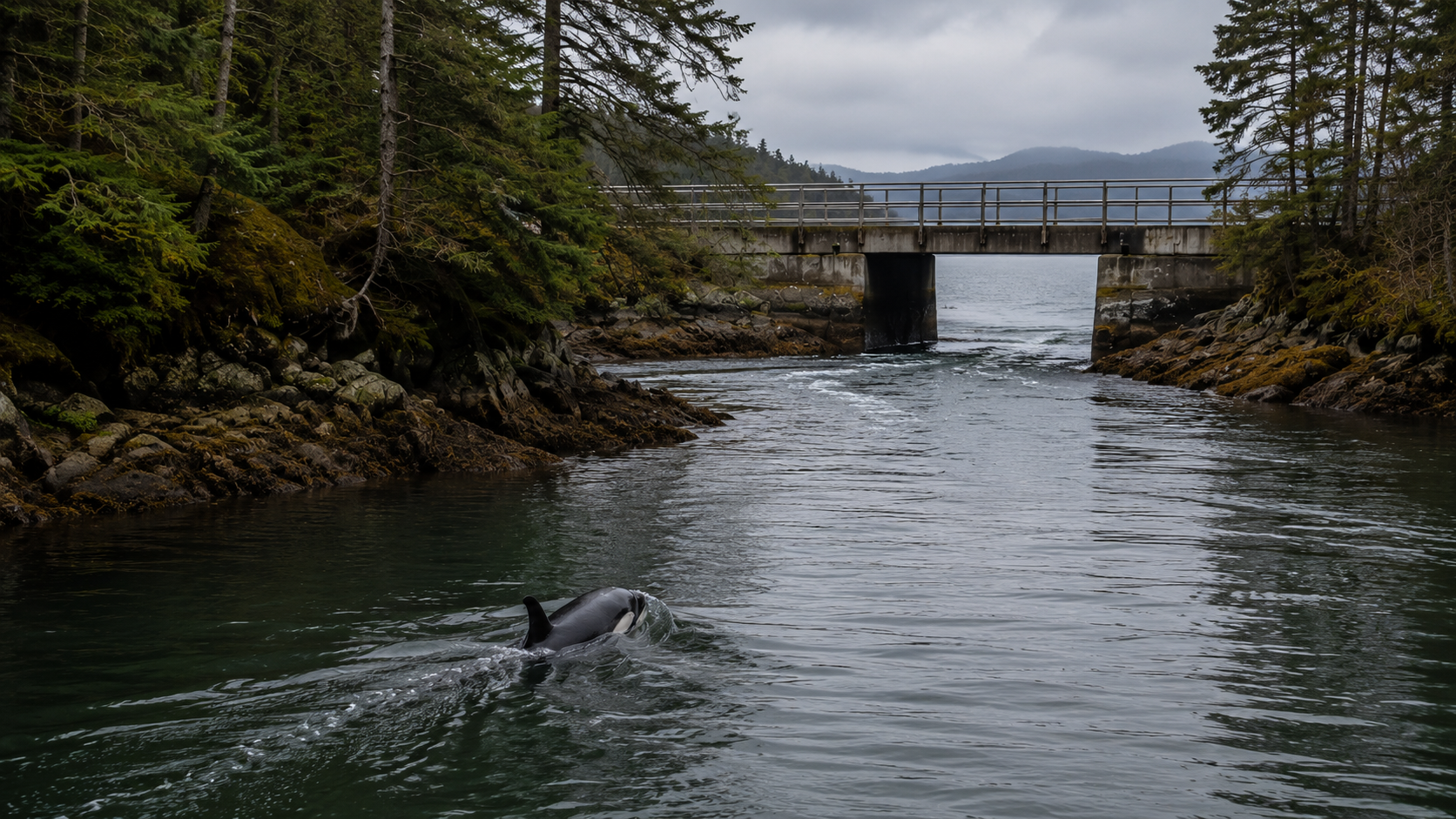
At first, the movement looked ordinary.
A young orca was swimming steadily through a narrow coastal channel surrounded by dark forest and cold water.
Ahead of her stood a small bridge.
Beyond it was deeper water.
Freedom seemed almost ridiculously close.
But this was not an ordinary swim.
For more than a month, the young killer whale had remained inside a tidal lagoon on Vancouver Island after losing the animal she had entered it with:
her mother.
And although humans had spent weeks trying to help her leave, the most important journey would eventually begin without anyone forcing her to go.
Note: The accompanying video is a modern visual reconstruction inspired by the documented story. It is not original footage of the exact moment described.
She Had Entered the Lagoon With Her Mother
The young Bigg’s killer whale became known publicly as Brave Little Hunter, or kʷiisaḥiʔis.
She and her mother entered a tidal lagoon near Zeballos, British Columbia, in March 2024.
Then everything changed.
Her mother became stranded on a shallow rocky area and died.
The calf survived.
Suddenly, the lagoon that had contained two orcas held only one.
And that created a problem far more complicated than simply pointing the young whale toward the ocean.
The Way Out Was Still There
That was one of the strangest parts of the story.
The calf was not trapped behind a concrete wall.
She was not inside an aquarium.
She was not physically tied down.
A route toward deeper water still existed.
But tidal passages can change dramatically depending on water level, current and timing.
A channel that appears simple to a person looking from shore can feel completely different to a young whale moving through it.
And there was another detail that could not be ignored.
The route out passed close to the area where her mother had died.
Whether that affected the calf’s behavior cannot be proven.
But observers watched her remain inside.
Days passed.
Then weeks.
Somehow, She Learned to Survive Alone
The calf did not simply stop functioning after losing her mother.
She remained active.
She moved around the lagoon.
Most importantly, she appeared capable of finding food.
That bought rescuers something extremely valuable:
time.
A starving animal creates an immediate emergency.
A young orca capable of feeding herself presents a different challenge.
Teams could think carefully about how to help without turning a difficult situation into a dangerous one.
But every additional day created another question.
If she could survive inside the lagoon, what would convince her to leave?
People Could Hear Her Calling
Hydrophones were used to listen beneath the surface.
The young orca vocalized.
For people following the story, that may have been one of its most emotional details.
Killer whales live intensely social lives. Young animals normally grow up surrounded by experienced family members, learning how to travel, hunt and interact with their environment.
Now this calf was moving through the lagoon alone.
Rescuers tried different ways to encourage her toward the exit.
Recorded killer-whale sounds were among the methods explored.
Boats were used.
Teams experimented with strategies designed to guide rather than injure her.
But the calf repeatedly resisted human plans.
Then the Rescue Became Much Bigger
Eventually, waiting was no longer the only option being considered.
A large operation was organized to capture and move the calf.
Dozens of people became involved.
Specialized equipment was prepared.
Boats, crews and experienced responders attempted to safely contain the young orca so she could be transported toward open water.
On paper, it sounded like the solution.
In practice, they faced an intelligent, fast-moving wild predator that had already learned the geography of the lagoon.
The calf avoided them.
The major capture attempt failed.
And strangely, that failure may be one of the most important parts of the story.
Because it showed something rescuers could not control:
the final decision might have to come from the orca herself.
More Than a Month Had Passed
By late April, the story had stretched far beyond the first emergency.
The calf had survived alone for weeks.
Rescuers had watched her behavior.
They had tried sound.
They had tried guiding her.
They had prepared a major capture.
Still, the young orca remained inside.
The open water beyond the passage had never disappeared.
That made the situation increasingly difficult to understand from a human point of view.
Why stay?
Why repeatedly stop short of a route that appeared to lead toward freedom?
There may never be one simple answer.
Fear, unfamiliar conditions, tidal flow, the loss of her mother and the calf’s own experience could all have mattered.
Then came the morning when the pattern finally changed.
The Tide Rose
On April 26, conditions in the lagoon shifted again.
The tide was high.
And the young orca began moving toward the passage.
This time, she kept going.
No giant rescue net pushed her forward.
No crane lifted her.
No person rode beside her directing every movement.
She simply continued swimming.
Toward the narrow channel.
Toward the bridge.
Toward the water beyond.
For anyone who had followed the story for weeks, those few minutes carried the weight of an entire month.
She Passed Beneath the Bridge
This is the moment our video reconstruction builds toward.
The calf approached the passage and continued through.
She moved beneath the bridge and out of the lagoon that had held her since her mother’s death.
The same young whale that rescuers had struggled to capture had accomplished the most important part herself.
She chose the route.
She chose the moment.
And the tide gave her enough water to do it.
Then the Humans Had to Stop Rescuing Her
The moment she left the lagoon, the mission changed completely.
The goal was no longer to remove a trapped whale.
Now the priority was to avoid interfering with a wild orca that had regained access to larger waters.
Observers followed from a respectful distance.
What everyone wanted next was obvious.
Could she locate other killer whales?
Could she reconnect with relatives or another social group?
That part of the story carried much more uncertainty.
Leaving the lagoon solved the immediate physical problem.
It did not automatically replace the family she had lost.
The Rescue Nobody Could Force
That may be why Brave Little Hunter’s story became so memorable.
Humans did help.
They watched.
They planned.
They tried different techniques.
They prepared an enormous intervention.
But ultimately, none of those efforts produced the cinematic rescue people might expect.
The decisive moment was quieter.
A high tide arrived.
A young orca approached a passage she had avoided for weeks.
And she kept swimming.
No dramatic leap.
No crane.
No cheering crowd in the water.
Just a black dorsal fin moving steadily toward a small bridge—and then beyond it.
For more than a month, freedom had been visible.
On April 26, the young orca finally chose the way out.
