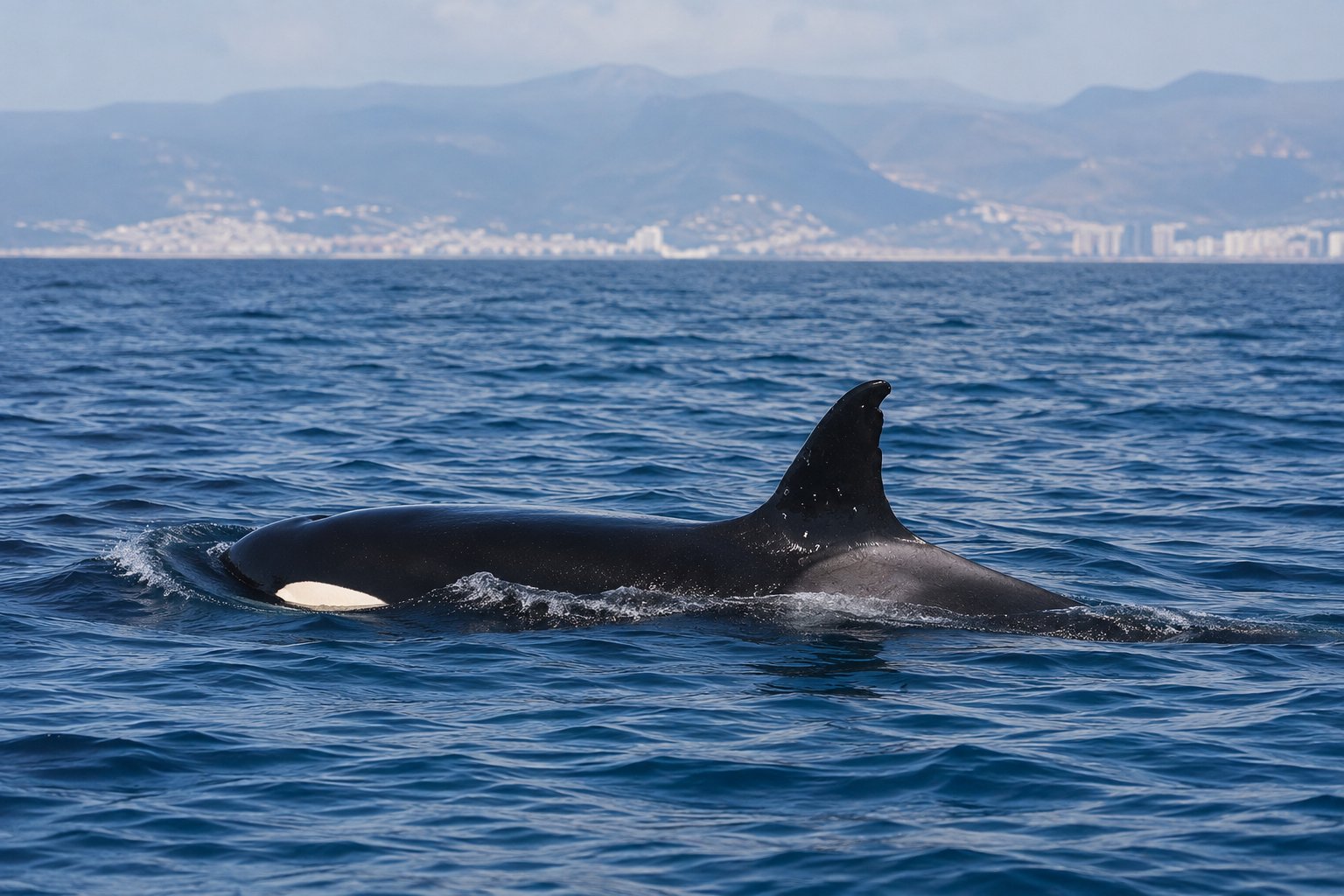
On a sunlit afternoon off the coast of southern Spain, the sea appeared entirely serene.
Mountains framed the distant horizon as a small boat drifted over the rolling blue water.
From the deck, passengers spotted a dark, familiar silhouette breaking the surface.
It was a solitary killer whale, swimming calmly along the coastline.
To an untrained observer, it looked like a routine sighting in the waters near the Strait of Gibraltar.
However, as the camera lens zoomed in to capture a closer look, the atmosphere onboard instantly changed.
Focused tightly on the animal’s high dorsal fin, the high-resolution lens revealed a series of striking, permanent marks.
The top edge of the fin was visibly notched and truncated.
Scattered across the dark skin were distinct, pale white scars and circular puncture-like blemishes.
This was not just any orca.
This was Toñi, affectionately known by marine researchers as “La Abuela”—the grandmother and revered matriarch of the critically endangered Iberian orca pod.
Who is Toñi, the Matriarch of the Strait?
Toñi is one of the oldest and most vital members of the Iberian killer whale population.
This distinct subpopulation of fewer than 50 individuals inhabits the waters between the Gulf of Cádiz, the Strait of Gibraltar, and the northern coast of Galicia.
Unlike larger ocean-dwelling pods, the Iberian orcas lead a precarious existence tightly tied to a single primary food source: Atlantic bluefin tuna.
For decades, Toñi has led her family through these narrow, heavily navigated waters.
As a matriarch, her role is crucial to the pod’s survival.
She holds the collective memory of the group, passing down ancient hunting routes, teaching younger generations how to navigate treacherous tidal currents, and guiding them through shifting ecological challenges.
When researchers examine her appearance, they aren’t just looking at a fin.
They are looking at a living historic record of survival in one of the busiest maritime corridors on Earth.
The Mystery Behind the Scars
The zoom-in footage of Toñi’s dorsal fin immediately sparked intense discussion among marine biologists and conservationists.
What caused the distinct damage to her fin, and where did those mysterious pale marks come from?
There are several leading theories, each highlighting the intense pressures these animals face daily.
1. Encounters with Industrial Fishing Gear
The Strait of Gibraltar is famous for its centuries-old traditional and commercial tuna fisheries, including the massive net systems known as Almadrabas.
For generations, Iberian orcas have learned to take advantage of human fishing activity, sometimes picking hooked tuna directly off longlines.
This dangerous feeding strategy, known as depredation, brings the whales into extremely close proximity with heavy ropes, steel hooks, and monofilament lines.
Entanglement or sharp contact with high-tension lines can easily slice through the leading edge of a dorsal fin, leaving deep notches that heal into smooth, rubbery indentations.
2. Vessel Propeller Impacts
With thousands of commercial cargo ships, ferries, and recreational yachts passing through the Strait every month, vessel strikes remain a constant threat.
A close encounter with a rotating boat propeller can inflict quick, clean slice marks across the trailing edge of a fin without proving fatal.
The blunt trauma of such an impact often permanently alters the shape of the fin’s tip.
3. Puncture Scars and Parasites
The pale, circular marks visible along her flank and fin base present another clue.
Some researchers believe these marks could be healed scars from past confrontations or interactions with other marine species.
Others suggest they are the lingering evidence of lampreys or cookiecutter-style parasitic bites that left depigmented ring-shaped scars on her dark skin.
A Pod Under Unprecedented Pressure
Toñi’s physical condition cannot be separated from the broader, extraordinary story unfolding off the Iberian Peninsula.
In recent years, the Iberian orca population has gained global attention for a unique and unprecedented behavior: interacting with and disabling the rudders of sailboats.
Scientists studying this behavior have documented small groups of young orcas approaching sailing vessels, pushing against their rudders, and occasionally snapping them off.
While some experts view this as a social trend or “play behavior” among juveniles, others point to the underlying stress in their environment.
Noise pollution from heavy shipping, severe depletion of bluefin tuna stocks, and decades of negative human interactions have pushed this tiny population to its absolute limit.
Toñi has lived through every phase of this changing ecosystem.
Her scarred fin stands as physical proof that surviving alongside human activity comes at a heavy cost.
The Silent Witness of the Ocean
As the camera zoomed out on Toñi, she slowly arched her back and glided beneath the blue surface.
She didn’t breach, slap her tail, or put on a dramatic display for the watching boat.
She simply continued her journey through the coastal waters she has called home for decades.
The video ended without voiceover or immediate explanations, leaving viewers with a haunting image of a resilient survivor.
Every mark on Toñi’s body tells a story of an encounter survived, a hazard navigated, and a lesson passed on to her pod.
She remains a symbol of both the incredible toughness of marine wildlife and the urgent need to protect the fragile waters she guards.
What Lies Ahead for “La Abuela”?
Marine tracking teams continue to monitor Toñi and her pod as they follow the seasonal migration of bluefin tuna along the Spanish and Portuguese coasts.
Researchers use photographs of her distinct dorsal fin—complete with its notched tip and pale scars—to track her movements and check on her health year after year.
Her presence is proof that despite the heavy industrialization of her habitat, the matriarch is still leading her family.
The mystery of exactly which vessel line or gear caused her scars may never be solved with 100% certainty.
However, the lesson her image conveys is undeniable: the ocean’s oldest guardians carry the visible memory of our shared world beneath the surface.
