At first glance, nothing seems wrong.
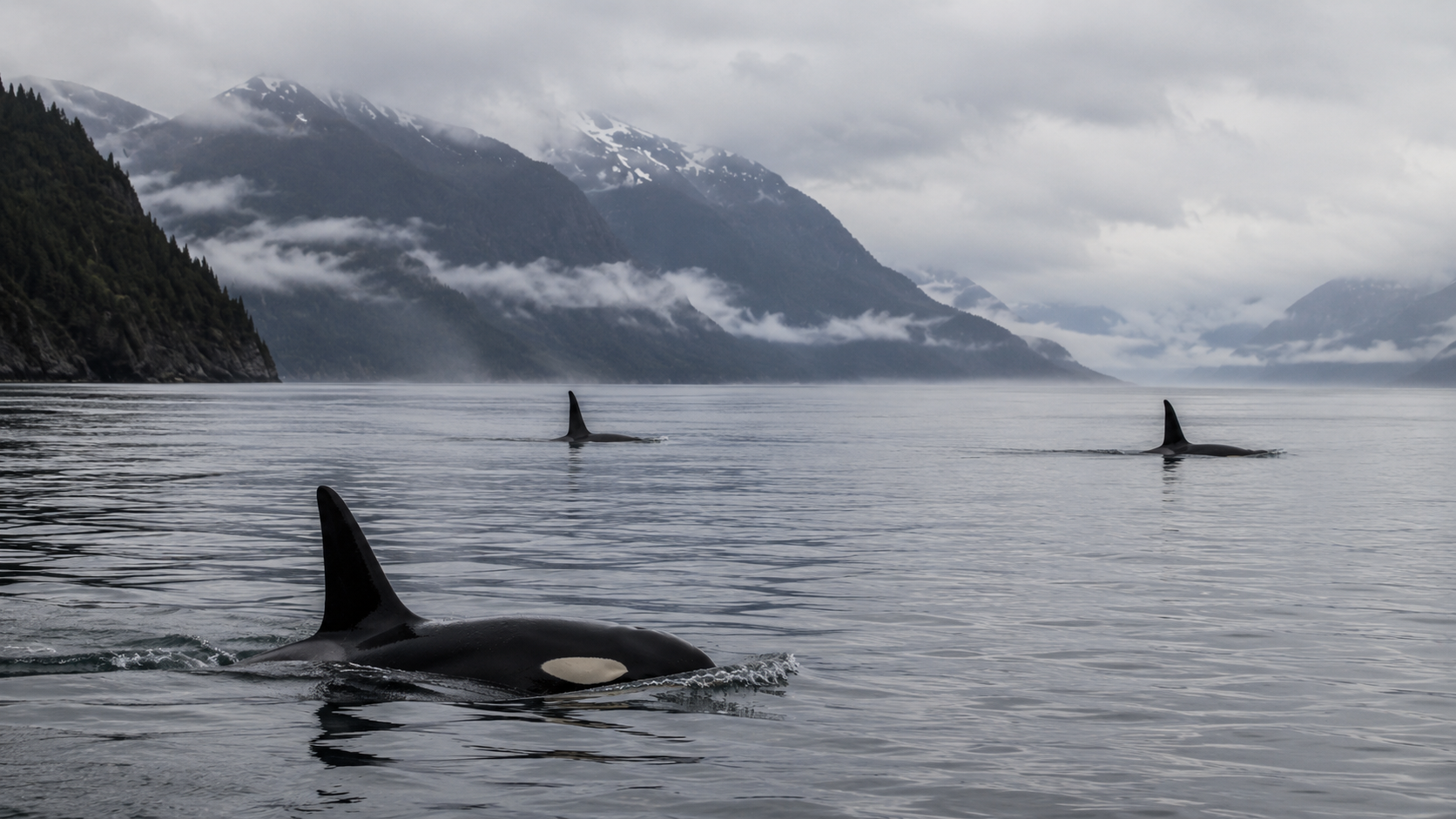
A few orcas move quietly through the cold waters of Prince William Sound, Alaska. Behind them, dark forested mountains disappear into low clouds. The water is steel-grey, the fjord enormous, and the whales continue forward as they have for generations.
But something is missing.
Something that has reportedly been missing from this particular group since 1984.
A calf.
For more than four decades, no new calf has been observed in Alaska’s small and isolated AT1 transient killer whale population.
Today, only seven individuals remain.
Once you know those numbers, a peaceful scene of several orcas swimming through an Alaskan fjord begins to look completely different.
A Pod That Is Still Here—but Barely
AT1 killer whales are part of a small population associated with Prince William Sound and surrounding waters.
They are transient, or mammal-eating, killer whales rather than the fish-eating resident orcas many people know from the Pacific Northwest.
But what makes AT1 extraordinary is not simply what they eat.
It is what has stopped happening.
According to NOAA Fisheries, no births have been observed in the AT1 stock since 1984.
Think about that for a moment.
Someone born in 1984 could now be in their forties.
Entire human families have grown through multiple generations during that time.
Yet this tiny orca population has apparently produced no observed calf capable of beginning a new generation.
That turns population decline into something much more unsettling.
It becomes a countdown.
There Used to Be Far More of Them
The group was once much larger.
Historical records put the AT1 population at roughly 22 whales before its devastating decline.
Today, official assessments list only seven.
That means most of the group has disappeared.
And because new calves have not been observed replacing the whales that die, each loss becomes increasingly difficult to recover from.
Seven is not an abstract conservation statistic.
Seven animals can almost be counted individually in a single encounter.
That is what makes this story so powerful.
Then Came the Exxon Valdez Disaster
In March 1989, the oil tanker Exxon Valdez struck Bligh Reef in Prince William Sound.
The resulting spill became one of the most notorious environmental disasters in U.S. history.
Millions of gallons of crude oil entered the surrounding marine environment.
The effects spread through shorelines, prey populations and marine wildlife.
Killer whales were among the animals caught in the aftermath.
NOAA has said the Exxon Valdez spill was strongly associated with the deaths of many AT1 killer whales.
For such a small group, losing even several individuals at once could have enormous consequences.
For a population already failing to produce new calves, the consequences were even more severe.
The Disaster Did Not End When the Oil Disappeared From View
One of the most misleading things about an oil spill is that its most visible stage eventually ends.
The surface becomes cleaner.
News cameras leave.
Years pass.
But biological consequences can remain far longer.
Killer whales sit near the top of the marine food web. Contaminants can accumulate through the animals they eat, and environmental disruption can also affect prey abundance and habitat.
For a large, healthy population, recovery may still be possible.
For a tiny, isolated group with almost no reproductive replacement, every additional pressure becomes much more dangerous.
AT1 never returned to anything resembling its earlier numbers.
Why No Calves Matters More Than Almost Any Other Number
A population of seven whales sounds frightening on its own.
But the absence of calves tells an even deeper story.
A small population can sometimes rebuild if reproduction continues.
Seven could become eight.
Eight could become ten.
Ten could eventually become more.
But when births disappear, there is no obvious path upward.
Existing whales continue aging.
Females pass through reproductive years.
Individuals die.
And the population moves in only one direction.
That is why “no observed calf since 1984” may be the single most important fact in the entire AT1 story.
It tells us that this is not simply a population that became small.
It is a population struggling to replace itself.
Why Can’t They Simply Join Other Orcas?
It sounds like an obvious solution.
There are other killer whales in Alaska.
Why could the remaining AT1 animals not simply join another population and begin reproducing there?
Orca society is far more complicated than that.
Different killer whale populations can have distinct social structures, diets, vocal traditions and family relationships.
They do not behave like interchangeable individuals randomly joining any group they encounter.
Researchers have also found evidence that AT1 whales are unusually distinct from some neighboring killer whale populations.
Their isolation is part of what makes their decline so worrying.
A nearby pod does not automatically provide a replacement family.
This Is Why the Video Looks So Empty
Our accompanying video is a visual reconstruction, not original footage documenting one specific AT1 encounter.
We deliberately kept the scene simple.
Only a few orcas move through a huge Alaskan fjord.
No calf appears among them.
There is no attack.
No rescue.
No stranding.
No dramatic explosion of action.
Because this story does not need one.
Once you know the numbers, the empty water becomes the disturbing part.
A huge wilderness surrounds them.
The whales continue swimming.
But the group looks small enough to disappear into the landscape.
Seven Whales Changes Everything
NOAA’s recent Alaska marine mammal assessment lists the AT1 transient stock at an estimated seven individuals and classifies it as a strategic stock.
With populations this small, percentages almost stop being useful.
If a population contains hundreds or thousands of animals, one death represents a fraction of a percent.
When there are seven, one whale represents a huge portion of everything that remains.
Every individual matters.
Every year matters.
And every year without a calf matters even more.
Could AT1 Still Recover?
That is the question with no comforting answer.
Wild populations sometimes surprise researchers.
A successful birth could change the trajectory.
New observations could alter what scientists understand about the remaining animals.
But decades without an observed calf make recovery increasingly difficult.
The longer reproduction fails, the fewer opportunities remain.
That is why scientists continue monitoring populations like AT1 even when the numbers are painfully small.
The final chapter has not technically been written.
But the margin for recovery has become extraordinarily narrow.
The Most Haunting Part Is That They Are Still Here
Extinction stories usually become famous after the final animal disappears.
AT1 is different.
The whales are still swimming.
They still surface.
They still travel through the cold fjords of Alaska.
Someone can still look across Prince William Sound and see one of them rise through the water.
That makes this story more powerful, not less.
Because what we are watching is not something that has already vanished.
We are watching a population that still exists while its future becomes increasingly uncertain.
More than four decades have passed since the last observed calf.
A group that once numbered around 22 has fallen to only seven.
And each time those remaining black dorsal fins appear against the enormous grey water of Prince William Sound, they carry a question that grows harder to ignore:
Will another calf ever appear among them?
