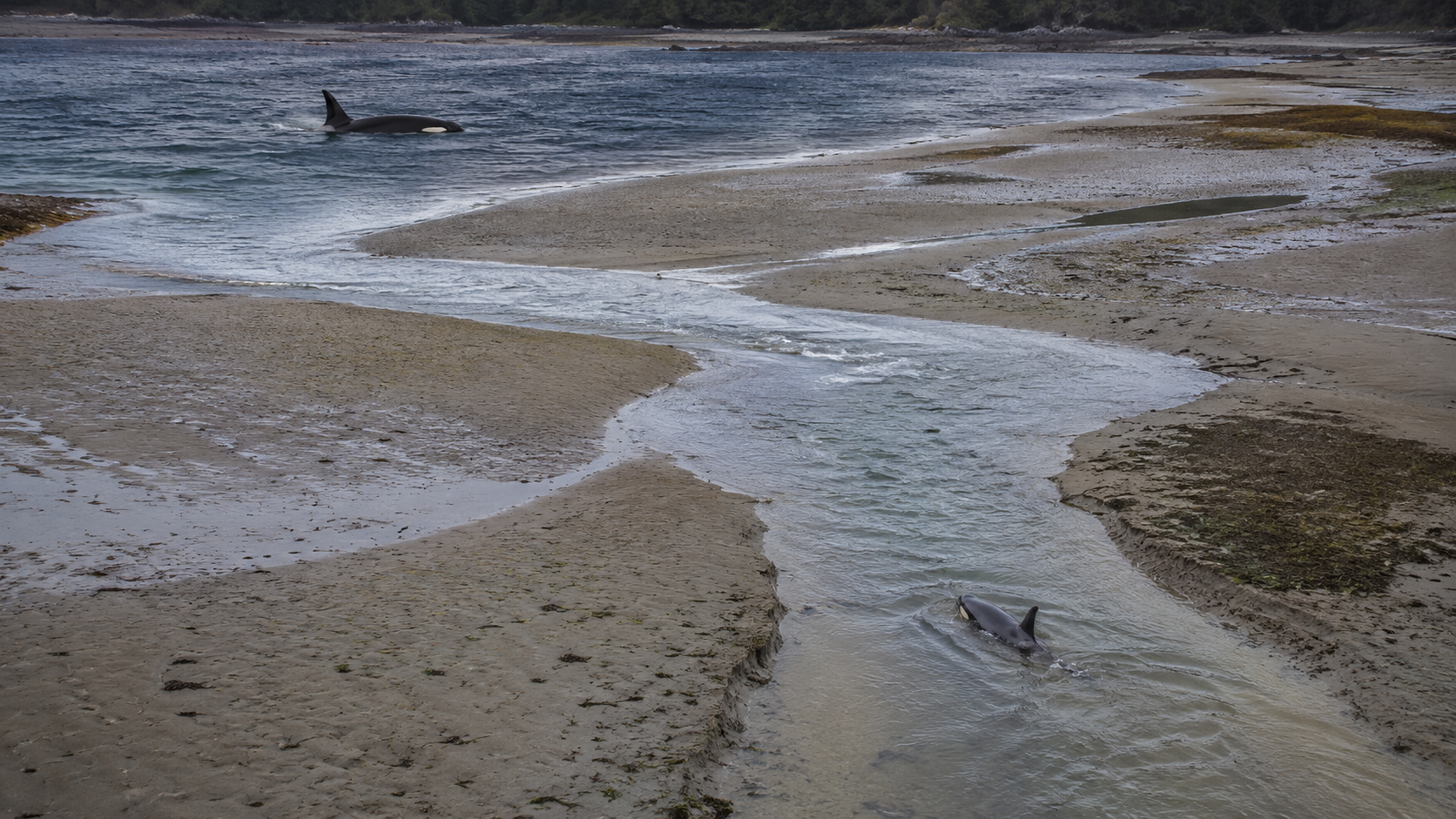
The mother was not gone.
That was what made the scene so difficult to watch.
She was still visible in the deeper water ahead, surfacing slowly as she moved along the outer channel.
Behind her, however, the young orca had a very different problem.
The calf was swimming through a thin ribbon of water winding between exposed sandbars. From above, the route looked almost connected to the channel where its mother waited.
Almost.
But in a tidal landscape, a few centimetres of water can completely change what is possible.
The calf continued forward.
Its mother remained ahead.
And between them, the tide was rewriting the coastline.
Note: The accompanying video is a modern visual reconstruction inspired by realistic killer-whale behavior and tidal coastal environments. It does not depict original footage of a specific documented incident.
The Distance Was Small. The Problem Was Not.
From the observer’s viewpoint, it looked simple.
The calf could see the deeper water.
It appeared to know exactly which direction its mother had gone.
There was no wall.
No fishing net.
No boat blocking the route.
Instead, broad areas of wet sand divided the estuary into several narrow channels.
One carried enough water for the calf.
Another led toward its mother.
But the two were not yet fully connected.
That creates a very different kind of separation.
The animals can remain incredibly close while experiencing completely different water depths.
The mother has enough water beneath her body to move normally.
The calf does not.
Why Couldn’t the Mother Simply Come Back?
That is probably the first question many people would ask.
If an adult orca can see its calf struggling through shallow water, why not simply swim toward it?
The answer is hidden beneath the surface.
An adult female is considerably larger than a young calf. A channel deep enough for the smaller animal may still be too shallow or risky for the mother to enter.
Moving farther into a tidal flat could turn one problem into two.
Instead, the safer behavior may be to remain in deeper water while the calf continues searching for a route out.
And that is what makes the image so powerful.
The mother seems close enough to reach.
But physically, she may be on the safer side of an invisible boundary.
The Calf Keeps Following the Water
The young orca does not stop.
It follows the curve of the shallow channel.
Its dorsal fin cuts through the silver-grey surface while a small wake spreads behind it.
Then the channel bends again.
For a moment, the calf is actually moving sideways rather than directly toward its mother.
It looks like the wrong direction.
But there is nowhere else to go.
This is something that is easy to misunderstand from above.
A stranded or isolated marine animal cannot simply travel in a straight line toward its destination.
It must follow the water that is deep enough to carry its body.
The shortest route may be unusable.
The longer, winding route may be the only one available.
Then Something Begins to Change
At first, the difference is almost impossible to notice.
A thin stream between two sandbars becomes slightly wider.
Water begins creeping over an area that had been exposed only moments earlier.
Another shallow branch starts flowing more continuously.
The tide is returning.
Not dramatically.
There is no enormous wave rushing through the estuary.
The entire landscape simply begins gaining water a little at a time.
And for the calf, that matters more than anything else.
A channel that was useless twenty minutes earlier can gradually become a route.
The question is whether enough water will arrive before conditions change again.
The Mother Adjusts Her Position
In the deeper channel, the adult orca continues moving slowly.
She does not disappear toward the open ocean.
Instead, she stays roughly opposite the route the calf is following.
The distance between them begins to shrink.
The calf reaches another bend.
Now the water ahead looks different.
What had previously appeared to be separate pools and narrow streams is beginning to resemble one continuous passage.
For the first time, there is a visible possibility.
Not a guarantee.
A possibility.
And that distinction is important.
Why Tidal Flats Can Become Natural Mazes
A coastline like this can look completely different over the course of a single tidal cycle.
At lower water, sandbars and mudflats emerge and divide larger areas of water into isolated channels.
When the tide returns, those same barriers gradually disappear beneath the surface.
To an animal swimming through them, the landscape is therefore constantly changing.
A route may close.
Another may open.
A shallow section may suddenly become deep enough to cross.
This is why the calf’s progress matters.
It is not simply swimming toward its mother.
It is effectively waiting for the ocean to rebuild the road between them.
The Final Channel Begins Filling
Now the calf is much farther along than when the scene began.
The channel around its body is slightly wider.
The exposed sand ahead is smaller.
Water moves through a narrow connection toward the deeper channel.
The mother is still there.
For several moments, the two animals seem almost aligned.
Only one final shallow section separates them.
The calf keeps moving.
Its wake tightens as the available water becomes narrower.
Then more water enters.
The exposed edge begins disappearing.
And suddenly, the route that had looked impossible starts to look passable.
But This Is Where the Video Stops
Our reconstruction deliberately ends before showing a reunion.
That is because the most powerful part of this situation is not a dramatic final moment.
It is the uncertainty immediately before it.
Will the next rise in water be enough?
Will the calf recognize the opening?
Will the mother remain nearby?
Or will the shifting current change the route again?
Real coastal environments do not operate according to a perfect rescue script.
Sometimes the difference between being trapped and being free is simply time and water depth.
The Ocean Was Slowly Giving the Path Back
At the beginning, the calf and its mother seemed to occupy two different worlds.
One was confined to a shallow winding channel.
The other moved freely through deeper water.
Yet they were separated by only a small stretch of tidal ground.
Then the water returned.
One channel widened.
Another connected.
The calf moved farther forward.
And the distance that had seemed impossible began to disappear.
The mother had never been far away.
The calf had never stopped moving toward her.
What they needed was something neither of them could control:
for the ocean to put the path back.
