The ocean waters off the icy coast of Iceland were remarkably calm when researchers onboard a marine biology vessel spotted the pod.
From a distance, everything appeared normal.
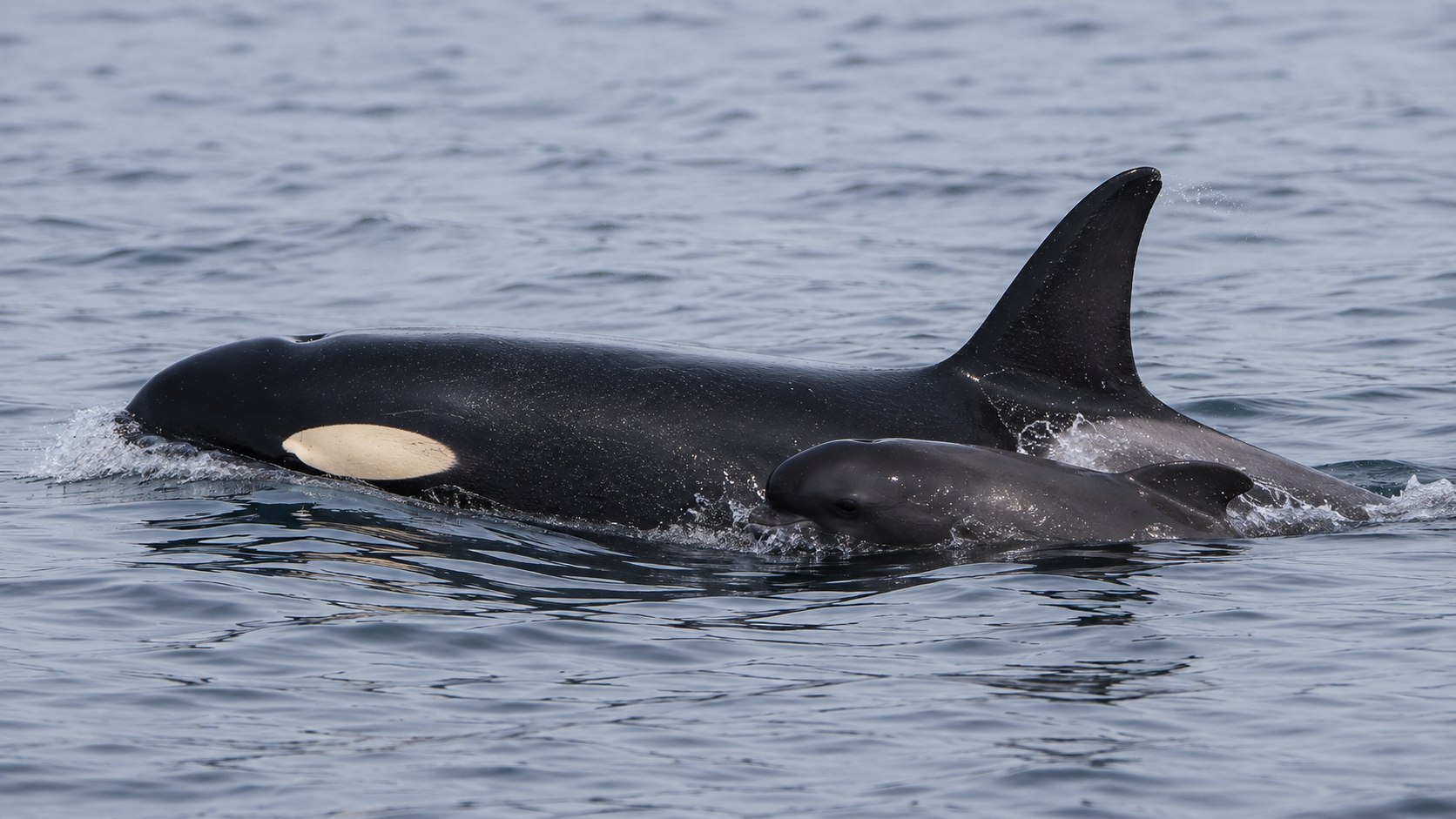
A large female killer whale was gliding near the surface, her dorsal fin cutting smoothly through the freezing grey water.
Beside her, swimming synchronously beneath her massive pectoral fin, was a tiny newborn calf.
It was a scene marine biologists had witnessed hundreds of times before.
However, as the boat drifted closer and high-resolution cameras zoomed in, the research team realized they were looking at an event that challenged fundamental laws of nature.
The baby swimming so closely to the apex predator was not an orca.
It was a newborn pilot whale.
A Sighting That Shocked Marine Biologists
The anatomical differences were unmistakable once scientists analyzed the footage frame by frame.
While orca calves feature distinct yellowish-white eye patches and sharp body contours, this infant possessed a bulbous head and a backwards-curving dorsal fin.
It was unmistakably a long-finned pilot whale calf.
What made the sighting baffling was the historic relationship between the two species.
In the wild, killer whales and pilot whales are fierce competitors.
In coastal waters around Iceland and the North Atlantic, encounters between orcas and pilot whale pods are frequently tense, aggressive, and sometimes lethal.
Pilot whales are known to mob and chase off killer whales when their paths cross.
Yet here, in the open sea, an apex predator was not hunting the calf.
She was protecting it.
The Mechanics of Cross-Species Adoption
For weeks, the research team tracked the female orca, whom they cataloged in their records as Sædís.
Observation logs recorded the female displaying classic maternal behaviors toward the tiny orphan.
She adjusted her swimming speed so the small calf could stay within her slipstream—a hydrodynamic phenomenon known as drafting, which helps young marine mammals save energy while traveling long distances.
Whenever the calf strayed too far, Sædís would gently circle back, nudging it with her rostrum to bring it back under her protective fin.
Biologists noted that the calf appeared fully attached to its surrogate mother, showing no signs of fear or distress.
It was a clear, undeniable case of cross-species adoption, a phenomenon so rare in wild cetaceans that fewer than a handful of cases have ever been documented in recorded history.
Grief, Loss, or Maternal Drive?
Why would an apex predator adopt the infant of a rival species?
Scientists specializing in cetacean psychology believe the answer lies in the profound emotional depth of killer whales.
Orcas possess an exceptionally developed paralimbic system—the area of the brain responsible for processing complex emotions, empathy, and social bonding.
One leading theory suggests that Sædís may have recently lost a calf of her own.
In cetacean communities, grieving mothers have been documented carrying deceased newborns for weeks, refusing to let them sink into the deep.
If Sædís had suffered a recent loss, her maternal hormones and protective instincts would have been operating at an all-time high.
When she encountered a helpless, stray pilot whale calf abandoned or separated from its pod, her maternal drive likely overrode her predatory instincts.
The Struggle for Survival
Despite the emotional beauty of the bond, the adoption presented severe biological hurdles.
Orca milk and pilot whale milk differ in nutrient composition, tailored by evolution for different growth rates and deep-diving capabilities.
Furthermore, as the calf grew, it would need to learn hunting strategies specific to its own species.
While pilot whales feed primarily on deep-sea squid, orcas in northern waters specialize in herding massive schools of herring.
Researchers monitored the pair closely, documenting how the mother attempted to integrate the small calf into her broader pod.
The other members of the pod tolerated the infant, allowing it to travel within their protective formation as they navigated through the coastal fjords.
A Mysterious Encounter in the Deep
Months into the observation study, the story took another dramatic turn.
Researchers tracking Sædís and her adopted calf recorded an encounter between her pod and a traveling pod of pilot whales.
As the two groups drew near, vocalizations underwater spiked significantly.
Hydrophones lowered into the water captured a chaotic mix of high-pitched whistles and echolocation clicks from both species.
During the interaction, the young pilot whale calf was seen moving toward the edge of the orca formation, responding to the calls of its own kind.
When the pilot whale pod eventually moved away into the deeper ocean, the calf was no longer with Sædís.
Whether the calf successfully rejoined its biological species or was reclaimed remains one of the ocean’s greatest unwritten mysteries.
Rethinking Animal Consciousness
The story of Sædís and the orphan calf captured global attention because it stripped away the simplistic labels humans often place on wild animals.
We tend to view apex predators through the narrow lens of hunting and survival.
Yet, encounters like this prove that the ocean holds levels of empathy, grief, and cross-species connection that transcend raw instinct.
In the cold, dark waters of the North Atlantic, a fierce predator chose protection over aggression.
She chose to be a mother.
And in doing so, she gave the world a rare glimpse into the deep, complex emotional lives of the giants who rule our seas.
