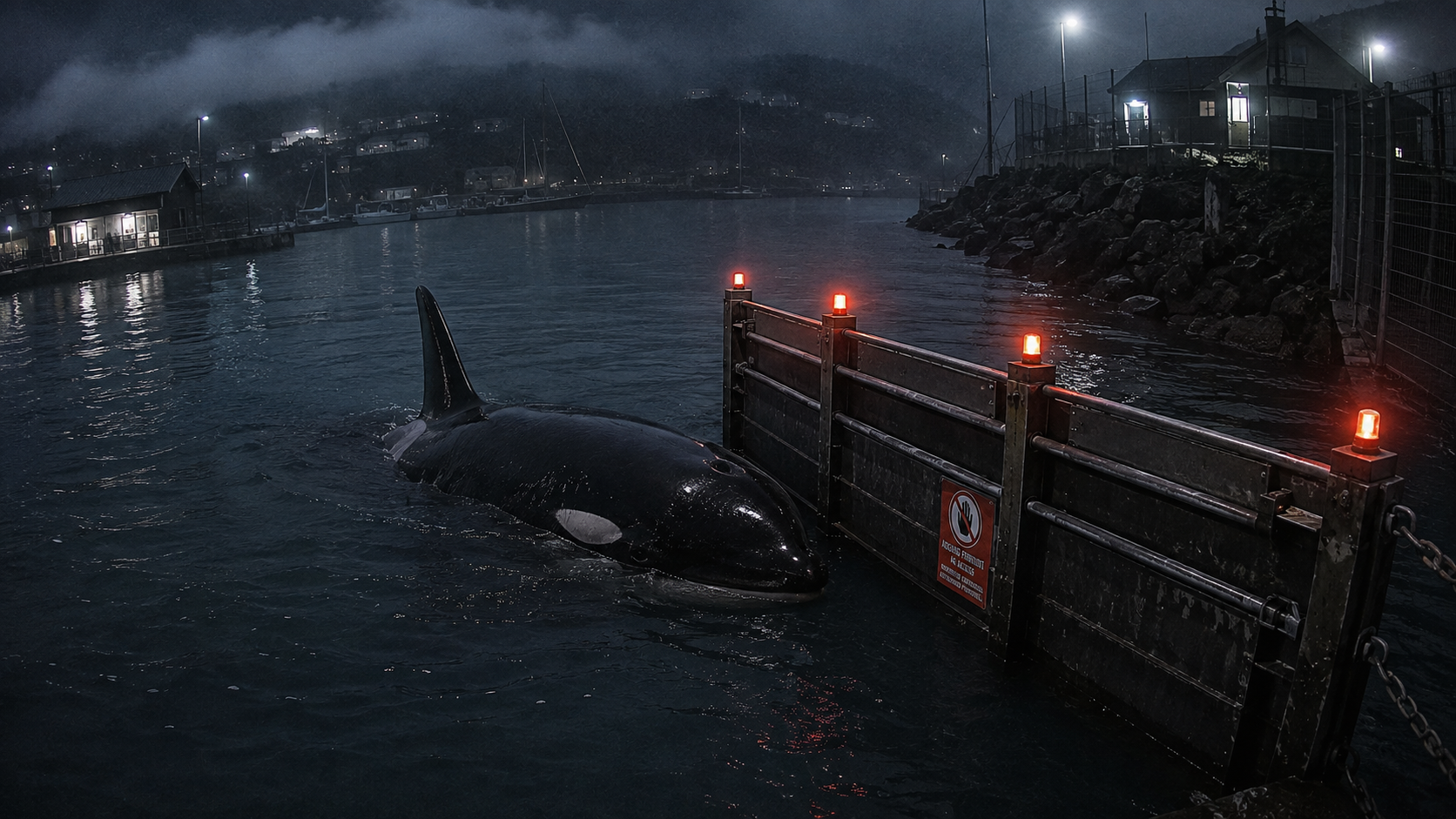
The night air over the Norwegian fjord was freezing and completely calm.
At 02:18 AM, automated security cameras monitoring a restricted marine facility recorded something that immediately raised red flags among facility operators.
The surveillance feed showed a massive shadow breaking the dark surface of the water.
It was an adult killer whale.
The apex predator was swimming dangerously close to the heavy steel floating barrier that sealed off the inner basin.
On the pier, a bright yellow warning sign clearly read in Norwegian: “STOPP IKKE GÅ FORBI LYSENE” (Stop, do not pass the lights).
Human trespassers knew better than to cross that line.
But the giant creature in the water was following a completely different set of rules.
A Deliberate Confrontation at Midnight
The surveillance footage did not capture a simple, accidental pass-by.
Killer whales are highly navigate creatures. They possess spatial awareness that far exceeds human capabilities in dark waters.
Yet, this specific orca turned its massive body directly toward the heavy steel structure.
It didn’t panic. It didn’t attempt to dive deep to avoid the obstacle.
Instead, the whale slowly surfaced, raised its rostrum out of the water, and deliberately pressed its body against the steel edge.
The impact sent subtle ripples across the dark surface, causing the warning lights on the pier to sway.
Engineers and marine biologists who later reviewed the archived security tapes noticed a striking detail.
The whale was actively testing the structural tension of the barrier.
It was using its physical strength to push against the metal, as if searching for a weak point or attempting to force the structure open.
The Hidden Reason Behind the Fence
Why would a wild, free-roaming killer whale pay so much attention to a human-made harbor wall?
The answer lies in what was happening on the other side of the steel barrier.
Norwegian fjords are home to complex acoustic environments and rich seasonal herring migrations.
However, they are also heavily utilized for commercial fish farming, military operations, and naval equipment testing.
To control marine traffic and protect valuable underwater infrastructure, facilities often deploy physical nets and acoustic deterrent devices.
To human ears on the dock, the facility sounded quiet.
To an orca—a mammal that experiences the ocean almost entirely through high-frequency echolocation—the area was anything but silent.
Low-frequency hums from generator cables, underwater acoustic barriers, or trapped prey inside the enclosure can draw an orca’s attention like a magnet.
In many documented cases, local pods become hyper-aware of human structures built inside their traditional hunting routes.
Intelligence or Desperation?
The footage recorded at 02:18 AM raised a intense debate among marine mammal experts.
Was this an act of sheer curiosity, or was it a calculated attempt to reach something inside?
Orcas are renowned for their problem-solving intelligence.
Across different oceans, pods have learned to strip fish from longline fishing hooks, coordinate waves to knock seals off ice floes, and even disable rudder systems on boats.
When faced with a physical barrier in their natural territory, an orca does not view it as a natural limit.
It views it as a puzzle.
By repeatedly pushing its snout and flank against the steel dock, the whale was gathering sensory feedback.
It was feeling the resistance of the metal, evaluating the force required to move it, and inspecting the obstacle separating it from the open fjord.
The Impact of Human Barriers on Ocean Giants
As industrial expansion continues along coastal waters, encounters like the one captured in Norway are becoming increasingly frequent.
Artificial barriers, underwater fences, and heavy marine traffic fragment the natural habitats of cetaceans.
For a species that travels dozens of miles every single day, coming across a locked harbor barrier is a direct disruption to their survival patterns.
Biologists emphasize that when a whale interacts with infrastructure in this manner, it is a clear warning sign.
It reveals how deeply human construction encroaches on ancient marine corridors.
The presence of the warning sign—intended for human security—served as an ironic backdrop to a creature that knew no human laws.
What Happened After the Camera Stopped Rolling?
Following the incident, facility operators conducted a full inspection of the perimeter fence.
While the steel structure suffered no structural failure, the event prompted a review of how underwater acoustic signals were managed during nighttime hours.
To prevent further stress to local pods, marine acoustic adjustments were made to ensure the sound levels near the barrier were reduced.
The giant male orca eventually turned back toward the deep waters of the fjord, disappearing into the dark horizon.
But the 15 seconds captured on the CCTV monitor remained archived as a powerful piece of evidence.
It serves as a stark reminder that beneath the quiet surface of northern waters lives an intelligence we are only beginning to comprehend.
An intelligence that will not simply turn away when humanity builds a wall in its path.
