The young orca had been found alone hundreds of miles from home. After treatment, transport and weeks inside a temporary sea pen, one final question remained: could she truly return to the family she had lost?
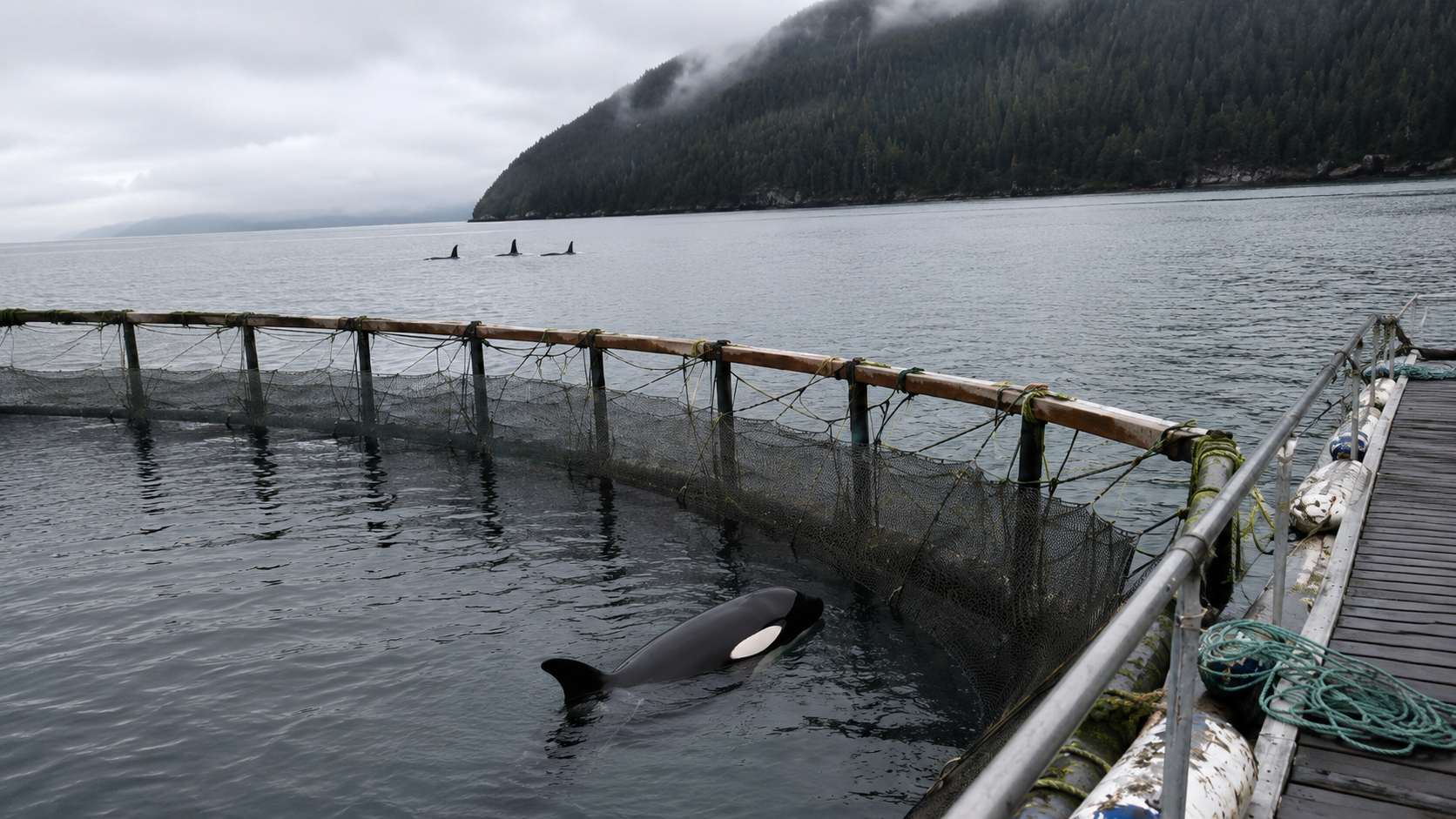
Springer stopped near the edge of the floating pen.
Beyond the dark mesh lay the cold, open water of British Columbia. Farther out, black dorsal fins moved across the bay—members of the Northern Resident killer whale community into which she had been born.
The young orca could hear them.
She lifted her head near the barrier and responded with loud calls. The whales outside continued through the area, close enough for acoustic contact but still separated from her by the temporary enclosure.
For the people watching from the nearby walkway, this was the moment they had spent months preparing for.
They knew Springer could swim through the opening.
They knew she could catch live fish.
They knew her medical condition had improved.
But no test could answer the most important question:
After living alone, approaching boats and spending weeks under human care, would her family still recognize and accept her?
The Orca Who Should Not Have Been There
Springer’s official identification was A73. She belonged to the Northern Resident killer whale population normally found in the coastal waters between northern Vancouver Island and mainland British Columbia.
Yet on January 14, 2002, the young female appeared alone in central Puget Sound, Washington—roughly 300 miles south of the area where her family was usually encountered.
Researchers estimated that she was only 18 to 24 months old. Her mother had probably died sometime before the summer of 2001, leaving Springer separated from the close family group upon which a young resident orca would normally depend.
Her presence alone was immediately alarming.
Resident killer whales do not normally live as solitary animals. Their lives are organized around stable maternal families in which offspring may remain with their mothers and relatives for decades.
Springer was not only far from home. She was also spending the winter in a busy area filled with vessels, industrial activity and human attention.
At first, observers hoped she might leave naturally or encounter other whales. Instead, she remained in the region and became increasingly interested in boats and people.
That curiosity made her situation more dangerous.
A wild orca that begins approaching vessels may be struck, injured by propellers or become so accustomed to humans that a return to normal social life becomes harder.
Springer was eating, but examinations and observations also raised health concerns. She had a skin condition, parasitic worms and signs that her metabolism was under strain. Experts had to decide whether intervention would help her—or whether capturing her temporarily would make the situation worse.
A Rescue With No Clear Precedent
There was no simple instruction manual for taking a young wild orca into temporary care and then returning her to a specific family.
NOAA Fisheries consulted scientists, veterinarians, Washington State officials, Fisheries and Oceans Canada, the Vancouver Aquarium and conservation organizations.
The plan carried several risks.
Springer could be injured during capture or transport.
She might become dependent on people.
She could carry an illness that endangered wild whales in British Columbia.
Even after treatment, her family might not accept her—or she might no longer possess the behavior needed to live with them.
But leaving her alone in Puget Sound also carried serious risks.
After months of monitoring and debate, an independent scientific panel recommended that Springer be rescued, treated and relocated to her home waters.
On June 13, 2002, the team moved her into a floating net pen on Washington State’s Kitsap Peninsula. At the time, she measured about 11 feet long and weighed approximately 1,240 pounds.
The enclosure looked like captivity, but the purpose was fundamentally different.
It was designed to prepare Springer to leave.
The Humans Had to Keep Their Distance
The rehabilitation team faced an unusual contradiction.
They needed to examine Springer, provide medication and make sure she was eating—but they also needed to prevent her from associating humans with comfort or food.
Too much interaction could undermine the entire release.
Staff therefore monitored her remotely whenever possible. Closed-circuit cameras allowed observers to study her behavior without standing beside the pen. Live salmon were introduced in a way that encouraged her to continue hunting rather than waiting for people to feed her directly.
Veterinarians treated her parasites and monitored her skin and metabolism.
Over approximately one month, her condition improved. Her ketosis disappeared, her skin became healthier and she gained about 112 pounds. By the time she was prepared for transport, she weighed close to 1,350 pounds.
Those improvements proved that she was physically stronger.
They did not prove that she was socially ready.
A resident killer whale does not survive through physical health alone. It must communicate, travel and forage within a community whose relationships may extend across generations.
Springer’s future depended on more than opening a gate.
The Journey Back North
On July 13, 2002, Springer was lifted from the rehabilitation pen and placed aboard a transport vessel.
The trip carried her north through coastal waters toward Johnstone Strait, between Vancouver Island and the Canadian mainland.
At Dong Chong Bay on Hanson Island, the team transferred her into another temporary floating pen. This was not an unfamiliar stretch of ocean chosen at random. It was within the range used by her Northern Resident relatives.
The plan was to allow her to recover from transport and wait for an appropriate opportunity to release her near known family members.
They did not have to wait long.
Within hours, Springer began hearing familiar whales.
The following day, members of her wider family group passed through the area. Springer reacted strongly, calling loudly and moving excitedly inside the enclosure. Contemporary reports described her trying to look over the net and vocalizing toward the whales outside.
It was the first sign that the journey north had restored something no medical treatment could provide:
a connection to the voices of home.
Did Springer Recognize Their Calls?
Killer whale populations possess distinct vocal traditions. Resident communities use repeated call types that can identify their acoustic clan and help maintain contact in dark or distant water.
Scientists cannot translate Springer’s exact calls into a human sentence.
They could not prove that she was thinking, “That is my family.”
But her reaction mattered.
She had not responded to a random recording in a tank. She was hearing free-ranging Northern Resident killer whales in the habitat where she had lived before becoming separated.
Her intense vocal response suggested that those sounds remained meaningful to her.
Recognition, however, had two sides.
Springer might remember the calls outside the pen—but would the whales outside respond to her as a returning relative rather than an unfamiliar juvenile?
The rescue team could not force that relationship.
All they could do was open the way.
The Moment the Barrier Opened
On the afternoon of July 14, officials decided the opportunity had arrived.
The temporary pen was opened at approximately 2:45 p.m., giving Springer access to the bay.
She did not transform into a cinematic hero and immediately disappear beside her family.
Contemporary accounts describe a more uncertain and believable sequence. Springer left the enclosure, paused around kelp and moved into open water. Other whales remained within acoustic range, but she did not immediately place herself tightly among them.
That hesitation did not mean the release had failed.
A young whale that had survived alone for months was entering a moving social world. The whales outside were not waiting in a straight line for a reunion scene. They were traveling, calling, feeding and making their own decisions.
Springer had to approach on their terms.
The people who had cared for her could follow with instruments and observations, but they could not swim beside her and explain where she belonged.
For the first time since the rescue began, the outcome rested almost entirely with Springer and the whales around her.
[EMBED YOUR VIDEO HERE]
Freedom Was Only the First Test
Releasing an animal is not the same as proving a successful return to the wild.
Springer still had to find food, maintain contact with other orcas and avoid returning to the boats and people that had once attracted her attention.
During the first days, observers reported her traveling near groups while sometimes remaining at a distance. The definitive answer did not arrive in a single dramatic moment.
It emerged gradually through later sightings.
By August 2002, Springer was observed traveling with relatives, including an aunt and possible cousins. Reports indicated that she appeared to have found a place among family members.
Then came an even more important test.
Would she remain integrated after the Northern Residents left their summer range?
Springer returned the following year with her pod.
She continued to be documented with her Northern Resident family through subsequent summers, healthy and active.
Her family had not merely recognized her for a few minutes near the release pen.
She had become part of their life again.
The Calf Who Returned as a Mother
More than a decade after her rescue, Springer appeared with a calf of her own.
In 2013, observers documented her with Spirit, officially identified as A104. In 2017, she was seen with a second calf, Storm, or A116.
In July 2022—almost exactly 20 years after the rescue—Springer was photographed in British Columbia with both calves, and all three appeared to be doing well.
That image changed the meaning of the entire operation.
The team had not simply kept one young whale alive.
By returning Springer to her family, they allowed her to grow into adulthood, contribute to her population and raise offspring within the social world from which she had once been separated.
Every later photograph of Springer with her calves became evidence that the difficult choices made in 2002 had produced something rare:
a rescue that did not end in permanent captivity.
Why Springer’s Story Cannot Be Repeated Automatically
Springer’s success is often mentioned when people discuss releasing other captive or isolated killer whales. But her story was possible because several unusual conditions aligned.
She was young.
Her separation from her family had been relatively brief.
Researchers knew her identity and knew which population she belonged to.
Her relatives still lived in the wild.
She retained the ability to catch live fish.
Her rehabilitation lasted only about one month, and human contact was deliberately minimized.
Medical testing indicated that she could be returned without posing an unacceptable disease risk to wild whales.
Those factors made Springer very different from an orca that has spent decades in an artificial environment, relies on humans for food or suffers from chronic medical problems.
Her case proved that rehabilitation and reunion can work.
It did not prove that every captive orca can be released using the same method.
That distinction is part of why Springer remains so important to marine-mammal science.
Her rescue provided knowledge later used when authorities considered emergency responses for other struggling whales. It also demonstrated how government agencies, veterinarians, researchers, conservation groups and communities from two countries could cooperate around one animal.
Would Her Family Still Recognize Her?
The answer was not contained in the moment the pen opened.
It was not proven by the first distant dorsal fins or even by the calls exchanged across the water.
The answer came in stages.
Her relatives allowed her to remain near them.
She traveled with family members.
She returned with the pod the following year.
She survived into adulthood.
And eventually, she brought two calves of her own through the same waters.
Springer had been found as an orphaned juvenile, alone and hundreds of miles from home.
Twenty years later, she was no longer the solitary whale following boats in Puget Sound.
She was a Northern Resident mother traveling with the family to which rescuers had once hoped she could return.
The gate gave her freedom.
Her family gave her a life beyond it.
