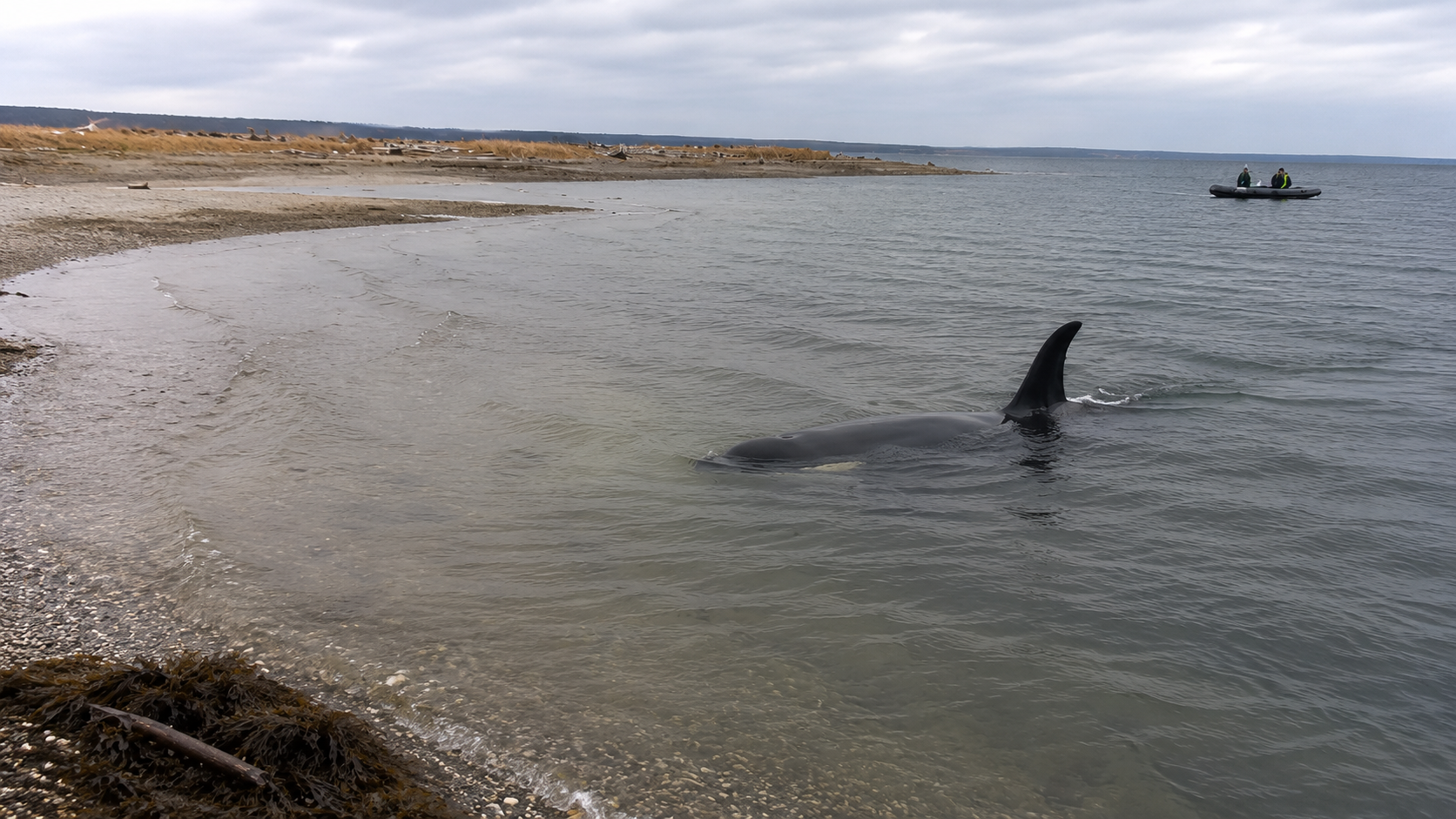
The rescue boat moved slowly away from the shallows.
Behind it, a large male orca followed under the pull of a harness. His tall dorsal fin cut through the grey water as the team guided him toward the opening of the bay.
For a moment, the plan seemed to work.
The water beneath him grew deeper. The dangerous sandbar began to fall behind, and the open Strait of Juan de Fuca lay ahead.
Then the harness loosened.
The male moved free.
Instead of continuing toward the open ocean, he changed direction and headed back toward the same shallow beach.
The rescuers watched his dorsal fin return to the place they had just pulled him away from.
It would not be the last time.
Something Was Wrong Inside Dungeness Bay
The mystery began on January 2, 2002, near Dungeness Spit on Washington’s Olympic Peninsula.
Residents looking down from the cliffs reported what appeared to be an orca lying motionless on a low sandbar inside the protected bay. When responders arrived, they discovered another whale nearby.
This second orca was alive.
He was a large male, later identified as CA188. However, he moved slowly through the shallow water and remained close to the stranded animal on the sandbar. As darkness approached, scientists and volunteers tried to guide him toward deeper water, but he stayed inside the spit.
At first, the situation looked like a difficult but understandable rescue.
One whale had died.
Another had entered dangerous water and needed help finding the way out.
Yet CA188 did not behave like an animal simply confused by the shape of the bay.
Whenever people moved him away, he returned.
The First Attempt Failed
Wildlife workers managed to tow the male toward deeper water on the first evening.
However, an unusually low tide followed. CA188 swam back toward shore and entered the shallow area again.
The next day, teams tried repeatedly to move him. Contemporary reports described him as approximately 22 feet long, weighing close to five tons and believed to be around 20 years old. Moving an animal of that size required boats, ropes, makeshift slings and careful coordination in cold tidal water.
Even then, the physical challenge was only part of the problem.
The rescuers could pull CA188 toward the mouth of the bay.
They could not make him choose the open ocean.
Several times, he escaped from the ropes or harness and turned back toward the beach. Each return carried him into water too shallow to support his weight when the tide dropped.
Why would a healthy wild orca repeatedly move toward a place where he could no longer swim?
The answer seemed to be waiting on the sandbar.
The Whale He Would Not Leave
Scientists identified the dead female as CA189. Local children later gave her the name Hope.
Researchers recognized CA188 and CA189 from their saddle patches—the pale markings behind their dorsal fins. They belonged to a group of transient orcas, now commonly called Bigg’s killer whales, that researchers had previously documented along the Pacific coast. The pair had last appeared in identification records years earlier near Coos Bay, Oregon.
At the time of the stranding, some observers believed Hope might have been CA188’s mother.
However, researchers never confirmed that exact relationship.
The two whales could have been close relatives or members of the same social group. Their history together remained incomplete because transient orcas travel across large coastal areas and may disappear from observation for years.
Still, CA188’s behaviour raised an unavoidable possibility.
Perhaps he was not failing to find the exit.
Perhaps he did not want to leave her.
A Third Orca Had Been Seen
The story became even more complicated when witnesses reported that a calf had been seen earlier with the two adults.
A Coast Guard helicopter searched the surrounding area, although later reports questioned whether the third sighting could be confirmed. No calf appeared beside CA188 during the rescue.
That left rescuers with more questions.
Had three whales entered the bay together?
Had the calf already moved away?
Was CA188 remaining near Hope because of a family bond, or had illness and disorientation caused both adults to enter the shallows?
A state research scientist suggested that the male might have been distressed by the female’s death. Nevertheless, the people at the scene could not know what CA188 understood or felt. The idea of grief remained a possibility, not a proven diagnosis.
His actions told them only one thing with certainty:
He kept going back.
The Tide Left Him Completely Exposed
As the water withdrew, the rescue became more urgent.
During two nights, the tide fell so far that CA188 ended up completely out of the water. Without the sea supporting him, the weight of his own body pressed against his organs and muscles.
Volunteers poured seawater across his skin. They covered him with wet sheets and blankets to reduce drying and protect him while they waited for enough water to attempt another move.
The team also monitored his condition and took medical samples.
Early tests did not reveal an obvious illness or serious internal injury in the male. Officials described the results as broadly consistent with a healthy killer whale, which made his repeated return toward the shore even harder to explain.
He did not appear too sick to swim.
Once the tide returned, he could move under his own power.
Nevertheless, when given the chance to head away, he repeatedly chose the shallows.
Every Rescue Created the Same Question
The teams experimented with different slings and harness arrangements.
They needed something strong enough to guide a five-ton animal but gentle enough to avoid cutting into his skin or damaging his dorsal fin and body.
Previous ropes had slipped free. Other attempts moved him only temporarily before he turned back.
By Thursday evening, the male had again stranded in a far corner of the bay, away from the narrow opening that led toward the Strait of Juan de Fuca. Rescuers stayed with him through the night, keeping him wet and trying to prevent further injury.
Each failed attempt increased the risk.
The longer CA188 remained in the bay, the more time his body spent unsupported during low tide. Exhaustion, skin damage and pressure-related injury could eventually make release impossible.
Yet forcing him out presented another danger.
A poorly positioned harness could hurt him, while a short tow might only give him another opportunity to return.
The team needed to move him far enough that the beach no longer remained the easiest direction to follow.
The Sixth Attempt
On January 4, rescuers tried again.
This time, they used a harness and a small boat to tow CA188 beyond the inner shallows and toward the Strait of Juan de Fuca.
The official account records the sixth effort as the successful one. Instead of releasing him close to the beach, the team continued until the male reached open water.
Then the line came away.
CA188 began swimming freely.
For the first time since rescuers had found him, his dorsal fin did not immediately turn back toward the sandbar.
He headed west through the strait, in the direction of the Pacific Ocean. People involved in the rescue reportedly cheered when they saw him continue along the correct route.
After days of cold water, failed harnesses and returning tides, the male had finally left the bay.
However, the mystery did not end there.
The Signal Disappeared
Before the release, rescuers attached a radio transmitter so researchers could follow CA188’s movement.
Initially, the male continued west. Reports placed him in the Strait of Juan de Fuca and described him as moving toward the open Pacific.
Then researchers lost the signal.
They could not determine whether the transmitter had malfunctioned, fallen off or moved outside receiving range. CA188 disappeared from immediate tracking, and the rescue team could no longer confirm his location.
The Port Townsend Marine Science Center later noted that researchers had not seen him again, but it warned against treating that absence as proof that he died. Transient orcas range widely and can pass years without another confirmed sighting.
Therefore, CA188’s final fate remains uncertain.
The last clear chapter ended with him swimming west.
What the Necropsy Revealed About Hope
While teams fought to save the male, scientists examined Hope’s body.
The results did not identify one simple cause of death.
Researchers found extraordinarily high concentrations of PCBs and DDT in her tissues. Those pollutants may have weakened her immune system and made her more vulnerable to disease.
The examination also found severe bone loss, a large abscess near the back of her skull and evidence of exposure to a marine Brucella bacterium. However, scientists could not prove that one of those findings alone caused her death.
That uncertainty matters.
Hope may have entered the shallows because illness had weakened or disoriented her.
CA188 may then have followed her or remained close after she died.
Alternatively, both whales may have entered the bay for another reason that observers never discovered.
The evidence supports several possibilities, but none fully explains every movement.
Was He Grieving?
It is easy to describe CA188’s repeated return as grief.
That interpretation fits the visible sequence: a male remained near a dead female, resisted efforts to leave and repeatedly returned to the same shore.
However, the scientific record cannot confirm what he felt.
Researchers did not prove that Hope was his mother. They also could not separate social distress from confusion, fatigue, environmental conditions or a possible response to the missing calf.
Calling the behaviour grief may be emotionally understandable.
Calling it certain would go beyond the evidence.
What rescuers actually witnessed was powerful enough without adding certainty:
They pulled a living orca toward safety five times.
Five times, he returned toward the beach.
The Beach He Chose Again
The most haunting part of CA188’s story happened before the final rescue.
A boat moved toward deep water.
A harness held the male gently as the dangerous shallows receded behind him.
Then the line loosened.
CA188 could have continued toward the open strait.
Instead, his dorsal fin changed direction.
He swam back toward the same sandbar where Hope lay.
No one could ask him why.
No one could prove whether he understood that she had died.
And no one knew whether he expected another whale—the reported calf—to return.
Eventually, people succeeded in guiding him out of the bay.
Yet the question that began on that cold January shore never received a final answer.
Why did the orca keep returning to a place that could kill him?
The rescuers saved his life.
But only CA188 knew what he was unwilling to leave behind.
