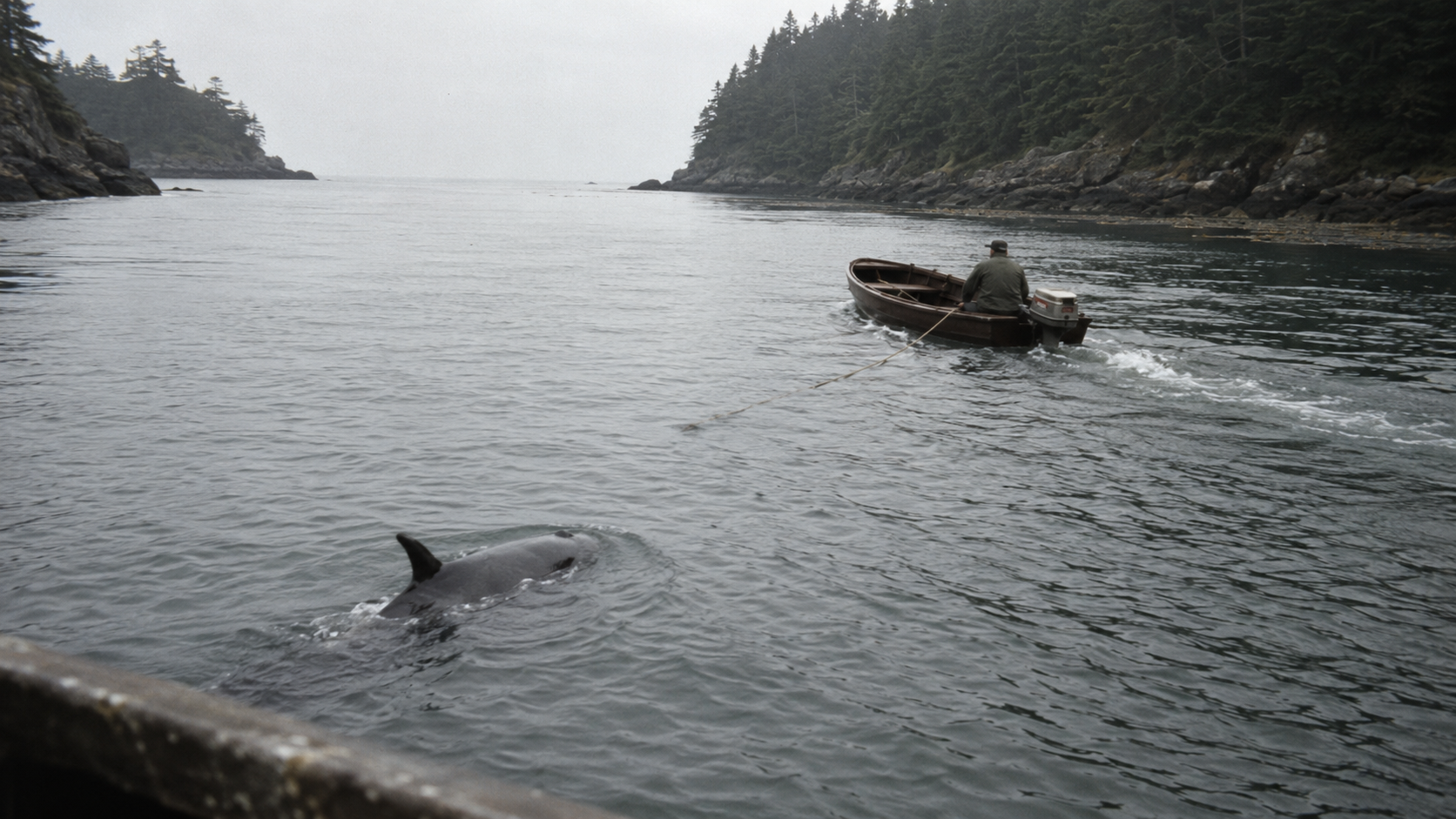
The small wooden boat moved through the cold water with an unexpected passenger behind it.
A rope stretched from the stern and disappeared beneath the surface. Farther back, a dark dorsal fin rose between the waves.
The young orca was still alive.
He surfaced low in the water, took another breath, and continued behind the boat. Meanwhile, the forested islands of British Columbia slowly passed on either side.
No transport cage protected him. No rescue team waited ahead. Instead, the rope connected the wounded animal to the same expedition that had come to kill him.
Yet the men in the boat had changed their plan.
They were now trying to reach Vancouver before the orca stopped breathing.
However, the strangest part of the story was not simply that the young whale survived.
It was why anyone had wanted his body in the first place.
A Hunt From Another Era
In the early 1960s, many people along the Pacific coast did not view orcas as intelligent family animals.
Fishermen often saw them as competition for salmon. Popular stories presented them as savage predators, while even experts knew little about their social lives, communication or behaviour.
At one point, officials placed a machine gun on Quadra Island as part of an effort to kill orcas passing through nearby waters. Although no one ultimately used it against them, its presence revealed how acceptable violence toward the species had become.
Against that background, Murray Newman, director of the Vancouver Public Aquarium, planned a new display.
The aquarium was preparing a major expansion. Its entrance hall would feature life-size models of British Columbia’s largest marine animals, including a basking shark and an orca.
However, photographs and measurements alone did not seem sufficient.
Newman wanted an anatomically accurate replica.
Therefore, he recruited a sculptor named Samuel Burich for an assignment that now sounds almost impossible to imagine.
Burich would kill a wild orca and use its body as the model for the sculpture.
Waiting on Saturna Island
Burich set up near East Point on Saturna Island, where orcas regularly passed close to shore.
Scientists, aquarium officials and fisheries personnel initially joined the project. Still, weeks went by without a suitable opportunity.
Burich waited from late May into July.
Then, on July 16, 1964, a group of roughly a dozen orcas appeared near the island.
One of them was smaller than the others.
The young whale swam close enough to the rocky point for Burich to fire the harpoon. The weapon struck the animal, but it did not kill him.
Suddenly, the expedition faced a situation it had never prepared for.
They had expected a body.
Instead, a living orca remained at the end of the line.
The Whale Would Not Die
The wounded animal continued moving in the water.
Burich and another man, Josef Bauer, remained near him while aquarium director Murray Newman travelled to the scene. By the time Newman arrived, the men had already spent hours beside the young whale.
They now faced a brutal choice.
They could complete the original plan and kill him. Alternatively, they could attempt something that few people believed possible: keep a wild orca alive and transport him to Vancouver.
Newman chose the second option.
During the night, the boat began the long journey toward the city, towing the young whale through the coastal water.
The historical accounts describe the journey, but they cannot tell us what the orca understood.
He could feel the pull of the line. He could hear the boat’s engine and the movement of water around the hull.
Behind him, the islands where his family had travelled slowly disappeared.
Ahead, the men did not know whether he would survive long enough to reach Vancouver.
A City Heard About the “Monster”
News travelled faster than the boat.
Reports described the men as bringing a dangerous living predator toward the city. At the time, the public knew orcas largely through stories of violence and fear.
However, the young whale did not behave as people expected.
He did not attack the men around him. Nor did he make aggressive attempts against those handling the line or later treating his wound.
After the boat reached Vancouver, the team placed the orca inside a flooded dry dock. Workers could then confine him, remove the harpoon and administer antibiotics.
The aquarium still had no proper facility for him.
Nevertheless, one fact had already changed everything.
The animal intended for a sculpture had arrived alive.
Twenty Thousand People Came to See Him
On July 18, two days after the capture, the aquarium opened the dry dock to the public for one day.
Approximately 20,000 people arrived.
Many had never seen a living orca. They expected the terrifying animal described in newspapers and old fishermen’s stories.
Instead, they saw a young whale swimming inside the temporary enclosure.
He did not throw himself at the people along the dock. He did not behave like an uncontrollable monster.
The public’s reaction was immediate.
The whale became a sensation.
Soon, the aquarium held a naming contest. Newman chose the name Moby Doll, partly because the staff still believed the young orca was female.
Only later did they discover that Moby Doll was a juvenile male. The mistake showed how little researchers understood about living orcas at the time.
Vancouver Had Captured a Whale It Could Not House
Public excitement did not solve the practical problem.
The aquarium had no tank large enough for Moby Doll. Therefore, about a week later, six tugboats moved the flooded dry dock to a temporary sea pen at Jericho Beach.
Workers had constructed the enclosure from the pilings of an abandoned pier at a military property.
The pen measured only a fraction of the size of a hockey rink. Moreover, the tide sometimes reduced its depth to roughly three metres.
Moby Doll now had seawater around him, but he could not leave.
He swam repeated circles inside the enclosure while crowds, journalists and scientists tried to understand him.
Then another problem emerged.
He refused to eat.
The Food Kept Floating Away
Keepers offered Moby Doll different foods, but he ignored them.
Days became weeks.
The young orca had already endured the harpoon wound, the tow to Vancouver and repeated human handling. Now he continued swimming without accepting the fish placed before him.
His refusal raised an urgent question.
Did he fail to recognize dead fish as food?
Was he too stressed to eat?
Or had the capture separated a young whale from the animals that had taught him how and where to hunt?
No one could answer with certainty.
Meanwhile, Moby Doll grew weaker.
Josef Bauer, one of the men involved in the capture, stayed to care for him. Samuel Burich also spent time beside the enclosure and played a harmonica near the water.
Moby Doll reportedly began responding to familiar whistles. Still, he would not take food.
Then, after 55 days, something changed.
The First Fish
Moby Doll finally accepted a fish.
Afterward, he began eating large quantities of lingcod and salmon—eventually as much as about 90 kilograms in a day.
His keepers could even feed him by hand.
The behaviour surprised people who had expected constant aggression from a “killer whale.” Instead, researchers observed an animal that tolerated close human contact without making hostile movements.
For scientists, Moby Doll provided an opportunity that had never existed before.
They recorded his sounds, watched his breathing, studied his swimming and documented his response to people.
Two years later, Newman and Patrick McGeer published one of the earliest detailed scientific studies based on a living orca, The Capture and Care of a Killer Whale, Orcinus orca, in British Columbia.
However, eating did not mean that Moby Doll had recovered.
The damage inside his body remained largely invisible.
The Pen Was Changing Him
The young orca continued swimming in the same restricted pattern.
Although the enclosure stood in the ocean, its conditions differed from the open channels where he had lived.
Fresh water from the Fraser River lowered the salinity around Jericho Beach. Less salty water provides less buoyancy, so Moby Doll may have needed to work harder to remain near the surface.
At the same time, the harpoon had caused more internal damage than the keepers initially understood.
From the shore, he had become a symbol of discovery.
Inside the pen, however, his body was still carrying the effects of the day he was never supposed to survive.
The Morning He Did Not Surface
On October 9, 1964, Moby Doll sank inside the enclosure.
This time, he did not rise for another breath.
He had lived for only 87 days after his capture.
A later examination found that the harpoon had caused more extensive damage than expected. Researchers also considered the low salinity, exhaustion and environmental conditions around the pen as possible contributors.
Therefore, no single simple explanation captures everything that happened to him.
Moby Doll had survived the initial strike.
He had survived the tow behind the wooden boat.
He had survived weeks without eating.
Nevertheless, his body never escaped the consequences of the capture.
The Sculpture Was Finally Completed
After Moby Doll died, Burich finished the life-size sculpture that had started the entire expedition.
The aquarium displayed it inside the entrance hall.
Visitors could now look up at a model created from the measurements and observations taken from the young whale.
Yet Moby Doll had already become far more important than the sculpture.
For 87 days, people had watched an animal they once considered a monster.
They heard his calls.
Scientists documented his behaviour.
Keepers discovered that he could respond calmly to humans.
As a result, public fear began turning into fascination.
However, that change carried a devastating consequence.
Admiration Created a New Demand
Moby Doll helped convince the public that orcas were intelligent, beautiful and capable of forming relationships with people.
At the same time, his popularity showed aquariums that a living orca could attract enormous attention.
Soon, institutions wanted captive orcas of their own.
Moby Doll’s capture helped open the era of organized removals from the waters of British Columbia and Washington. Many young whales were later separated from their families and sold to marine parks.
Thus, the whale who changed attitudes also unintentionally helped create an industry that would take many more orcas from the ocean.
His legacy remains painfully divided.
He encouraged people to respect a species they had once shot at.
Yet humans first learned that lesson by taking away his freedom.
The Image That Remains
Today, the most haunting moment may not be the crowded dry dock or the final morning at Jericho Beach.
Instead, it is the journey at the beginning.
A small boat moved through the islands.
Behind it, a rope disappeared into the cold water.
The men had gone to Saturna Island expecting to bring back a dead animal for a sculpture.
But the young orca behind the boat was still swimming.
Every few moments, his back rose through the surface.
Then he took another breath.
And the boat continued toward Vancouver.
