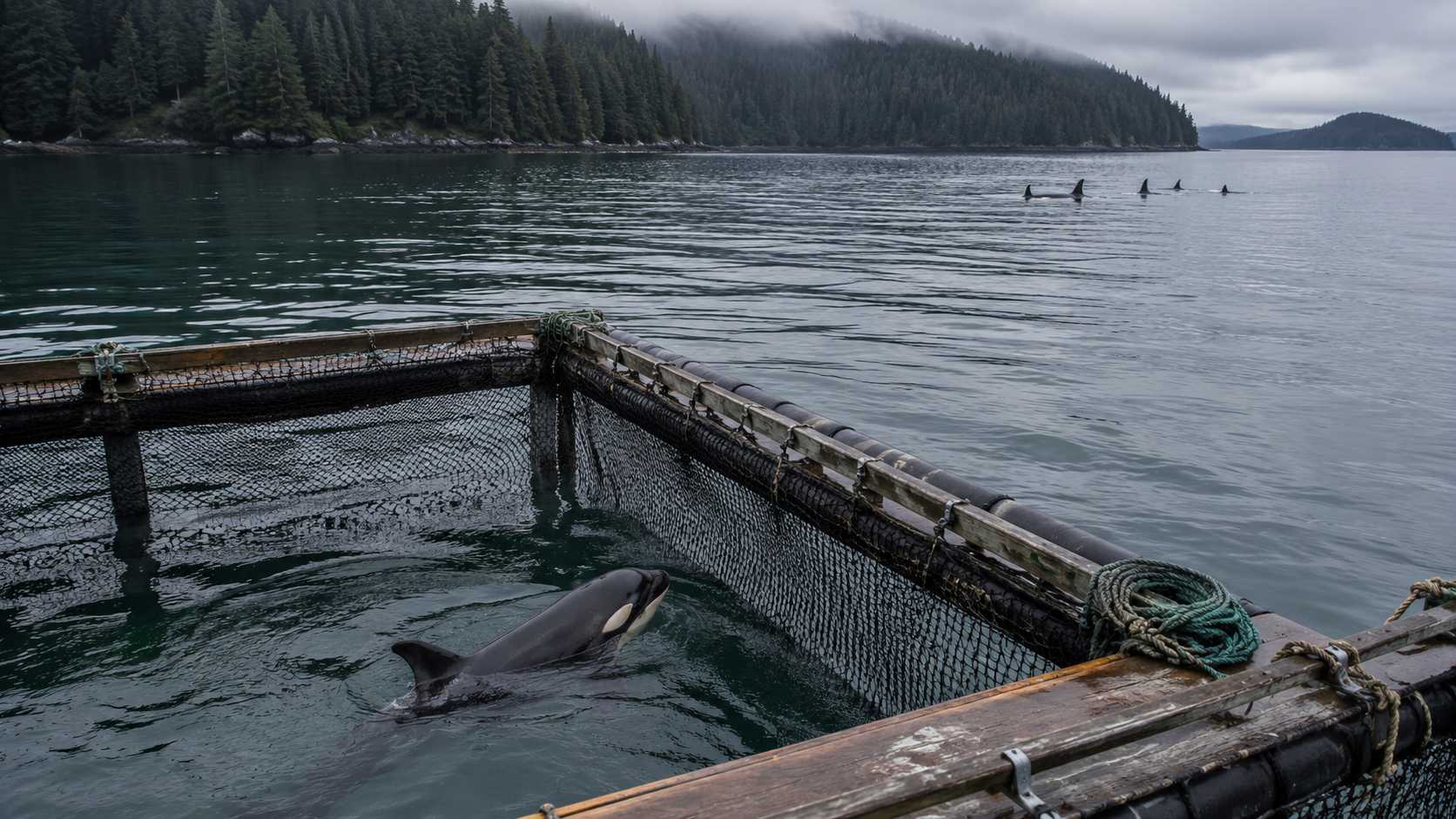
At 2:45 in the afternoon on 14 July 2002, in a small bay on the north end of Vancouver Island, someone lowered a section of net.
There was a young orca inside the pen. She had been alone for more than six months. Her family was somewhere out in the strait beyond the bay — close enough that she could hear them.
Nobody in the world knew what she would do. Nothing like this had ever been tried.
The whale nobody could identify
She turned up first in the wrong place entirely.
In November 2001, a lone orca was reported in Puget Sound, in Washington State. More sightings followed near the north end of Vashon Island, and on 14 January 2002 researchers Ken Balcomb and Mark Sears confirmed what people had been seeing: a single young killer whale, roughly two years old, with no family anywhere near her.
That is not how orcas work. They travel in tight family groups. Calves stay with their mothers, and in resident communities they usually stay for life. A lone juvenile orca in winter, in the wrong body of water, is not a rare sighting — it is close to an impossible one.
At first nobody knew who she was. Photo-identification is the standard method: every orca is identifiable from the shape of its dorsal fin, the notches along the trailing edge, and the pattern of the grey saddle patch behind it. One researcher thought he recognised her as the calf of a female he had photographed the previous summer. That turned out to be wrong.
It was sound that settled it. Resident orca families have distinct vocal dialects, learned and passed down within the matriline. Researchers recorded her calls, compared them, and got an answer.
She was A73 — a Northern Resident, from the waters between the British Columbia mainland and Vancouver Island. Roughly 500 kilometres north of where she was floating.
Her mother had almost certainly died sometime before the summer of 2001. She had been on her own ever since.
People started calling her Springer.
What was wrong with her
She was not just lost. She was failing.
Her skin was in poor condition. She was lethargic and underweight. And when a veterinary team from the Vancouver Aquarium examined her in February 2002, they noticed something that told them more than the rest of it: her breath smelled wrong.
That is a specific and serious sign. It meant she was burning through her own fat reserves — the marine equivalent of a body running on empty. She was not feeding herself adequately.
There was something else, and it was the part that made people uneasy.
She had started using boats as company.
She hung around marinas. She rubbed herself against hulls. She let people touch her nose. Observers watched her respond to hand signals — rolling over when someone gestured, over and over. One person who saw it said she behaved as though she were auditioning for a marine park. People had become her entertainment, because she had nothing else.
It was charming to watch and it was a death sentence. A young orca who seeks out propellers and boat traffic does not have a long future.
The argument
Here is the part that gets left out of the happy version of this story: almost nobody agreed on what to do.
Intervening meant capturing a wild endangered animal, holding it, treating it, and moving it hundreds of kilometres — with no precedent to draw on. If it went wrong, it would go wrong publicly, and it would set back every argument for leaving wild whales alone.
There were real technical objections. Could she carry a disease back to her family and infect a whole population? Would her family even recognise her after that long? Would she simply swim back to the boats she had grown attached to?
And there was the alternative: do nothing, and let a two-year-old starve slowly in the wrong ocean while people watched from the shore.
The debate ran for months. Meetings, proposals, disease screening, veterinary assessments, jurisdictional negotiation across an international border. Two governments, an aquarium, multiple research organisations and a public that had strong opinions in both directions.
Eventually the answer was yes.
The lift
In June 2002 she was lifted out of the water in a sling and moved into a holding pen off Manchester, Washington.
For the next few weeks she was treated and fed. Live salmon, deliberately — the point was not just calories, it was making sure she could still hunt. A whale who had forgotten how to feed herself would not survive a release no matter how healthy she looked.
She recovered fast. Faster than expected.
Then she was loaded onto a fast catamaran and taken north — 500 kilometres up the coast, back into the waters her family used.
She was put into a net pen at Dong Chong Bay, on Hanson Island, to rest after the trip. The plan was to hold her there for a while and watch her.
The plan did not survive the first day.
2:45 in the afternoon
Whales from her own community were moving through the area nearby.
She heard them. The people on the walkway watched her react — pressing toward the net, calling, agitated in a way she had not been since she arrived. Whatever the debate had been about, this part was not ambiguous.
Officials made the call on the spot. The gate went up at 2:45 that afternoon, and she swam out.
The first twenty-four hours
She did not go back to the boats.
Within less than a day, relatives came for her — her grandmother’s line, her aunts, her cousins. Two adult females took her in tow. Researchers watching from OrcaLab described clear signs of bonding and acceptance, and were careful, at the time, not to declare it a success.
They had reason to be careful. The next few weeks were the actual test.
Three weeks later
By the end of three weeks she had been recorded in the company of more than half of the 200-plus Northern Resident orcas — with 21 of her community’s 34 matrilines, and with families from all three clans.
She was not being tolerated at the edge of a group. She was being circulated through an entire society.
In August 2005 she was examined again. She was undersized, still — she had lost too much growing time. But she was behaving like an ordinary orca in every way that mattered. She swam fast. She ate well. She was no longer the smallest whale in her group.
The intervention had worked.
The one who didn’t make it
There was a second orphan in those same years, and his story is the reason Springer’s matters.
Luna was a young male, separated from his family, alone in Nootka Sound on the other side of Vancouver Island at almost exactly the same time. He did the same thing Springer had done: he went looking for company, and he found boats.
The same debate happened. It went differently. He stayed. He became a local fixture, then a local problem, then a tragedy — killed by a tugboat propeller in 2006.
Two orphans. Two arguments. One of them ended well.
Twenty years later
Here is the part worth waiting for.
On 21 July 2022 — almost exactly twenty years to the day after that net came down — Springer was photographed near Telegraph Cove, British Columbia.
She was not alone in the picture.
She had two calves with her. Spirit, born in 2013, and Storm, born in 2017. Both of them healthy. Both of them the direct result of a decision a group of arguing scientists made in 2002. In 2021, drone photography suggested she was pregnant with a third.
The whale who was found starving and rubbing herself against boats is now a mother in a population of around 300, and her children exist because someone decided to try something that had never worked before.
Springer’s reunion is the first and, more than twenty years on, still the only successful orca rehabilitation and reunion in history.
Nobody has managed it again.
Frequently asked questions
Was the video in this article real footage? No. It is a dramatised visual reconstruction created with AI, based on the documented events described above. Some real footage of Springer’s release exists in the archives of the organisations involved; the video accompanying this article is not it.
Is Springer still alive? She has been documented repeatedly with her calves, most notably in 2022 on the twentieth anniversary of her release. Northern Resident orcas are monitored closely, so sighting records are updated regularly by the research organisations listed below.
Why has it never been done again? The circumstances were unusually favourable. Her exact family was known, their location was known, she was young enough to reintegrate, and she was healthy enough to survive the process. Most stranded or orphaned orcas fail at least one of those conditions.
How do researchers know which orca is which? Dorsal fin shape, notches on the trailing edge, and the grey saddle patch behind the fin. These are individually distinctive and stable over a whale’s lifetime. Vocal dialect can identify the family group.
How far from home was she? Around 500 kilometres — roughly 300 miles — from the waters her community normally uses in summer.
Note on the video: The accompanying video is an AI-generated dramatisation, not archival footage. All events described in this article are documented; verify names, dates and identification numbers against the primary sources below before republishing.
Sources
- NOAA Fisheries — Orphan Killer Whale A73 (Springer)
- NOAA Fisheries — Springer (A73) is Back! Now a Mother of Two Calves
- Ocean Wise — Rescue of orphaned orca Springer, 20 years on
- The Whale Trail — Springer Day
- Orca Network — Whale Tales: Springer
- OrcaLab — Reintegration updates, 2002–2004
- Orcazine — The rescue of Springer (A73)
- Victoria Times Colonist — Springer, mother of two, third calf expected
