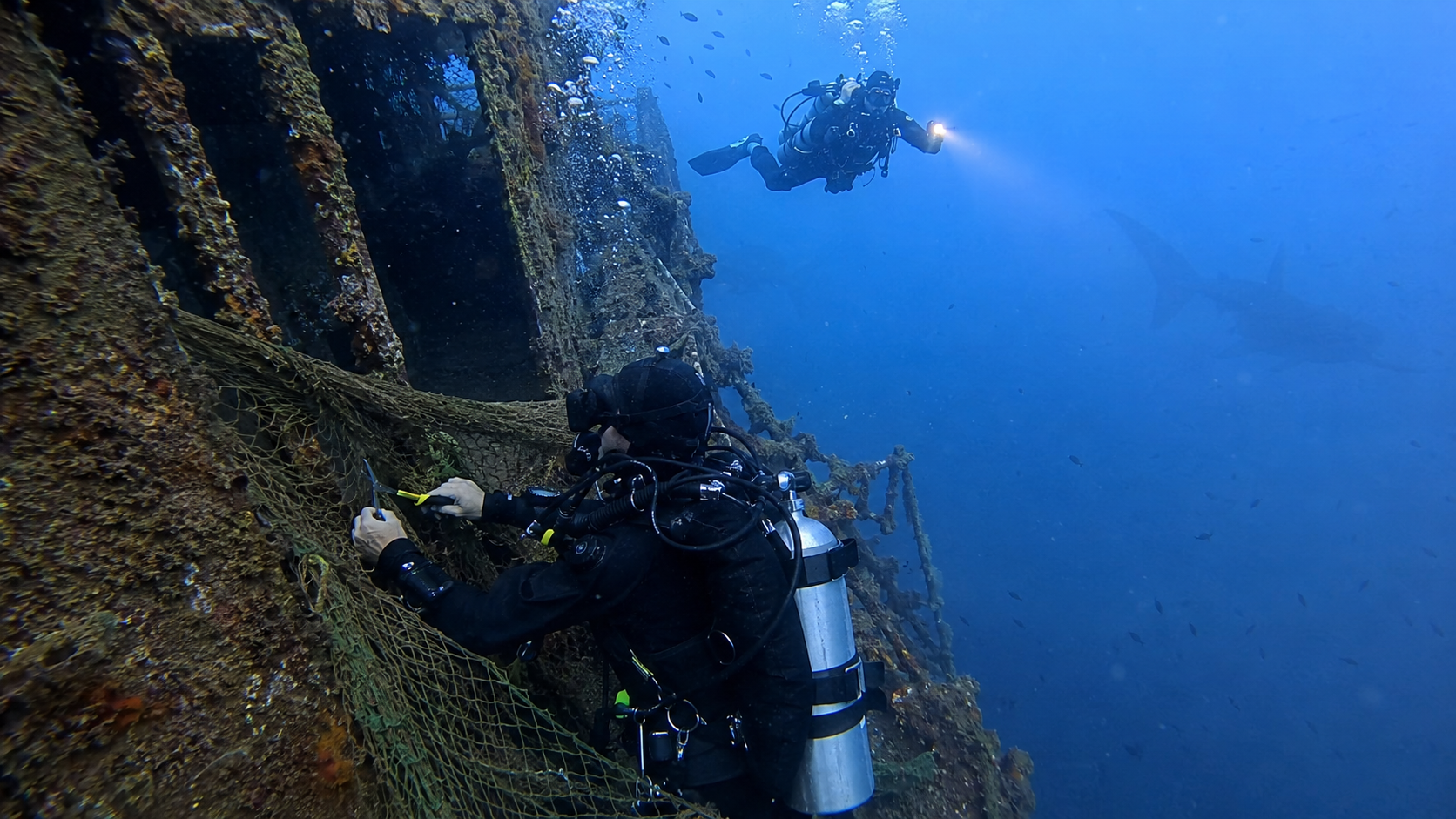
The abandoned net had settled across the shipwreck like a second skeleton.
Its lines clung to rusted metal, stretched across openings and disappeared into the dark blue water beyond the wreck.
Derk Remmers and the other technical divers had descended for a difficult but familiar reason: remove as much of the fishing gear as possible before it trapped another animal.
Far above them, the surface was no longer visible.
There was only the wreck, the net and the narrow world illuminated by their equipment.
Remmers was focused on the work when something changed beyond the ship.
A large gray shape appeared in the blue.
At first, it was too distant to identify.
It moved without urgency, passing the wreck with the slow momentum of an animal that did not need to hurry.
The divers stopped cutting.
For several seconds, the shape continued away from them.
Then it faded into the water.
The encounter appeared to be over.
But the shadow had not continued into the open sea.
Somewhere beyond their visibility, it turned around.
A Mission Far From the Coast
The encounter occurred during a high-seas conservation mission in the Strait of Sicily, the channel separating Sicily from North Africa.
The team was working roughly 50 miles offshore during May 2026, according to reporting by National Geographic. The operation was organized by the Healthy Seas Foundation with Ghost Diving and the Society for Documentation of Submerged Sites.
These were not recreational divers exploring a convenient coastal wreck.
They were trained technical divers working far below the surface, where time, breathing gas and decompression requirements limit every decision.
Their objective was to recover abandoned fishing equipment—often called ghost gear—from a submerged vessel.
A shipwreck can gradually become an artificial reef. Its beams, compartments and broken surfaces provide shelter for fish and other marine life.
But when fishing nets settle over that structure, the same wreck can become a trap.
Animals may enter the site for shelter or food and become caught in lines that continue fishing long after the people who lost them have left. Previous work at the site had documented trapped animals, including endangered loggerhead turtles and large fish.
That was the known danger when the team descended.
The unknown danger was already moving through the water nearby.
The Shape Appeared Minutes Into the Dive
Remmers had spent decades exploring wrecks and participating in underwater cleanups.
Yet only a few minutes into this descent, he saw an animal unlike anything he expected to encounter there.
The first view did not provide every answer.
Distance and suspended particles reduced the animal to a heavy silhouette. Its outline appeared and disappeared as it moved through different layers of blue water.
The divers could see that it was large.
They could see smaller fish traveling near it.
And they could see that it was passing close enough to the wreck to demand their full attention.
Remmers reached for his camera.
That simple task became unexpectedly difficult.
His fingers were shaking.
He later explained that part of his fear was not only the animal’s proximity. He was also afraid that he would fail to activate the camera before it disappeared, leaving the group with an extraordinary encounter that no one else would believe.
The shape continued past them.
For a moment, the camera seemed to have captured all that it would.
Then the animal disappeared into the opaque blue.
It Seemed to Be Leaving
Large animals can vanish underwater much faster than their size suggests.
As distance increases, color and contrast are absorbed until a clearly visible body becomes a faint outline and then nothing at all.
The divers watched the empty water.
Their bubbles rose above the wreck.
Small fish continued moving around the broken metal and hanging net.
There was no sudden charge and no violent disturbance.
The animal had simply passed through their limited field of vision.
Under different circumstances, the team might have returned immediately to the net.
But something in the surrounding water held their attention.
The smaller fish changed position.
The divers continued looking toward the point where the shadow had disappeared.
Then the blue behind the wreck darkened again.
The same animal was returning.
The Shadow Had Turned Around
The second approach changed the encounter.
During its first appearance, the animal had seemed to be traveling past the site.
Now its direction brought it back toward the wreck and the waiting divers.
It did not rush them.
Its movement remained slow and controlled, following a broad curve rather than an aggressive sprint.
Remmers later said the animal swam away, turned and came back. Other accounts described it circling the group before eventually losing interest.
From the divers’ position, however, the animal’s motivation could not be known.
It may have been investigating the unusual shapes, lights and bubbles near the wreck.
It may have been interested in activity around the abandoned net.
It may simply have altered its route while moving through an area it already used.
The footage records the animal’s movement.
It does not record what the animal was thinking.
As the shape approached again, more details emerged from the blue.
The head was broad.
The body was thick and powerful.
Gray covered the upper half, while a lighter underside became visible as it passed through clearer water.
Only then did the identity of the visitor become impossible to mistake.
It Was an Adult Great White Shark
The animal was an adult great white shark estimated at approximately 13 feet, or about four metres, in length.
It passed within roughly nine feet—less than three metres—of Remmers during the closest portion of the encounter.
The shark was accompanied by a group of striped pilot fish, small fish frequently seen traveling beside large marine animals and predators. Their presence made the animal’s scale even more striking.
The great white’s mouth was not opened in an attack.
It did not bite the net, strike the wreck or rush one of the divers.
Instead, it moved through the scene with the controlled, economical swimming typical of a large shark.
Remmers described the animal as appearing as surprised by the encounter as the divers were. That was his personal impression, not a measurable conclusion about the shark’s mental state.
The danger was still real.
A four-metre shark passing within a few metres of divers at depth deserves caution regardless of whether it shows aggression.
But the footage does not document an attack.
It documents an approach, a turn and a rare moment of close observation between humans and one of the Mediterranean’s most elusive predators.
Why the Video Became Historically Important
Great white sharks are not newcomers to the Mediterranean.
Their presence in the region has been documented for centuries through catches, historical records, surface observations and dead specimens.
What made Remmers’ footage remarkable was the form of evidence it provided.
Healthy Seas described it as what is believed to be the first underwater footage of an adult great white filmed in its natural Mediterranean habitat. Rare surface observations had occurred before, but the organization said no comparable encounter recorded by divers was previously known.
Researchers were careful not to claim that one video could answer every question about the population.
It could not reveal how many great whites remain in the Mediterranean.
It could not prove that the wreck is regularly visited by adult sharks.
And it could not, by itself, establish why this individual was present.
But it confirmed that a large adult was alive and moving through an area considered important for Mediterranean shark conservation.
Dr. Carlo Cattano of the Sicily Marine Centre explained that much of the available knowledge about Mediterranean white sharks comes from dead animals caught in fishing operations.
A living animal recorded underwater provides a different kind of information: its appearance, movement, habitat and association with the surrounding marine community can all be examined.
A Population That Is Rarely Seen
Globally, great white sharks are classified as vulnerable, while the Mediterranean population is considered critically endangered.
Exact numbers are unknown because there is no comprehensive Mediterranean-wide tagging and photo-identification system.
Live encounters are so infrequent that even confirming current distribution is difficult.
Research summarized by National Geographic indicates that Mediterranean great whites form a genetically distinct population isolated from other groups over a very long period.
That isolation may make the population especially vulnerable to fishing pressure, habitat changes and the loss of prey.
The Strait of Sicily is particularly important.
It lies along routes used by large pelagic fish, including bluefin tuna, and is considered one of the remaining strongholds for great whites in the region. Pregnant females, juveniles and adults have all been recorded across waters between Sicily, Tunisia and Libya.
It is also one of the Mediterranean’s most heavily exploited fishing areas.
That overlap places rare predators and intensive human activity in the same water.
The divers had arrived to remove one visible consequence of that conflict.
Had the Ghost Net Attracted the Shark?
One member of the diving operation suggested that the shark might have been attracted by dead marine animals caught in the abandoned fishing gear, including turtles.
That possibility was reported by Reuters, but it was not established as the confirmed reason for the shark’s arrival.
Several explanations remain possible.
The wreck itself may attract fish, which can attract larger predators.
The shark may have been traveling through the channel independently of the cleanup operation.
It may have detected struggling or dead animals near the net.
It may also have investigated the sound, movement and bubbles created by the divers.
Without tagging data or a longer sequence of observation, none of those explanations can be treated as proven.
The most accurate conclusion is also the simplest:
An adult great white entered the area while the team was working and chose to pass close enough to observe them before moving on.
The Shark Was Not the Only Threat at the Wreck
The animal’s appearance created the most dramatic images.
But the shark was not the reason the divers had entered the water.
The abandoned net remained attached to the shipwreck after the encounter.
Unlike the great white, which approached and then moved away without making contact, the net represented a continuing danger.
It could remain in place for months or years.
It could capture fish, turtles and potentially sharks without anyone present to retrieve the catch.
Healthy Seas emphasized that the mission’s purpose was still the removal of this gear and the monitoring of marine life around the wreck. The team also collected environmental DNA samples intended to improve knowledge of species using the area.
The irony was difficult to ignore.
The divers had unexpectedly found one of the Mediterranean’s rarest large animals while removing equipment capable of killing the animals that lived around it.
The encounter did not cause the team to abandon the operation.
After the shark disappeared, the divers continued with the planned work.
What Happened When It Came Close
The great white passed close to the divers, turned through the area and eventually disappeared into deeper blue water.
No diver was struck or injured.
The shark did not become entangled in the net, and the footage does not show an attempted bite or charge.
For Remmers, the encounter ended with a camera containing evidence he had feared he might fail to capture.
For researchers, it became a rare record of a living adult great white in an area where much of the species’ history has been reconstructed from catches and remains.
For the cleanup team, it was also confirmation that the wreck was not an empty piece of metal resting in deep water.
It belonged to an active ecosystem.
Fish moved through its openings.
Turtles approached its structure.
A large predator passed beside it.
And the net stretched across all of them.
The Moment the Blue Water Changed
The most powerful part of the footage is not the moment when every feature of the shark becomes visible.
It is the moment before that.
A diver is working on an old net.
Another diver looks into the water.
A shape passes behind the wreck.
Then it disappears.
For several seconds, no one knows whether the encounter has ended.
Only when the shadow returns does the ordinary cleanup mission become something that may never have been filmed there before.
The animal that turned back was not hunting the divers.
At least, the available footage provides no evidence that it was.
It was an adult great white moving through one of the last places in the Mediterranean where its population still appears to persist.
It approached closely enough to make a veteran diver’s fingers shake.
Then it slipped back into the blue without revealing where it would go next.
The divers returned to the net.
The shark returned to the open sea.
And the camera preserved a brief meeting between one of the Mediterranean’s rarest predators and the people trying to remove one of the threats from its habitat.
The first shadow had raised a question.
When it turned back, it left behind evidence far more valuable than fear:
The great whites of the Mediterranean are still there.
But no one yet knows how many encounters like this remain possible.
