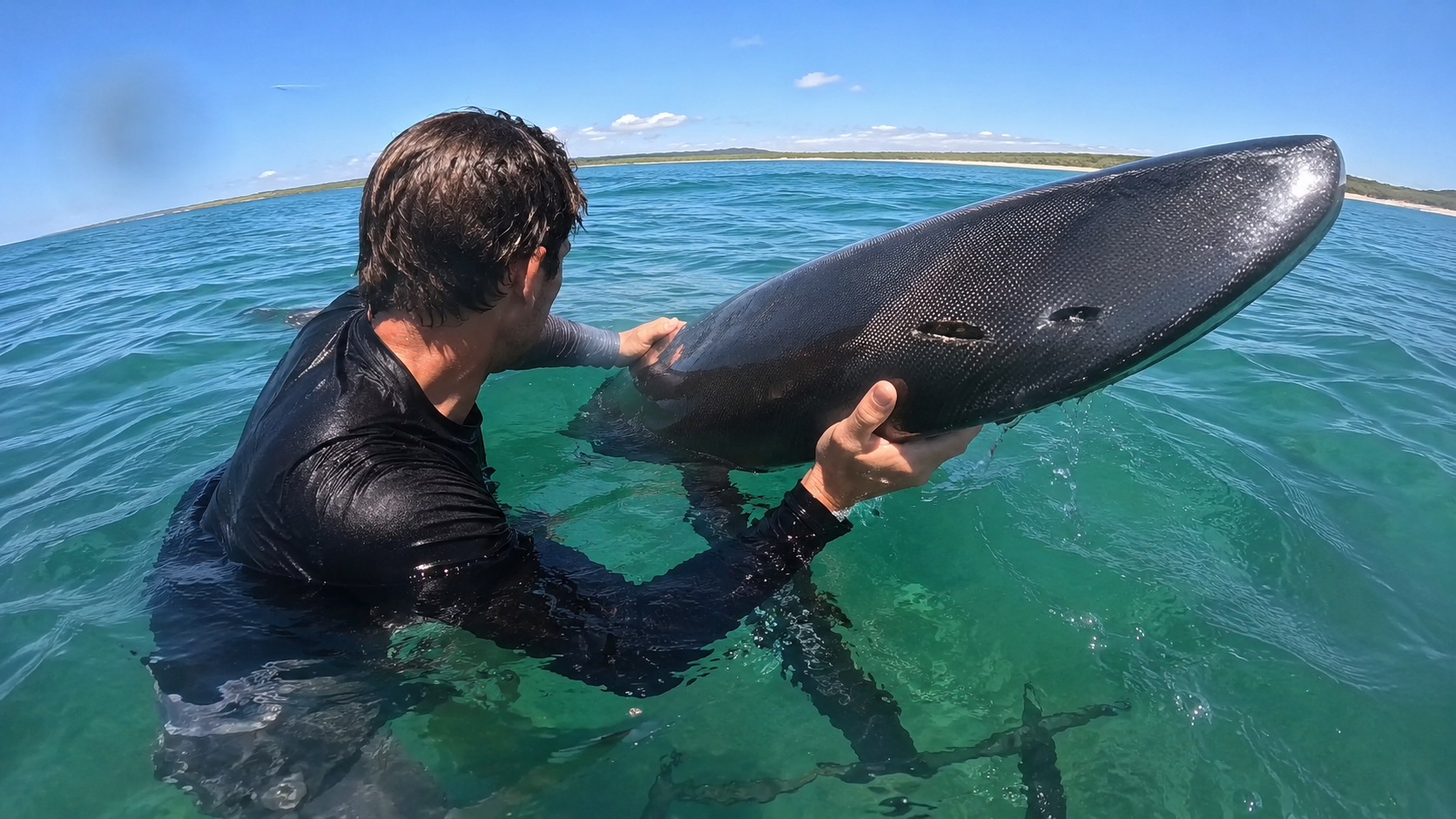
Dave Seymour was still lying flat on the board when the ocean beneath him seemed to explode.
One moment, the hydrofoil was moving normally across the water off Queensland’s coast.
The next, something struck it from the side with enough force to throw him clear.
Dave hit the water without seeing what had caused the impact.
The board continued moving without him, drifting several metres away while he surfaced and tried to understand what had just happened.
His first thought was surprisingly ordinary.
He believed he had hit a log.
But when Dave looked around, there was no wood floating beside him.
There was no broken branch.
There was no visible object of any kind.
Only open water—and the board now sitting several metres away.
A Normal Test Ride Changed in Seconds
The encounter happened on July 19, 2026, near Moore Park Beach, north of Bundaberg in Queensland, Australia.
Dave was an experienced boardrider who had spent roughly 35 years in the ocean. That morning, he was testing a friend’s motor-assisted hydrofoil board near Claude Dooley Park. Reports placed the incident at approximately 10:30 a.m.
Unlike a conventional surfboard, a hydrofoil uses a mast and wing beneath the water to lift the board above much of the surface drag.
Dave had not fully stood up.
He was still in a prone position, lying along the board and preparing to rise when the strike came from below and to one side.
There was no fin cutting through the surface beforehand.
There was no warning from another surfer.
Dave later described the impact as sudden enough to send him flying from the board.
For several seconds, he was no longer thinking about what might have hit him.
He was simply trying to regain control of his body in the water.
The Board Kept Moving Without Him
The impact did not stop the hydrofoil immediately.
With Dave’s weight removed, the board continued travelling and drifted several metres away. That created a new problem: whatever had caused the collision was somewhere in the same water Dave now had to swim through.
He lifted his head and searched the surface.
A floating log would have explained everything.
It could have struck the submerged foil, twisted the board and launched him into the water without ever touching his body.
But Dave could not find one.
As he continued scanning the area, the absence of an explanation began to feel more disturbing than the impact itself.
He later recalled experiencing an uneasy sensation while swimming around and realizing there was no log beside him.
The water looked empty.
Yet something powerful enough to knock him off the board had just passed within centimetres of his body.
There Was No Time to Stay Still
Dave had to make a decision.
He could remain where he had surfaced, searching for an object that might not exist.
Or he could swim toward the only solid platform nearby.
The board was several metres away.
He began moving toward it.
Dave later said that remaining calm became his immediate priority. In his view, panicking and splashing could have attracted more attention from whatever was nearby. That was his personal response to the situation, not proof of what the unseen animal would have done.
Each stroke brought him closer to the drifting board.
Nothing surfaced between them.
No dark fin appeared.
No second impact followed.
From above, the ocean had returned to the same calm appearance it had before Dave was thrown into it.
But when he finally reached the hydrofoil and pulled himself against its side, the mystery changed.
The board did not look the way it had moments earlier.
The First Mark Was Not Consistent With a Log
Dave began inspecting the thick carbon structure.
The damage was concentrated around the board rather than the exposed upper half of his body.
There were deep indentations in the material.
Other areas appeared punctured.
The marks were not the long, scraped lines someone might expect after sliding across a submerged branch or piece of debris.
They were separated impressions driven into the carbon surface.
Dave could now see evidence that something had not merely collided with the hydrofoil.
It appeared to have closed around it.
The empty water suddenly felt different.
The object he had been searching for had probably never been a log.
The damage pointed toward a living animal.
And the spacing and depth of the marks suggested that it had been large.
The Marks Pointed to a Shark
The punctures on the carbon board were consistent with a shark bite, according to the reporting and expert assessment that followed the incident.
Marine scientist Dr. Vincent Raoult of Griffith University reviewed the available evidence and estimated that the animal may have measured somewhere in the range of two to three metres—approximately 6.5 to 9.8 feet.
That was an estimate, not a confirmed measurement.
Dave never saw the complete animal.
There was no clear underwater video showing its body, and no species was immediately identified from the encounter.
The size estimate came from the force of the strike and the damage left on the hydrofoil.
The board had not been lightly tested or bumped.
Something had hit it at speed, bitten into the thick material and released it after throwing Dave into the water.
Reports said the bite came dangerously close to his waist while he was still lying prone.
Only the board had been between them.
Which Species Was Responsible?
Local speculation quickly focused on species known from Queensland waters, including bull and tiger sharks.
However, neither identification had been confirmed.
Guessing from bite marks alone can be unreliable, particularly when the damaged object is thick, curved and constructed from layers of carbon and internal material rather than natural tissue.
A fisheries representative was expected to swab the punctures in an attempt to recover biological material that could help identify the species through DNA analysis. At the time of the initial reports, the result of that testing had not been announced.
That uncertainty matters.
It would be easy to look at the damaged board and confidently label the animal as a bull shark, tiger shark or great white.
The available evidence did not establish any of those answers.
What it established was narrower but still remarkable:
A large shark struck and bit the board with Dave lying directly above it.
Why Would a Shark Bite a Hydrofoil?
Dave believed the incident may have been a case of mistaken identity.
That is a reasonable possibility, but it cannot be proved from the marks alone.
From below, the outline, vibration and sound of a powered hydrofoil are unlike those of a conventional surfboard.
The submerged mast and wings move through the water while the board and rider travel above them. That creates several potential signals—movement, pressure changes, mechanical vibration and silhouette—that an investigating animal could detect.
It is unclear which part attracted the shark.
It may have responded to the submerged foil.
It may have approached the moving board.
It may have made a brief investigative bite and immediately released it after encountering hard carbon rather than prey.
None of those possibilities can be presented as the animal’s confirmed motivation.
The only direct evidence of its behaviour was the strike itself, the bite damage and the absence of a second reported attempt.
Dave also raised the possibility that recent trawler activity in the area might have drawn sharks closer to shore. That was his own theory; no evidence published with the reports demonstrated a direct connection between trawling and this particular encounter.
The Board May Have Created a Crucial Barrier
Hydrofoil boards are substantially thicker than many standard surfboards.
Dave estimated that the board involved in the incident was approximately four to six inches—about 10 to 15 centimetres—thick.
He believed that depth may have created enough separation between the shark’s bite and his body to prevent a very different outcome.
That cannot be verified with certainty.
No one could reconstruct the animal’s exact angle or determine what would have happened had Dave been lying on a thinner board.
But the location of the marks showed how little space had separated him from the point of impact.
The shark’s jaws met carbon instead of his waist.
The force still launched him into the water.
The board, however, remained usable.
That became critical once Dave reached it.
He Was Still Offshore With the Animal Unseen
Finding the bite marks answered one question.
It also created a more urgent one.
Where was the shark now?
Dave had no way to know whether it had moved away after biting the board or remained beneath the area.
The surface gave him no answer.
He was uninjured, but he was still in the water and needed to return to shore.
Remaining beside the damaged board would only extend the time he spent exposed.
Dave climbed back onto it, activated the motor-assisted system and began heading toward the beach.
There was no dramatic pursuit behind him.
No fin appeared beside the board.
The shark did not return for a second visible strike.
But until the water became shallow enough for Dave to leave it, he could not know whether the encounter had truly ended.
He Reached the Beach Without a Scratch
Dave made it back to shore safely.
Despite the force of the collision and the proximity of the bite, he had not suffered a visible injury.
The damage was confined to the board.
Only after he reached land could he examine the punctures without balancing in open water.
The marks revealed how close the jaws had come.
They also preserved the only physical clues left by an animal he had never clearly seen.
Dave later described the experience as a reminder that people enter the ocean as visitors. Although he had spent decades boardriding, he said he had never previously experienced an encounter like this.
He did not use the incident to claim that every shark near Bundaberg was dangerous.
Instead, he characterized it as an unusual and isolated event.
That distinction is important.
The hydrofoil encounter was dramatic because it was rare—not because such strikes happen every time someone enters the water.
What the Ocean Never Showed Him
The most unsettling part of Dave Seymour’s encounter was not a visible fin or an open mouth.
It was the absence of both.
He did not watch a shark approach.
He did not have time to prepare or change direction.
The first evidence of its presence was the force that threw him from the board.
The second was the lack of any log in the water.
The final evidence appeared only after he swam back and inspected the carbon beneath him.
By then, the animal had disappeared.
Its species remained uncertain.
Its reason for biting the board could only be interpreted.
Even its precise size was an expert estimate rather than a direct measurement.
But the marks established one part of the story beyond the initial confusion:
Dave had not collided with a piece of floating wood.
Something living had risen from below, closed its jaws around the board and come within centimetres of the person lying on top of it.
Dave reached shore with no injury.
The board returned carrying the answer he had been searching for in the empty water.
And somewhere beneath the surface, the animal that left those marks was already gone.
