Researchers off Dominica thought they were recording unusual group behavior. What unfolded became one of the most detailed whale births ever documented.
The ocean below the research drone looked unusually crowded.
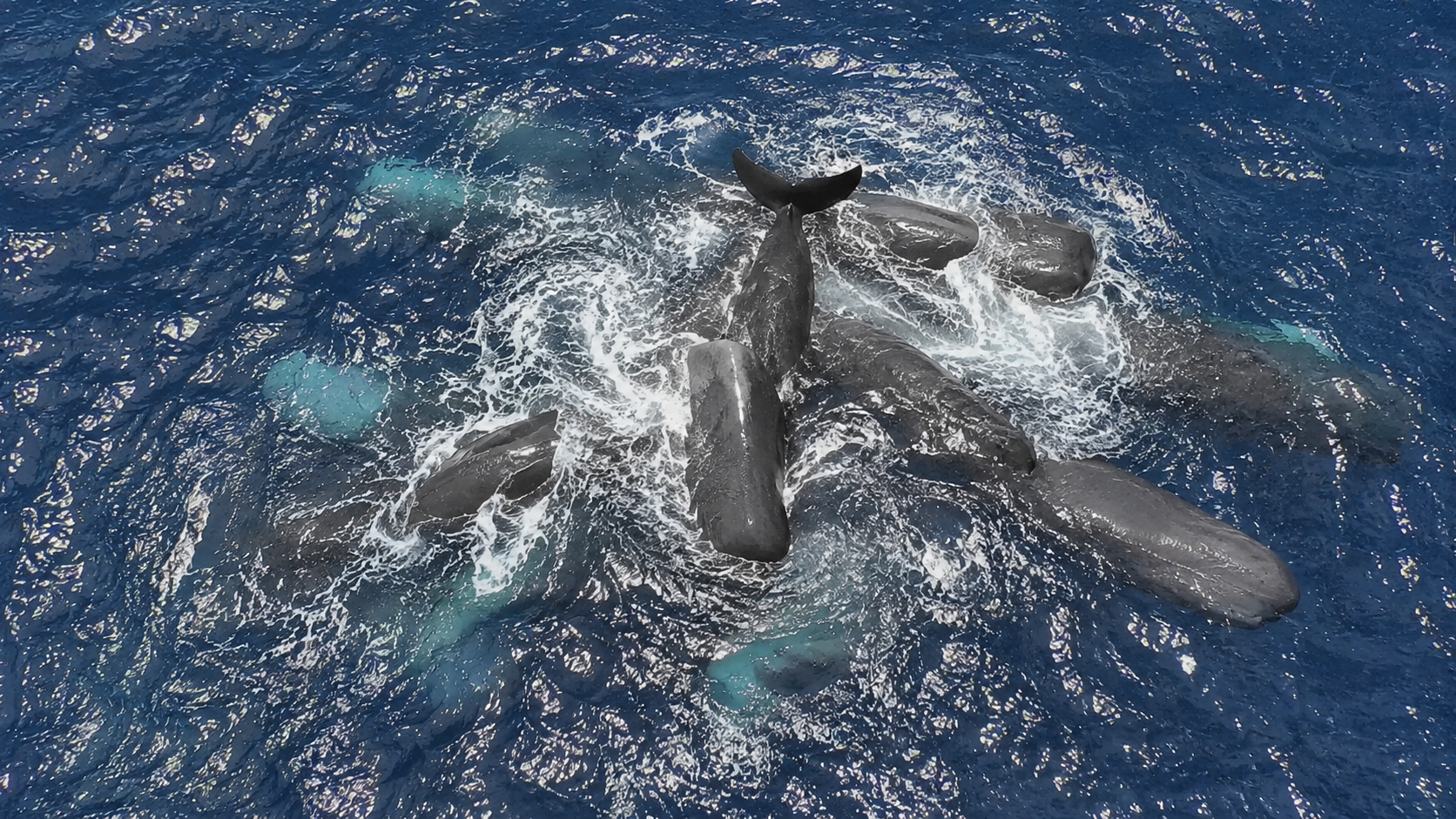
Instead of traveling in their normal formation, a group of sperm whales had gathered tightly around one adult female. Their enormous gray bodies crossed and disappeared beneath one another as white water spread across the surface.
Some whales remained beside her. Others repeatedly moved underneath her body. The group seemed focused on one small area in the middle—but from above, the reason was almost impossible to see.
Then something much smaller moved between them.
For the researchers watching from a boat off the Caribbean island of Dominica, the scene was about to become far more extraordinary than anyone first realized.
The whales were not feeding. They were not defending themselves from a predator. And the female in the center was not simply resting.
She was giving birth—and the other sperm whales were actively helping her.
Something Was Different About the Group
On July 8, 2023, researchers from Project CETI encountered 11 sperm whales belonging to a well-studied social group known as Unit A off the coast of Dominica.
The group included eight adults and three calves. At first, the research team began doing what it normally did: recording the whales’ movements, behavior and communication using aerial drones and synchronized underwater microphones.
But the whales were behaving differently.
Instead of spreading out, they gathered around one pregnant female. The researchers later identified the mother as a whale nicknamed Rounder. Her older offspring, Accra, was also among the animals present.
The whales remained unusually close to Rounder while changing positions around her. Some moved along her sides. Others disappeared beneath her. From the air, their bodies created a shifting circle around the central female.
Project CETI’s instruments captured video, underwater sound, shipboard photographs and behavioral observations before, during and after the event. In total, the researchers collected more than six hours of data surrounding the birth.
The Moment Researchers Understood
The mystery became clear when the newborn’s flukes began to appear.
According to the researchers’ detailed account, the delivery lasted approximately 34 minutes from the first emergence of the calf’s flukes until the birth was complete.
But the mother was not handling the process alone.
Every member of Unit A was present and participated in some part of the event. The adults repeatedly oriented toward the mother and newborn, while individuals moved into positions that allowed them to support the calf.
What appeared from the drone to be a chaotic mass of enormous bodies was actually coordinated assistance.
Once the calf emerged, the whales helped lift it toward and above the surface. The newborn was still weak, its fluke had not fully unfolded, and it could not yet move through the water like an experienced swimmer.
The surrounding whales took turns supporting and carrying it.
Rather than immediately swimming away after the delivery, they remained close for hours, helping the newborn stay near the surface where it could breathe.
Why a Newborn Sperm Whale May Need Help
Giving birth in the open ocean presents a challenge that land mammals never face.
A newborn whale must reach the surface almost immediately to breathe air. Yet it enters the world underwater, with little experience controlling its body and no opportunity to learn gradually.
Sperm whale pregnancies are believed to last approximately 14 to 16 months. A calf may be around four meters long at birth, but even at that size, it is still vulnerable during its first moments.
Research suggests newborn sperm whales may initially be negatively buoyant, meaning their bodies can naturally tend to sink rather than float. Their tails may also remain folded or furled immediately after delivery.
That combination could make reaching and remaining at the surface difficult.
In the Dominica birth, the other whales appeared to compensate for this problem. They positioned their bodies beneath and beside the newborn, helping raise it through the water and keeping it close to the air.
Project CETI reported that the group continued carrying the calf until its fluke unfolded and it became capable of swimming more effectively on its own.
They Were Not All Close Relatives
The most surprising discovery came later, when scientists analyzed exactly which whales helped and how their roles changed.
Unit A contains two different matrilines—family lines organized around females and their descendants. Some participants were closely related to the mother, but others were only distantly related or belonged to the other family line.
Researchers used high-resolution drone footage, computer vision and network analysis to follow the animals’ positions and interactions throughout the event.
Their analysis suggested that a female relative initially played a leading role in assisting the mother. But after the delivery, support expanded across the entire group.
Whales from both family lines oriented toward the newborn, approached it and participated in lifting it. The animals appeared to take turns rather than leaving the responsibility only to the mother or her closest relatives.
The cooperation crossed normal kinship divisions.
A study published in Science described the event as evidence that sperm whale social relationships can become especially flexible during a birth. Individuals that might normally forage or associate differently came together around the same mother and calf.
A Kind of Whale Midwifery?
Researchers are cautious about applying human labels to animal behavior. Calling the helpers “midwives” may imply intentions that science cannot directly prove.
However, the physical actions are difficult to ignore.
The whales gathered around a laboring female. They remained attentive throughout the delivery. They moved beneath the newborn and helped raise it. They continued supporting the calf after it entered the water.
In humans and some other primates, individuals may assist a mother during birth. Until this event was analyzed, comparably detailed evidence of organized birth assistance outside primates was extremely limited.
That does not mean sperm whales understand birth exactly as humans do. It does show that their social cooperation can extend to one of the most dangerous and vulnerable moments in an animal’s life.
The assistance was not a single accidental push. It was repeated, distributed across multiple individuals and maintained after delivery.
[EMBED YOUR VIDEO HERE]
The Whales’ Voices Changed Too
The researchers were not only watching the whales. Hydrophones beneath the surface were recording their clicks.
Sperm whales produce patterned sequences of clicks called codas. These vocalizations are used socially and can vary in timing and rhythm.
During the birth, the whales vocalized extensively. Scientists detected statistically significant changes in their coda style around key moments, including the beginning of the birth.
The study did not claim to translate those clicks into specific words or sentences. Researchers cannot say that one whale announced the birth or instructed another to lift the calf.
But the changes suggest that the group’s communication shifted as the event unfolded.
One coda pattern was especially frequent during the birth. That pattern is associated with the Eastern Caribbean cultural clan to which these whales belong.
The recordings therefore provide more than an emotional soundtrack. They offer scientists a rare opportunity to compare social communication with precisely documented behavior.
More Visitors Arrived After the Birth
The event did not remain limited to the sperm whale group.
Short-finned pilot whales later approached, and Fraser’s dolphins were also observed around the area. The sperm whales’ vocal behavior changed again during interactions with the pilot whales.
Researchers do not yet know exactly why the other cetaceans arrived.
They may have been attracted by unusual sounds, concentrated activity, odors or movement in the water. Their appearance added another layer to an already exceptional observation.
For the mother and newborn, however, the priority remained survival at the surface. The sperm whales continued surrounding and supporting the calf during its earliest hours.
Why Scientists Almost Never See This
Sperm whales spend much of their lives far from shore and frequently dive to great depths. Their births are unpredictable, brief and difficult to observe safely.
Wild cetacean births have been documented in fewer than 10 percent of known cetacean species. Even when researchers happen to witness one, they rarely have drones, underwater microphones, photography and identified individuals recording simultaneously.
Before the Dominica event, the previous scientific observation of a sperm whale birth commonly referenced by researchers occurred in 1986.
This made the 2023 encounter extraordinary not merely because someone saw a calf being born, but because scientists captured the social structure surrounding the delivery.
They could identify the participants, compare family relationships, map their movements and connect their behavior with changing vocal patterns.
The result became what researchers described as the most detailed observation of a wild cetacean birth to date.
What This Reveals About Sperm Whale Society
Scientists already knew that female sperm whales live in stable social units and collectively care for young.
Mothers must make deep feeding dives, while small calves remain closer to the surface. Other females may remain with the young, providing protection and supervision. In some groups, females have even been documented nursing calves that are not their own.
The Dominica birth suggests that collective care can begin before a calf has taken its first independent swim.
It also shows that the mother’s support network may extend beyond her closest relatives.
The newborn entered not only a relationship with its mother, but an entire whale society prepared to keep it above water.
That may be one reason sperm whales developed such durable social groups. In an environment where a newborn can sink before it learns to swim, cooperation is not simply companionship.
It can be the difference between reaching the surface and disappearing beneath it.
The Small Shape in the Middle
From above, the event initially looked confusing.
Huge bodies pressed together. White water hid the center. Whales repeatedly moved beneath one another, making it difficult to understand where one animal ended and another began.
But the confusion was part of the answer.
The whales were closing every open space around the mother and newborn. Some remained beside them. Others provided support from below. Together, they created a living platform in an ocean with no solid ground.
The tiny movement between those enormous bodies was a newborn sperm whale experiencing its first moments in the world.
And before it could swim on its own, an entire group was already carrying it toward its first breath.
