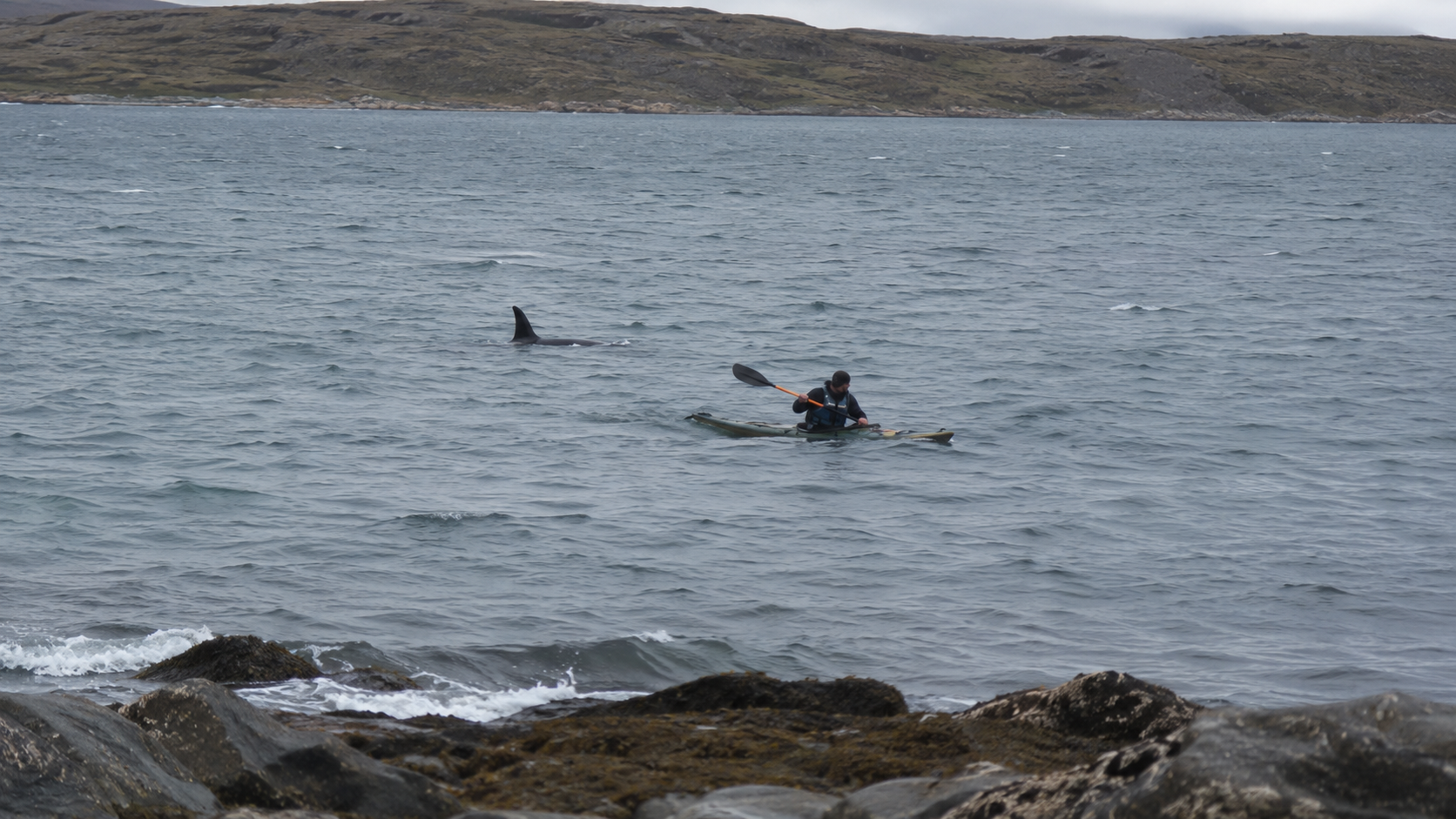
Boris Ibáñez had been fishing alone for some time when a dark shape broke the surface behind his kayak.
It was only a fin.
From that distance, there was no clear head, no visible mouth and no complete body that would tell him exactly what kind of animal had entered the bay.
The water near Bahía Rosas looked calm. People were watching from the Patagonian shoreline, and the small kayak was still within sight of land.
But Boris was far enough from the beach to understand one thing immediately:
If the animal decided to come closer, he could not reach safety quickly.
He stopped paddling and looked over his shoulder.
The black fin remained on the surface.
Then he turned the kayak toward shore.
Moments later, the fin turned too.
The Animal Entered the Same Line
The encounter unfolded on May 25, 2026, in Bahía Rosas—also known as La Ensenada—on the Gulf of San Matías in Argentina’s Río Negro Province. Boris was fishing from a kayak roughly 100 metres from shore when he noticed the animal in the surrounding water.
At first, its presence did not automatically mean danger.
Large marine animals frequently pass through the region, especially during the colder months. From a kayak, however, judging distance and intention is difficult. A fin moving parallel to the coast may simply be traveling through the bay.
Boris watched it long enough to become uncomfortable.
He began rotating his kayak toward land.
Turning a kayak requires several strokes, and each paddle blade makes a distinct splash as it enters and leaves the water. Boris had barely established his new direction when he looked back again.
The animal was no longer following its original route.
It appeared to be moving into the same line as the kayak.
What had begun as a distant sighting now looked like an approach.
He Began Paddling Harder
People on shore had a wider view than Boris did.
They could see the kayak, the open water behind it and the dark fin gradually reducing the distance between them. One witness, Mili Yahuar, recorded the encounter from land, preserving the changing positions of the animal and the small vessel.
Boris increased his paddling speed.
His strokes were no longer the steady movements of someone fishing. He was trying to reach shallow water while repeatedly turning his head to locate the fin.
Each time he looked back, the animal appeared to be closer.
The kayak moved forward in short bursts. The fin continued behind it.
Boris later described shouting toward the animal, hoping the sound of his voice would distinguish him from something it might normally pursue. He wanted whatever was behind him to understand that he was a person—not food.
But there was no visible reaction.
The fin remained behind the kayak.
Then it disappeared.
The Fin Was Gone—but the Animal Was Not
A dorsal fin provides a frightening kind of reassurance.
As long as it remains visible, the person being followed can estimate the animal’s direction and distance.
When it vanishes, all that information disappears with it.
Boris could no longer see where the animal had gone.
It might have turned away.
It might have slowed down.
Or it might have continued beneath the surface, where the kayak’s low position prevented him from seeing it.
He kept paddling toward shore.
Behind him, the water showed only small waves and reflections. There was no dramatic splash and no clear underwater body. The animal had simply slipped out of view.
For the people watching from land, the silence in the water may have been even more alarming than the visible fin.
The kayak continued toward shallower water.
Then a dark shape returned near its path.
The Black Fin Belonged to Pao
Only after specialists examined the footage was the animal publicly identified.
It was an adult male orca known as Pao, catalogued by researchers as PTN-006 and monitored as part of the northern Patagonian orca population. His identity could be recognized through characteristics recorded by researchers who follow individual animals in the region.
That identification explained the fin’s height and the large body moving beneath it.
It did not explain why Pao had changed direction toward the kayak.
The first reports offered a disturbing possibility.
Researchers suggested that the sound and movement of Boris’s paddle could have resembled the splashing produced by a sea lion—one of the animals hunted by orcas along the Patagonian coast. Under that interpretation, Pao may initially have approached an unfamiliar sound before discovering that its source was a human in a kayak.
That explanation spread rapidly.
But it was not the only interpretation.
Did the Paddle Sound Like Prey?
Orcas are highly acoustic animals.
They use sound to communicate, maintain contact and understand activity around them. A repetitive paddle entering the water can travel much farther below the surface than it appears to travel above it.
In northern Patagonia, orcas are famous for hunting sea lions close to shore. Some have learned a specialized technique known as intentional stranding, in which they drive themselves partly onto the beach to capture young sea lions before maneuvering back into deeper water. The behavior is learned socially and has been documented in the region for decades.
The possibility that Pao heard the paddling and investigated it was therefore biologically plausible.
But plausible does not mean proven.
The video could record his route.
It could not record what attracted his attention or what he expected to find when he approached.
Boris’s fear was real, but fear alone could not determine the animal’s intention.
Then researchers received more information about what had happened before the final moments shown in the most widely shared footage.
That additional context complicated the original explanation.
A Later Clarification Changed the Story
A later account reported that Boris had been moving farther out when he first noticed Pao approaching. Boris then turned toward shore, and the orca followed him into shallow water.
Once Boris had reached the shoreline, Pao turned and returned toward deeper water without making physical contact. Based on that fuller sequence, observers familiar with the regional animals suggested the encounter may have reflected an attempt to interact rather than a failed hunting approach.
Patagonian orcas have previously shown curiosity toward people standing near shore and toward small vessels.
An investigative approach can look frightening from the human side, particularly when the animal is a large adult male and the person is sitting only centimetres above the water.
Curiosity also does not make an encounter safe.
An orca does not need to attack a kayak to overturn it accidentally. A gentle bump, close turn or movement beneath the hull could place the paddler in the water.
That is why the two explanations should not be treated as certainty.
Pao may have investigated the paddle sounds.
He may have been curious about Boris and the kayak.
His behavior may have included elements of both.
The footage does not prove that he mistook Boris for prey, and it does not prove that he was attempting to play.
The Distance Closed Near the Beach
As Boris approached shallow water, the dark body came within only a few metres of the kayak.
Local reporting placed Pao approximately two or three metres away during the closest part of the encounter. From shore, the scale difference was unmistakable: the narrow kayak remained directly beside an animal capable of moving through the water with enormous power and almost no visible effort.
Boris continued paddling and shouting.
He did not attempt to approach Pao, touch him or turn the kayak around for a better view.
His only priority was the beach.
The water beneath the kayak became shallower. Boris closed the final distance toward shore while witnesses continued filming.
Pao remained close enough to be visible.
Then the kayak reached the edge of the water.
What Pao Did at the Shore
Pao did not strike the kayak.
He did not bite it, overturn it or pull Boris into deeper water.
Once Boris reached shore, the orca turned away and moved back toward the open bay. Boris emerged unharmed, and no physical contact between the animal and the kayak was reported.
Officials in Río Negro responded to the viral footage by reminding the public that there are no documented attacks by wild orcas on humans in the region. They nevertheless urged people to respect the animals’ space and follow precautions around marine wildlife.
That ending does not mean Boris had overreacted.
From his position, he could not know that Pao would stop.
He could see only the fin, the decreasing distance and the moments when the animal vanished beneath the surface.
The safest interpretation available to him was that he needed to leave the water.
Was It a Chase?
The word chase describes what the footage felt like from Boris’s perspective.
He turned toward shore.
Pao changed direction.
Boris paddled faster.
The orca continued behind him.
Yet describing the encounter as an attempted attack would go beyond the available evidence.
Pao never made contact. There was no visible strike, bite or attempt to overturn the kayak. The animal followed the small vessel into shallow water and then returned to deeper water.
The incident sits in the uncertain space between pursuit and investigation.
The paddle may have attracted Pao.
The kayak may have become an object of curiosity.
Or the animal may have been responding to several signals that people watching the video could not detect.
The only mind capable of resolving that mystery belonged to the orca.
The Most Frightening Moment Was When Nothing Was Visible
The image people remember is the tall black fin behind the kayak.
For Boris, the more frightening moment may have been when that fin disappeared.
As long as Pao remained at the surface, Boris knew where he was.
Once the orca submerged, the entire bay became a field of uncertainty. The animal could have been behind the kayak, beside it or directly beneath the hull.
Boris continued toward shore without that information.
Only later could the footage be studied, the animal identified and the competing explanations discussed.
During the encounter, there was no time for analysis.
There was only a man in a small kayak, a beach that still seemed too far away and a black fin that had turned when he did.
Boris reached the shore safely.
Pao returned to the deeper waters of the Gulf of San Matías.
But the central question followed the video long after both had separated:
Had an apex predator mistaken the rhythm of a paddle for prey—or had one of Patagonia’s best-known orcas simply decided to investigate the stranger moving through his bay?
The camera recorded how close he came.
It could never record why.
