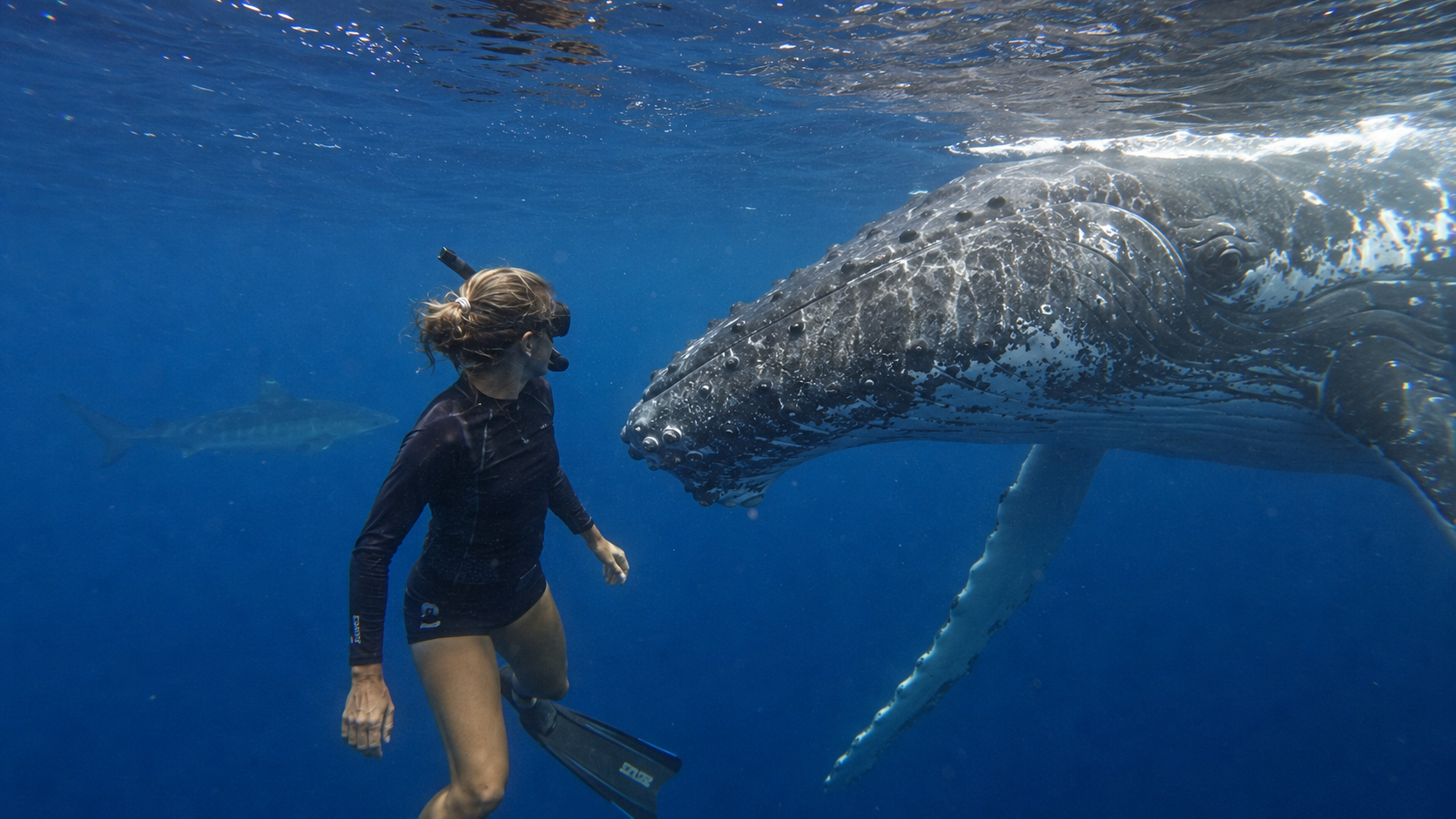
Nan Hauser had spent nearly three decades studying whales.
She knew how quickly a calm encounter could change. She understood the danger of swimming beside an animal powerful enough to move tens of tons of body weight with a single turn.
But nothing in her years of research had prepared her for the humpback whale that moved directly toward her in the waters of the Cook Islands.
At first, Hauser tried to remain calm.
The whale was enormous, but it did not appear to be attacking. Its mouth remained closed. Its movements were controlled. Yet instead of passing her and continuing through the open water, the animal came closer.
Then it nudged her.
Hauser attempted to create distance.
The whale followed.
When she changed direction, the animal repositioned its massive head and body in front of her again.
It was not allowing her to swim away.
The Whale Kept Closing Every Route
Hauser was in the South Pacific filming whales when the unusual encounter began. She and another diver had cameras with them, allowing parts of the event to be recorded from more than one perspective. The interaction continued for approximately ten minutes.
For someone watching the footage from a safe distance, the whale’s movements can appear gentle.
For Hauser, they were frightening.
A slight miscalculation by an animal of that size could break bones, knock her unconscious or push her farther beneath the surface. She later said she had believed she might lose her life and feared the whale could strike her hard enough to cause serious injury.
She tried to move away from the animal’s head.
The whale shifted with her.
She attempted to swim toward a different opening.
Its body blocked that direction.
Then the humpback began using its long pectoral fin.
Instead of striking Hauser, the whale appeared to draw her beneath or beside the enormous fin, keeping her within the space immediately around its body. At other moments, it pushed her forward with its closed mouth and lifted her toward the surface with its head or back.
Hauser could not understand why.
The animal was not behaving like a whale that simply wanted to investigate a diver and continue swimming. Each time she attempted to separate herself, it moved back into her path.
It appeared determined to keep her close.
She Could Not Tell Whether It Was Helping or Hurting
Hauser had studied humpback whales long enough to know that interpreting their intentions from one movement can be dangerous.
A whale does not need to behave aggressively to injure a person.
Its pectoral fin alone is far larger and heavier than a human body. Barnacles and rough skin can cause cuts and bruising. A sudden roll could trap a swimmer beneath the surface.
Hauser therefore did not assume the animal was being affectionate.
She kept trying to protect her head and body while remaining calm enough not to provoke a more forceful reaction.
The whale continued nudging her.
At one point, it appeared to place her on or near the front of its head and lift her partly out of the water. At another, it brought its pectoral fin around her as though closing a barrier between Hauser and the surrounding ocean.
The animal’s attention also seemed divided.
It repeatedly stayed close to Hauser, but its position suggested it was responding to something beyond her.
A second humpback was visible farther away. That whale was behaving differently, remaining behind the first animal and reportedly making forceful tail movements.
Hauser still did not know what the whales were reacting to.
She only knew that the closest one refused to let her move freely into the open water.
Then She Noticed Another Shape
Through the blue water, Hauser saw what initially appeared to be another whale moving in the distance.
The shape was large.
But something about its movement was wrong.
Whales drive themselves through the water by moving their tails primarily up and down. The distant animal was moving its tail from side to side.
As it came into better view, Hauser realized it was not another whale.
She identified the animal as an enormous tiger shark.
Only then did the humpback’s strange behavior begin to make sense.
The whale had repeatedly placed its body between Hauser and the direction from which the shark was moving. It had pushed her away whenever she tried to swim into more open water. Its long pectoral fin had covered or enclosed her while the other whale remained farther out.
The animal Hauser had feared might injure her may have been the reason the shark never reached her.
But she was not yet safe.
She still had to reach the boat.
The Whale Continued Moving Her Toward the Surface
After recognizing the shark, Hauser no longer viewed the whale’s actions as random interference.
She believed the humpback had detected the predator before she did and had been attempting to move her away from it.
The whale continued nudging and lifting her while remaining close enough to block much of the surrounding water.
Hauser eventually managed to move toward her boat.
By the time she climbed from the ocean, she had suffered bruises and scratches, some caused by contact with the barnacles and rough surface of the whale. She was otherwise unharmed.
The encounter did not end the moment she reached the boat.
The humpback surfaced again nearby.
Reports placed the whale roughly 20 feet from the vessel, as though it had followed long enough to confirm that Hauser was out of the water. Hauser interpreted the whale’s return as another indication that the animal had been monitoring her rather than merely pushing her accidentally.
The shark did not attack her.
The whale did not remain indefinitely.
But the pattern of movement left Hauser convinced that she had just experienced something she had never previously documented during decades of whale research.
She believed the humpback had protected her.
Can Anyone Prove the Whale Intended to Save Her?
The footage shows the whale repeatedly nudging Hauser, placing its body near her and bringing its pectoral fin around her.
It also supports Hauser’s report that a large shark was in the area.
What the camera cannot record is the whale’s intention.
Hauser has acknowledged that limitation. She experienced the encounter at close range and believes the whale deliberately moved her away from danger, but she has also recognized that no person can know exactly what the animal was thinking.
Several marine researchers responded cautiously.
Humpback researcher Jim Darling said he did not see definitive evidence of protection in the available footage, although he did not reject Hauser’s account. He noted that humpbacks sometimes make friendly or persistent contact with boats and divers, and that more information would be required to determine whether the shark caused the whale’s behavior.
Marine biologist James Sulikowski was also unconvinced that the shark intended to attack or that the whale had necessarily saved Hauser’s life. The shark may simply have been moving through the area, and the motivations of both animals remain impossible to confirm.
Another possibility is that the whale’s protective behavior was instinctive rather than a carefully understood rescue.
A researcher interviewed by National Geographic suggested that hormonal or maternal responses could potentially lead a whale to protect another animal, especially if it had recently lost a calf. That explanation was speculative, but it illustrated why the same footage can support several interpretations.
Humpbacks Have Intervened in Other Attacks
Hauser’s interpretation did not emerge without biological context.
Humpback whales have repeatedly been observed interfering when killer whales attack other animals.
A scientific review examined 115 recorded interactions spanning more than six decades. Humpbacks often intervened when orcas attacked humpback calves, but some incidents involved entirely different species, including seals and sea lions. The researchers could not rule out the possibility of interspecies altruism, even when helping the other animal did not provide an obvious benefit to the whale.
There are several possible explanations.
Humpbacks may react automatically to the sounds of an attack.
Adults that survived orca attacks earlier in life may respond whenever they recognize similar behavior.
They may initially intervene without knowing which species is being pursued and continue after discovering that the victim is not another humpback.
Or, in rare circumstances, they may recognize that another animal is vulnerable and deliberately choose to help.
None of those possibilities proves what happened around Hauser.
They do show that a humpback placing itself between a predator and another species would not be completely without precedent.
The Shark Was Not Proven to Be Attacking
The tiger shark should not be reduced to a villain in the story.
Hauser saw a very large animal moving nearby and believed it represented an immediate threat. From her position in the water, that concern was understandable.
But the available footage does not establish that the shark was preparing to attack.
It did not bite Hauser, and there is no recorded physical contact between the shark and either whale. The shark may have been investigating the activity, traveling through the same area or approaching out of curiosity.
That uncertainty is important.
Saying the humpback definitely prevented a fatal attack would go beyond what the evidence can demonstrate.
The more accurate conclusion is that Hauser was in the water with a large tiger shark nearby, while a humpback repeatedly pushed her away from the surrounding open ocean and kept its body close to hers.
The whale’s behavior may have protected her regardless of whether the shark had already decided to attack.
Why the Encounter Still Matters
The mystery does not weaken the story.
It is the reason the encounter remains so compelling.
If the whale had merely passed beside Hauser, there would be little to debate.
Instead, it repeatedly changed position when she attempted to leave. It nudged her with its head, drew her beneath its fin and lifted her toward the surface. It remained near the boat after she climbed out.
Those actions created a pattern.
Hauser experienced that pattern while a large shark was nearby, and she came away believing the whale had recognized a danger that she could not yet see.
Scientists can debate whether the behavior was deliberate altruism, protective instinct, curiosity or coincidence.
The camera cannot settle the question.
It can only show a woman trying to swim away—and a humpback whale refusing to let her go.
The Moment She Finally Understood
During the encounter, Hauser feared the whale more than anything else around her.
It was the animal touching her.
It was the animal blocking her path.
It was the animal powerful enough to injure her with one movement.
Only after she saw the tiger shark did those same actions take on a different meaning.
The whale may not have been trapping her.
It may have been keeping her inside the only safe space available: the narrow area beside its enormous body.
Hauser reached the boat bruised and scratched, but alive.
The shark remained at a distance.
The humpback surfaced nearby one final time.
Whether the whale consciously decided to save a human can never be known with certainty.
But Hauser knows what she experienced.
Each time she tried to swim away, the whale pushed her back.
And when she finally saw what was moving beyond its fin, she understood why.
