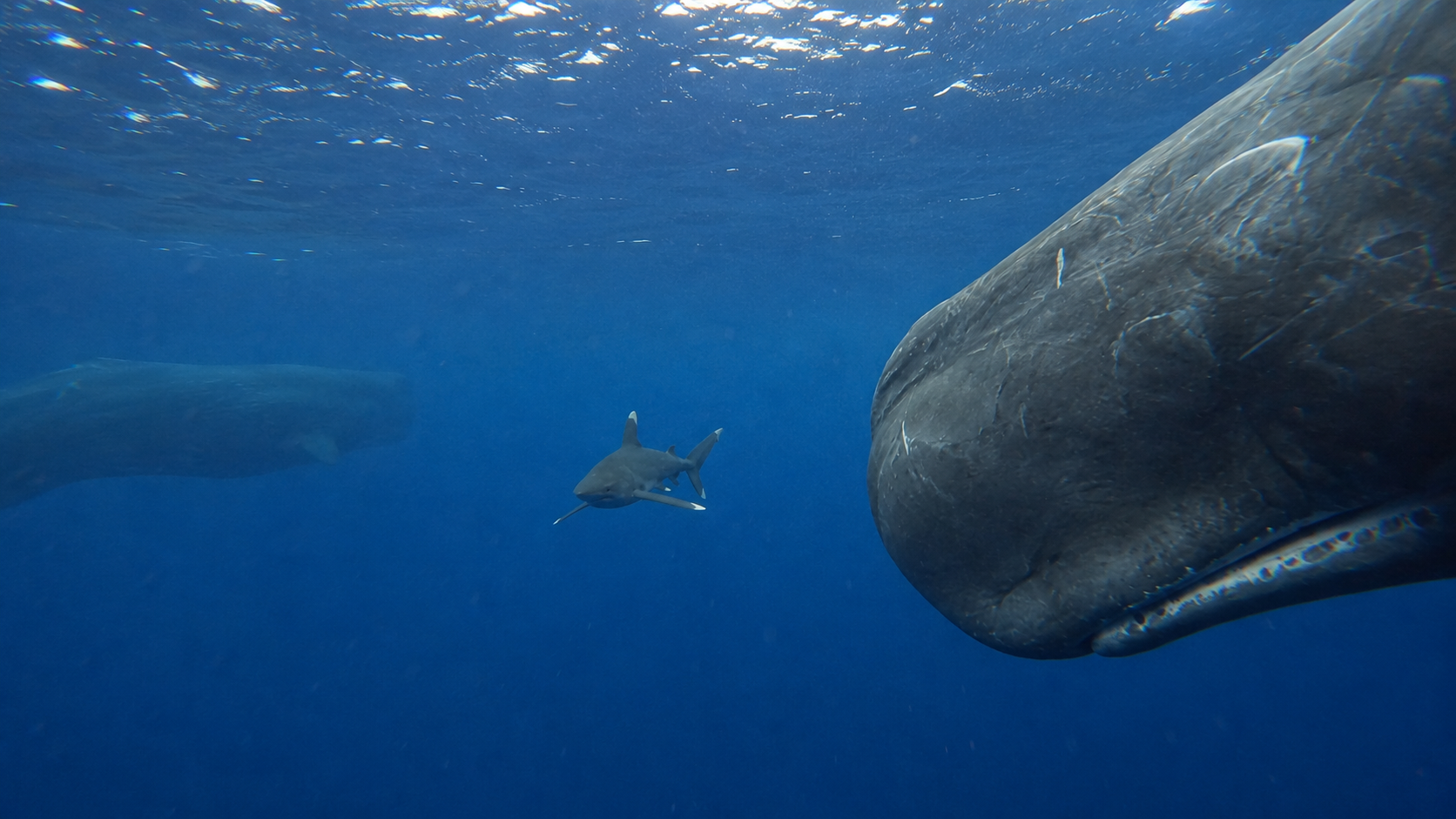
There was no cage between Benoît Girodeau and the open ocean. No reef wall to retreat toward. Only deep blue water, a camera in his hands, and three enormous animals moving through the same space.
The encounter unfolded off Mauritius, where Girodeau—a divemaster also known as musician Natty Gong—was filming sperm whales when an oceanic whitetip shark began approaching. Because the footage is recorded from his perspective, the diver never appears on screen. The viewer is effectively looking through his eyes.
At first, the shark is only a dark shape in the middle distance. Its broad, rounded fins and pale tips identify it as an oceanic whitetip, a species adapted to life far from shore.
It does not charge like a movie monster. It moves steadily through the blue, gradually closing the distance.
Then the right side of the frame fills with the massive, scarred head of a sperm whale.
The whale is so close that only part of its body fits inside the image. It glides directly across the shark’s route, placing its enormous body between the approaching animal and the unseen diver.
What followed was not a single dramatic collision. It was a strange sequence of blocking, following, turning and repositioning that left Girodeau convinced the whales were guarding him.
The First Whale Crossed the Shark’s Path
According to Girodeau, the shark made what he considered an aggressive approach, but a sperm whale immediately blocked it. The whale then followed the shark with its mouth open before turning back toward the diver. The footage clearly shows the shark approaching, the whale entering its path and the larger animal following when the shark changes direction.
That movement is what makes the video so compelling.
The whale does not merely pass through the background. Its position changes the entire encounter.
The shark is moving along one line toward the camera. The whale crosses that line. When the shark turns away, the whale goes with it.
An oceanic whitetip is itself a large open-ocean predator, recognizable by its stocky body and long, paddle-shaped pectoral fins. NOAA says the species can reach approximately 11 feet in length. Yet beside an adult sperm whale, the shark suddenly appears surprisingly small.
The whale’s size does not remove the danger. It makes the scene even stranger.
Girodeau was now floating in the moving space between a shark and one of the largest toothed predators on Earth.
Then Another Whale Took Over
The encounter did not end when the shark first moved away.
Girodeau said a young female sperm whale continued keeping the shark at a distance. In his narration, she increased speed, rolled partly upside down and positioned herself beneath the shark.
He believed the whale was trying to keep the shark near the surface and prevent it from returning toward him. He also said she moved beneath the shark and appeared to nip or bite at its tail—his interpretation of what he witnessed during the encounter.
But the shark did not disappear.
After moving away, it began circling back.
That return transformed the footage from a brief meeting between animals into something far more mysterious. The first whale crossing the shark’s route could possibly have been coincidence. But when the shark attempted to return, another sperm whale appeared between it and the diver.
Girodeau described himself as “well guarded” and said the other whale returned so the two whales were positioned around him. Discover Wildlife described the scene as sperm whales getting between the divemaster and an inquisitive oceanic whitetip.
Girodeau eventually returned safely. The shark did not bite him, and the footage does not show it making physical contact with his body.
The remarkable part of the story is therefore not a shark attack. It is the way the whales repeatedly altered their positions while the shark remained nearby.
Were the Whales Really Protecting Him?
That is the question at the center of the encounter.
The honest answer is that nobody can prove the whales’ intentions from the footage alone.
Girodeau experienced the event at close range and interpreted the animals’ behavior as protection. The movements he recorded certainly support that possibility: one whale crossed the shark’s route and followed it away, while another later occupied the space between the shark and the diver.
But an animal’s position does not automatically reveal what it was thinking.
The whales may have considered the shark a disturbance or possible threat to their own group. They may have been asserting control over the space around them. They may also have recognized that the diver was vulnerable and deliberately included him within their response.
The camera cannot separate those possibilities with certainty.
Marine conservationists have also warned against turning the encounter into a simple battle between heroic whales and an evil shark. Luke McMillan of Whale and Dolphin Conservation told Discover Wildlife that sharks should not be treated as villains, noting that they play an essential role in healthy ocean ecosystems.
That caution does not make the encounter less extraordinary.
The mystery is not whether the whales moved between the shark and Girodeau. The footage shows that they did.
The mystery is why.
Sperm Whales Know How to Defend Their Groups
There is a biological reason the protection theory feels believable.
Sperm whales have complex social lives, especially females and young animals living in tropical and subtropical waters. They communicate, maintain long-term relationships and can respond collectively when members of their group are threatened.
NOAA explains that sperm whales may gather in a defensive arrangement known as a rosette when confronted by predators. Vulnerable animals are positioned toward the center while the adults face inward, leaving their powerful tails directed toward the threat.
The Mauritius encounter does not show a textbook rosette formation. Nor does this known behavior prove that the whales temporarily accepted a human diver as part of their group.
Still, coordinated defense is not outside the abilities of sperm whales. These are highly social animals capable of changing their positions in response to predators and the needs of other whales.
What makes Girodeau’s footage unusual is that a human was inside that moving arrangement.
Perhaps he happened to be in the safest place when the whales confronted the shark. Perhaps they understood that he was not a threat and tolerated his presence. Or perhaps they recognized that he was vulnerable and acted accordingly.
Each explanation fits part of the footage. None can be confirmed.
The Shark Was Not Necessarily Attacking
The oceanic whitetip’s behavior also deserves a careful interpretation.
Oceanic whitetips are adapted to tropical and subtropical waters far offshore. They often travel through the upper layers of the open ocean and around isolated oceanic islands. Their long, rounded pectoral fins allow them to cruise efficiently through areas where food may be widely scattered.
The species can be dangerous, and the International Shark Attack File records confirmed unprovoked bites involving oceanic whitetips. But that does not mean every close approach represents an attempted attack.
Sharks commonly investigate unfamiliar animals and objects by circling, approaching and changing direction. Before physical contact occurs, it can be difficult to distinguish predatory intent from persistent curiosity.
In the Mauritius footage, the shark appears interested and returns more than once. That was certainly enough reason for Girodeau to remain cautious.
However, the shark is not shown biting him, making contact or charging with its mouth open.
The description used by Discover Wildlife is therefore more responsible: an inquisitive oceanic whitetip approaching a diver before an extraordinary interaction with sperm whales.
The encounter does not need exaggeration. A human floating in deep water, an open-ocean shark moving closer and two massive whales repeatedly changing its route is already an astonishing story.
What the Camera Could Not Reveal
Underwater footage often gives viewers the impression that they have witnessed an entire event.
In reality, Girodeau’s camera recorded only one narrow section of a much larger environment.
The footage does not show his body or the exact distance between him and the shark at every moment. Other whales may have been positioned outside the frame. The animals may also have reacted to movements or sounds that occurred before the recording began.
The camera cannot tell us whether the shark was focused specifically on Girodeau, investigating the whales or simply exploring an unusual gathering of large animals.
What the footage does preserve is a striking sequence:
The shark approaches.
A whale crosses its route.
The shark moves away.
The whale follows.
The shark begins returning.
Another whale appears between it and the diver.
That repeated pattern is why the video captured so much attention. People are not simply reacting to the possibility of danger. They are trying to understand whether the animals were making deliberate choices about the human among them.
A Rescue—or Something We Still Do Not Understand?
It is tempting to finish the story with a confident conclusion: two sperm whales saw a diver in danger and saved his life.
Perhaps that is exactly what happened.
Girodeau came away believing he had been protected, and the positions of the whales gave him a powerful reason to feel that way.
At the same time, it would be impossible to prove that the shark intended to attack or that the whales were consciously protecting a human. The encounter exists in the narrow space between what the camera recorded and what people believe those movements meant.
Two sperm whales placed their enormous bodies between Girodeau and an approaching oceanic whitetip. They followed the shark when it changed direction. When it returned, the whales were there again. Girodeau reached safety without being harmed.
Those are the visible facts.
Everything beyond them remains one of the ocean’s unanswered questions.
Did the whales understand that the diver needed help? Were they protecting their own group while accidentally sheltering him? Or did a social instinct normally reserved for other sperm whales briefly expand to include a human floating beside them?
The video ends before that question can be answered.
And perhaps that is why the encounter is so difficult to forget.
