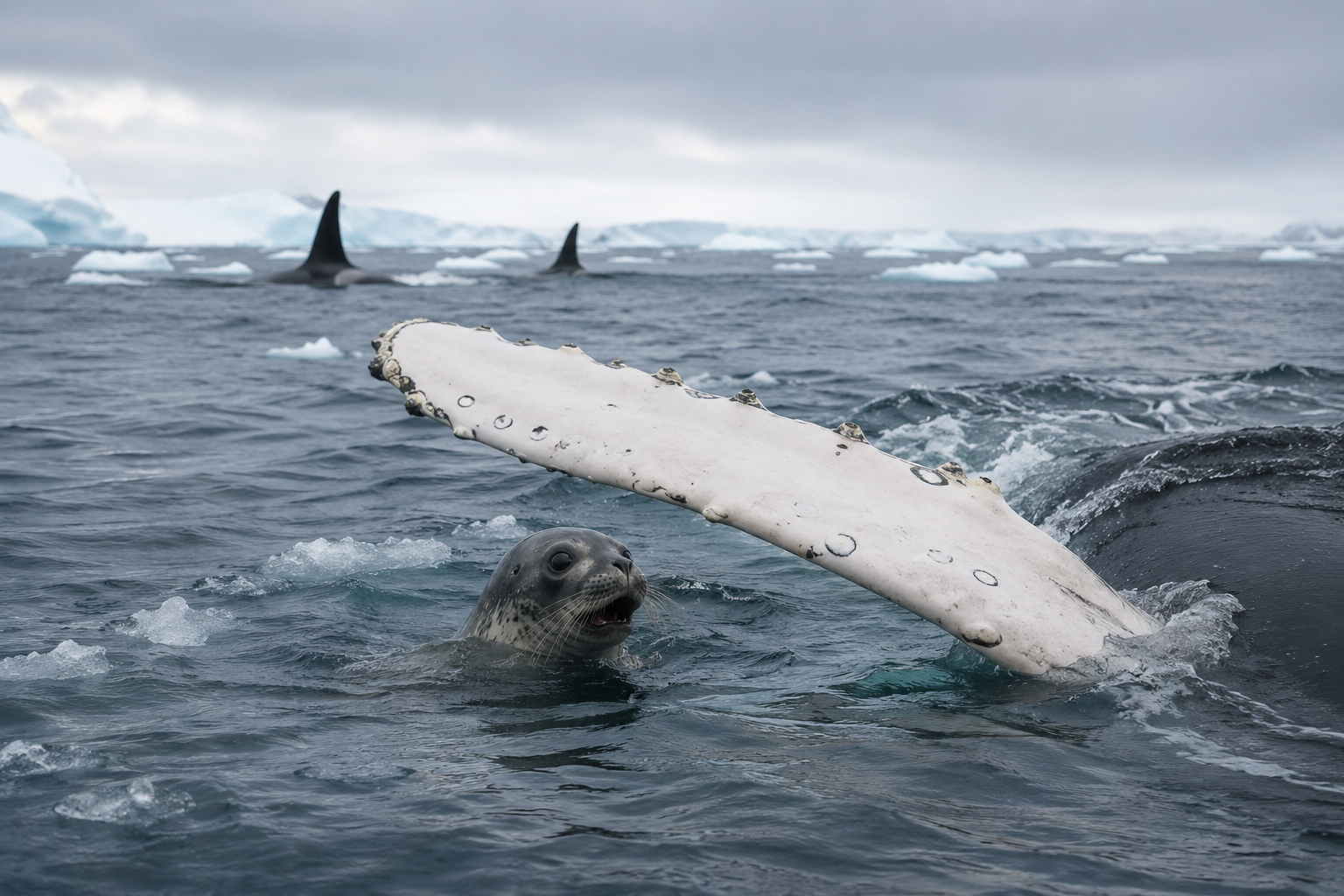
The seal had already lost its safest place.
Moments earlier, it had been resting on a piece of Antarctic ice while killer whales moved beneath the surface nearby. The predators worked together, using the water itself as a weapon.
Then a wave swept across the ice.
The seal slipped into the sea.
In open water, it was slower than the animals pursuing it. There was no boat close enough to become a refuge and no large ice floe immediately within reach.
But there were two humpback whales.
The frightened seal began swimming directly toward them.
What happened next was so unusual that the scientists watching from a nearby research vessel struggled to decide whether they had witnessed instinct, coincidence—or a deliberate attempt by one species to save another.
Researchers had travelled south to study the hunters
In January 2009, marine biologists Robert Pitman and John Durban sailed from the southern tip of South America toward the Antarctic Peninsula aboard the 65-foot research yacht Golden Fleece. Their goal was to observe a form of Antarctic killer whale known for hunting seals around pack ice.
These orcas had developed a remarkable cooperative technique.
Several animals could swim side by side toward an ice floe, producing a coordinated wave that rolled across its surface. The water could break the floe apart or wash a resting seal into the sea, where the orcas had a much greater advantage.
The researchers expected to document predation.
Instead, they repeatedly saw humpback whales inserting themselves into hunts that did not appear to involve them.
The first strange confrontation
Early one morning, the team encountered a group of ten killer whales surrounding two agitated adult-sized humpbacks.
The humpbacks were noisy and active. They blew forcefully, struck the surface with their tails and moved their long pectoral fins through the water.
At first, the observers thought the orcas might be testing or harassing the humpbacks. But when the researchers reviewed their video footage, they noticed a Weddell seal positioned between the two larger whales.
The orcas eventually moved away.
About 15 minutes later, the same killer whales targeted a crabeater seal resting on ice. They created a wave that broke the floe into a much smaller platform.
Just as the orcas appeared close to succeeding, the same pair of humpbacks entered the confrontation. They moved around the ice, vocalized and thrashed the water until the killer whales abandoned the attempt.
The seal remained alive on the ice.
Pitman and Durban initially considered the behavior a form of mobbing—the animal equivalent of smaller birds gathering around a predator and harassing it until it leaves.
Then, one week later, they witnessed an encounter that seemed even more personal.
The seal was washed into the water
A different group of killer whales had found a Weddell seal on another ice floe.
Two other large humpbacks were already nearby.
The orcas began their attack and eventually succeeded in washing the seal from its refuge. Suddenly exposed in open water, the seal swam frantically toward the humpbacks.
The scientists could not know what the seal understood.
It may have recognized the humpbacks as large living animals capable of providing protection. It may simply have seen their bodies as the nearest solid-looking objects rising above the surface.
Pitman and Durban noted that seals fleeing killer whales have also used boats as emergency refuges. In a life-or-death pursuit, almost any large object can become a possible escape route.
But the humpback did not remain passive.
As the seal reached the nearest whale, the humpback rolled onto its back.
The movement brought the seal onto the whale’s chest between its enormous pectoral fins.
The whale lifted the seal above the sea
The seal weighed roughly 400 pounds, yet it looked small against the body of the humpback.
As the killer whales moved closer, the humpback arched its chest and lifted the seal farther out of the water. For a brief moment, the whale’s body became a living platform.
Water draining from the humpback’s chest began carrying the seal back toward the edge.
Then came the detail that made the encounter extraordinary.
The humpback used one of its massive pectoral fins to give the slipping seal a gentle nudge back toward the middle of its chest.
It was not a violent strike. The fin appeared to reposition the seal away from the water and the waiting orcas.
Moments later, the seal scrambled off the humpback, swam to a nearby ice floe and reached safety.
Was the humpback deliberately rescuing it?
The sequence certainly looks protective.
The humpback rolled into a position that brought the seal onto its body, lifted it above the surface and used a pectoral fin when the animal began slipping back toward danger.
Yet scientists must be cautious when assigning human motives to wildlife.
Pitman and Durban suggested that the presence and behavior of the killer whales may have triggered a powerful protective response in the humpbacks. They considered whether the behavior could resemble allomaternal care—care directed toward an animal that is not the individual’s own offspring.
However, a humpback does not need to understand the seal’s experience exactly as a human would in order to help it.
The whale may have recognized the sounds and movements associated with an orca attack and responded with a defensive behavior normally used to protect humpback calves. The seal may then have benefited from that response, regardless of whether it was the whale’s original focus.
That possibility became more important as researchers collected additional reports.
This was not an isolated encounter
Years after the Antarctic observation, Pitman and other researchers reviewed 115 recorded interactions between humpback whales and killer whales.
The pattern was striking.
When humpbacks approached killer whales, the orcas were usually mammal-eating animals that were attacking or feeding on prey. In encounters where humpbacks interfered with an active attack, only a minority of the targets were humpbacks. Most of the prey belonged to other species, including seals and other cetaceans.
The researchers argued that many of these interventions were consistent with mobbing behavior.
Humpbacks may hear the sounds of an orca attack from a distance and approach before knowing which animal is being targeted. Once they arrive, they may respond aggressively to the orcas whether the victim is a humpback calf, a seal or another marine mammal.
From an evolutionary perspective, such a response could still make sense.
Orcas are known predators of young humpback whales. A strong instinct to confront mammal-eating orcas could protect humpback calves often enough to be valuable, even if the same response occasionally benefits unrelated species.
Why humpbacks can challenge killer whales
Humpback whales are not helpless giants.
An adult humpback is much larger than an individual orca and carries powerful natural defenses. Its tail can strike with enormous force, while its exceptionally long pectoral fins can be used to block, sweep or threaten an attacker.
Those fins may also carry barnacles, adding rough and potentially damaging edges.
During confrontations, humpbacks have been observed turning toward orcas, positioning their bodies near vulnerable animals and striking the water with their tails and fins.
An orca hunting a seal must therefore decide whether a relatively small meal is worth remaining beside one or more agitated humpbacks.
In the 2009 observations, the humpbacks did not need to kill or injure the orcas. Their presence disrupted the hunt and created opportunities for the seals to escape.
The orcas were not villains
The footage is naturally emotional because the seal appears frightened and vulnerable.
But the orcas were not acting cruelly.
They were specialized predators performing behavior required for survival. Cooperative hunting allows them to feed themselves and possibly other members of their group. A successful hunt may also provide food for younger animals that are still learning.
The humpbacks, the seal and the orcas were all following different survival pressures.
For the seal, safety meant escaping the water.
For the orcas, survival meant completing the hunt.
For the humpbacks, the sounds and behavior of attacking killer whales may have triggered a deeply rooted defensive response.
Nature did not assign heroes and villains. Human observers did that afterward.
A moment that remains difficult to explain
The safest scientific conclusion is not that humpback whales always rescue other animals.
They do not.
Nor can one encounter prove that a whale experiences compassion exactly as humans do.
But dismissing the event as meaningless instinct may also be too simple.
The humpback did more than merely remain nearby. It rolled beneath the fleeing seal, raised it from the water and used its pectoral fin when the animal began sliding back toward the pursuing orcas.
Whatever mental process produced those actions, the outcome was clear.
The seal survived.
The orcas lost their opportunity.
And the scientists aboard the Golden Fleece returned with evidence that interactions between predators and prey can sometimes be changed by an animal that was never supposed to be part of the hunt.
The living island in the Antarctic sea
For the Weddell seal, the humpback may have looked less like another animal and more like an island rising from the waves.
It had no time to understand what the whale intended.
It simply swam toward the largest possible refuge.
Then the refuge moved beneath it.
A huge body rolled toward the sky. A chest rose from the freezing water. A long fin prevented the seal from slipping back toward the predators.
Seconds later, the seal was swimming toward solid ice.
The humpback remained behind with the orcas.
Researchers are still left with the same question raised by that Antarctic morning:
Did the whale recognize that another animal needed help?
Or did an instinct designed to protect humpback calves happen to save a seal?
The answer may remain hidden inside the mind of the whale.
But to the seal balanced briefly on its chest, the difference probably did not matter.
Editor’s note: The accompanying video and featured image are AI-assisted visual reconstructions inspired by the documented 2009 observations of Robert L. Pitman and John W. Durban. They are not original footage of the complete encounter. The event itself was reported by the researchers, but the humpback whale’s exact motivation cannot be established with certainty.
