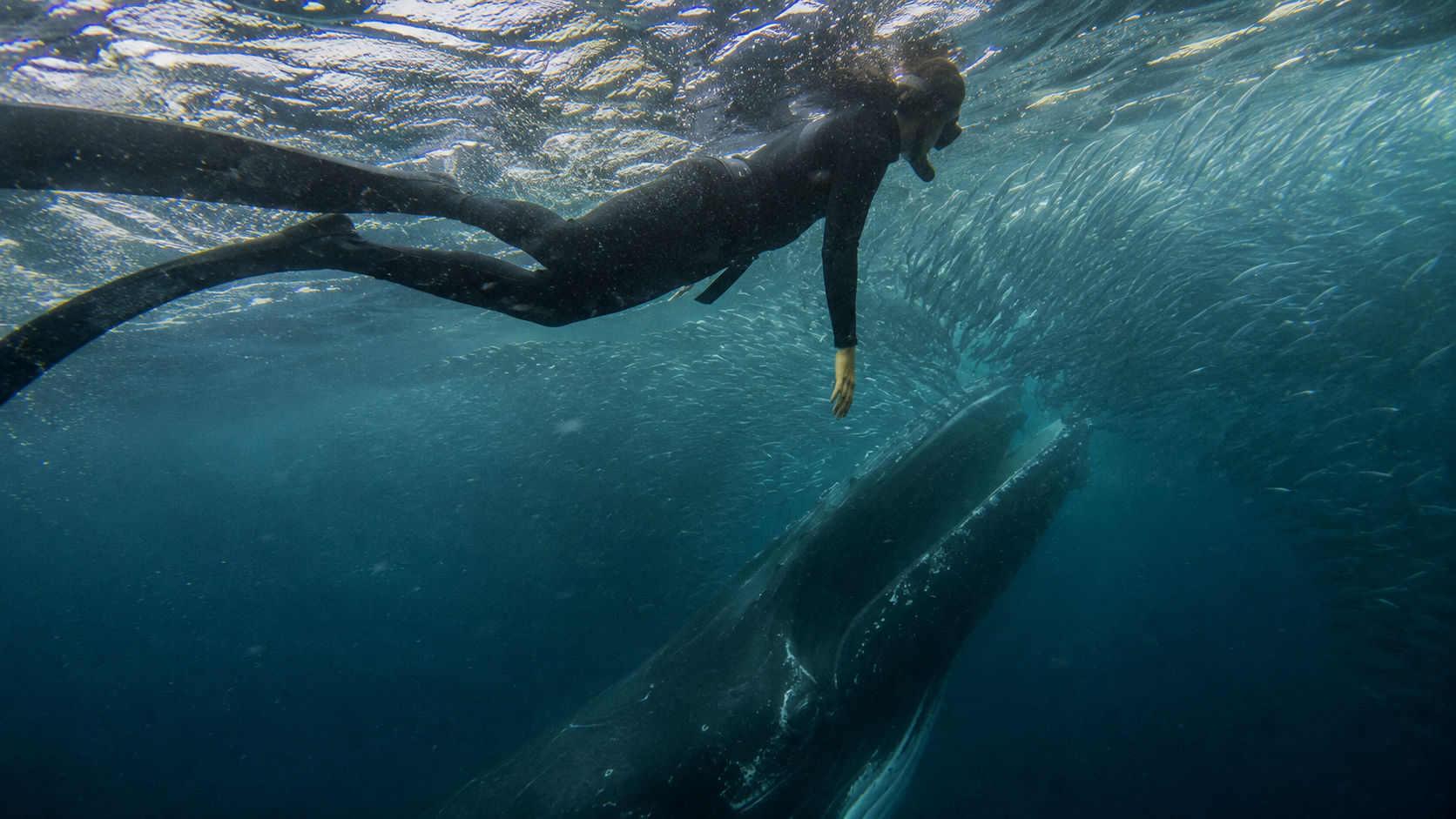
At first, the fish appeared to be moving toward her.
Cindy Yang was floating just beneath the surface in the cold water off Norway, her body stretched horizontally as she watched a dense school of herring rise from the darker water below.
There was no time to study what was happening.
The fish were suddenly everywhere.
They passed beneath her body, around her fins and toward the surface in one tightly compressed rush. For a moment, the scene looked almost beautiful—a silver wall moving through the blue.
Then the water beneath the fish began to change.
Bubbles rose from the darkness.
A massive shape followed them.
And only when it was almost directly below her did the reason for the herring’s sudden movement become clear.
A humpback whale was coming up to feed.
The Shape Beneath the Fish
Cindy Yang is an Australian freediving coach and underwater photographer. During the reported encounter off Norway, she was swimming close to the surface when a large bait ball of herring appeared beneath her. A humpback whale then surged upward through the school with its mouth open.
The footage became so striking because the danger was not obvious at the beginning.
There was no visible whale racing directly toward her.
There was only the fish.
They rose first, escaping from the animal below them. Their movement acted like a warning, but it was a warning that could only be understood once the whale appeared.
The humpback was not hunting Yang.
It was following the herring.
But for a diver positioned directly above the fish, that distinction did not make the moment feel any less dangerous.
Her Left Hand Was Still Below Her
As the whale reached the upper part of the water column, Yang began moving away from its path.
She appeared remarkably calm.
There was no violent kicking, frantic struggle or uncontrolled attempt to escape. She shifted her body while the whale continued upward toward the tightly packed fish.
For one brief moment, however, her left arm remained close to the open side of the whale’s mouth.
Reports describing the footage said the whale passed within inches of her hand. Yang later described the encounter as one in which the whale came from below to feed and nearly took her with the bait ball.
The video freezes the mind on that single question:
What would have happened if she had moved half a second later?
Was the Whale Trying to Swallow Her?
No evidence from the encounter suggests that the humpback intended to attack Yang.
Humpback whales feed on small fish and krill. They often gather or compress prey before lunging through it, taking a huge volume of water and fish into the expandable area beneath the lower jaw. The water is then pushed outward through plates of baleen, which trap the prey inside.
This feeding movement is fast, powerful and focused on the prey concentration.
From the whale’s perspective, the target was the dense school of herring.
Yang happened to be immediately above it.
That is what made the encounter dangerous: not aggression, but the enormous force and momentum of a feeding animal following prey toward the surface.
A humpback can reach roughly 60 feet in length and weigh up to about 40 tons. Even without biting or intentionally striking a person, contact with an animal of that size could cause serious injury.
Why the Herring Moved Toward the Diver
The fish were not seeking protection from Yang in any deliberate way.
They were trying to escape.
When threatened by a predator, schooling fish often compress and change direction rapidly. The individuals move together, creating what appears to be one coordinated body.
In this encounter, the surface limited where the herring could go.
The whale was coming from below.
Yang was above them.
For a few seconds, the safest direction available to the fish was the same direction in which she was floating.
That created the disturbing illusion that the herring were rushing directly toward her.
In reality, she had become part of the narrow space between predator, prey and surface.
The Whale’s Mouth Looked Impossible to Avoid
A feeding humpback does not approach with the narrow mouth shape people usually associate with a whale.
The lower jaw expands.
The throat pleats unfold.
The entire front of the whale appears to grow wider as it takes in water and prey.
From underwater, that movement can look like an enormous dark wall opening beneath the diver.
But the whale’s mouth was not simply rising in a straight line toward Yang.
It was tracking the concentration of fish.
When she moved sideways, the whale continued through the bait ball rather than turning to pursue her. That is one of the clearest signs that this was a feeding event, not an attack.
The difference may sound reassuring after the fact.
In the water, with the whale already only a short distance away, it would have offered very little comfort.
How Did She Remain So Calm?
Yang’s experience as a freediver likely mattered.
Freedivers train to control their breathing, conserve movement and remain aware of their position in open water. Panic creates unnecessary motion and rapidly consumes oxygen.
Her reaction in the footage is restrained.
She notices the whale.
She adjusts her direction.
She moves out of its immediate path.
She does not strike the animal or attempt to outswim it in a straight sprint.
Yang later called the encounter the most breathtaking and humbling moment of her underwater career.
That description captures both sides of the event.
It was terrifying because of how little space remained between them.
It was breathtaking because she was witnessing one of the ocean’s largest animals feeding at close range.
Could a Humpback Whale Actually Swallow a Person?
The dramatic phrase “swallowed by a whale” is often used when a person enters or nearly enters the open mouth of a feeding humpback.
But taking something into the mouth and swallowing it into the stomach are not the same thing.
Humpbacks are baleen whales. They are adapted to filter small prey rather than consume large animals. Their feeding system is designed to engulf fish-filled water and then strain it through baleen plates.
That does not mean entering the mouth would be harmless.
A person could still be injured by the jaw, pressure, sudden movement or impact. The whale could also be placed in danger during an unexpected collision.
The important point is that the whale was neither equipped nor behaving like a predator attempting to eat a human.
The near miss happened because Yang and the bait ball briefly occupied the same feeding path.
Norway’s Cold Waters Attract Both Whales and Herring
Humpback whales inhabit oceans around the world and migrate across enormous distances between breeding and feeding regions.
North Atlantic populations travel to productive northern waters, including waters extending toward Norway, where they feed on small fish. Humpback feeding grounds are generally cold and rich in prey.
When large concentrations of herring gather, whales may follow them.
That creates extraordinary opportunities for photographers and divers—but also unpredictable moments.
The ocean can appear empty seconds before a feeding whale rises from below.
A diver may see fish but not immediately see the much larger animal beneath them.
The deeper the water and the darker the conditions, the less warning there may be.
The Detail That Made the Video Unforgettable
The whale’s size is not the only reason the footage spread.
It is the delay.
The viewer sees Yang.
Then the viewer sees the fish.
The viewer has time to wonder why they are moving.
Only afterward does the whale appear.
That order turns an ordinary underwater scene into a story.
The danger is revealed in stages.
By the time the open mouth becomes visible, Yang’s arm is already near its path.
Nothing graphic happens.
There is no blood and no visible injury.
Yet the closeness of the moment makes the mind imagine everything that could have happened differently.
She Was Not the Whale’s Target
It is easy to interpret the video as a giant animal charging toward a person.
The more accurate interpretation is almost more unsettling.
The whale was doing something normal.
The herring were doing something normal.
Yang was simply positioned in the exact place where those two natural behaviors met.
The whale followed its food.
The herring fled toward the surface.
And a diver became trapped for a moment between them.
That is why the encounter should not be presented as proof that humpbacks are aggressive.
It is a reminder that wild animals do not need to attack a person to create danger.
Size, speed and timing can be enough.
What Happened After the Whale Passed?
The whale did not turn and chase Yang.
It continued through the fish as she moved away from the immediate feeding path. Reports of the encounter indicate that she was not injured.
What remained afterward was the scale of what she had witnessed.
For viewers, the encounter lasts only seconds.
For the person in the water, those seconds contained several separate realizations:
The herring were rising.
Something was beneath them.
The shape was a whale.
Its mouth was open.
Her hand was still too close.
Then it passed.
A Rare Moment, Not an Invitation to Approach
Yang later emphasized publicly that the encounter was extremely unusual.
That distinction matters.
Videos like this can make close whale encounters appear controllable or repeatable. They are neither.
Humpbacks are powerful wild animals, and feeding behavior can change direction quickly as fish move. Wildlife authorities generally advise maintaining substantial distance from large whales rather than attempting to recreate close encounters. NOAA, for example, recommends observing large whales from at least 100 yards away in the regions it regulates.
The lasting value of the footage is not that someone should try to experience the same thing.
It is that a camera captured what usually happens far below the surface and far away from human eyes.
A school of fish changed direction.
A whale followed.
And Cindy Yang escaped the narrow space between them with only inches to spare.
Visual disclosure for the article:
The accompanying visuals are a dramatized recreation inspired by the reported real encounter. They are not the original footage and do not depict Cindy Yang’s identifiable likeness.
