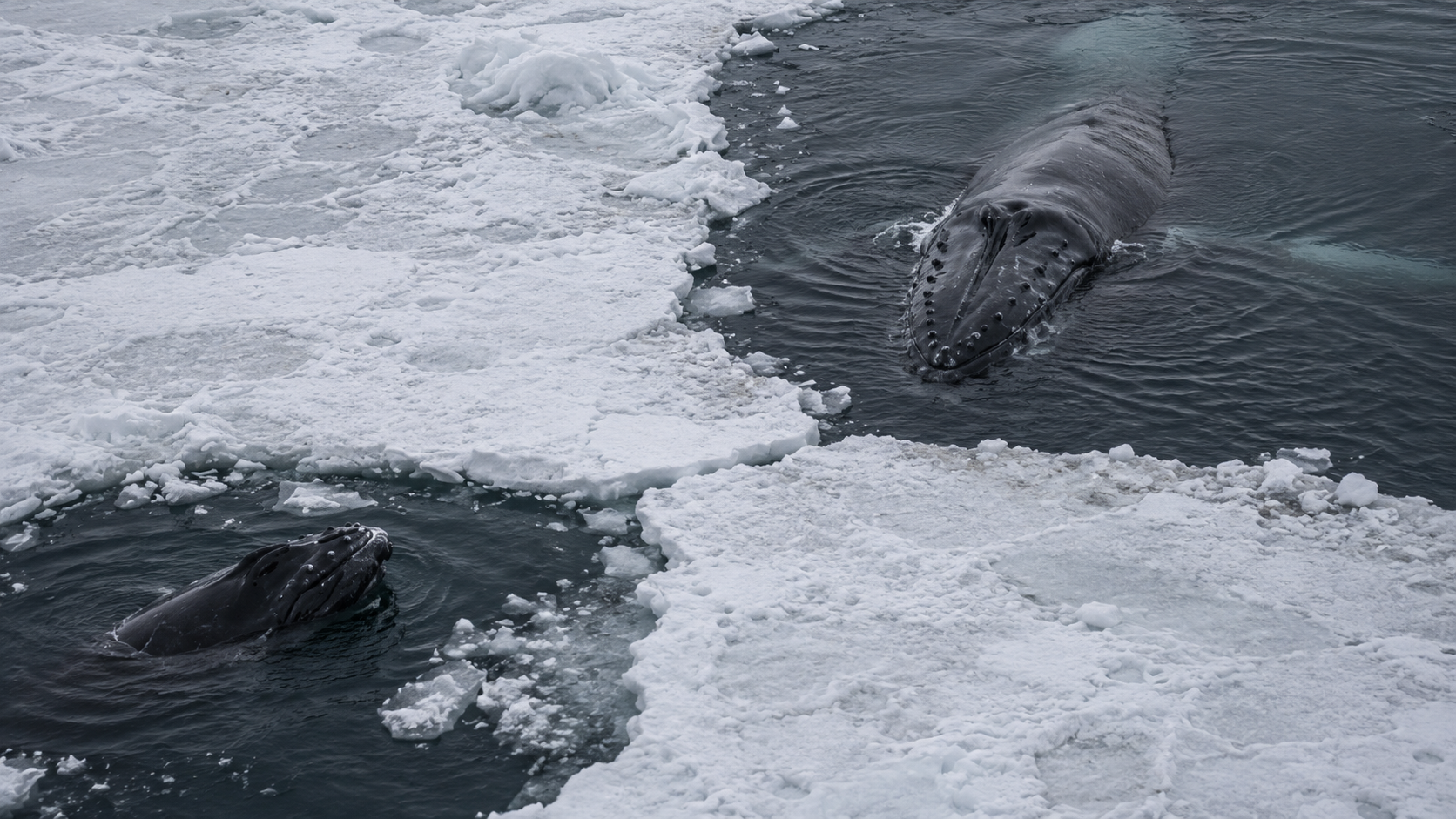
The distance between them looked painfully small.
A young humpback whale calf surfaced inside a narrow strip of dark water surrounded by broken sea ice. On the other side of a thick white sheet, its mother waited in a larger opening, her head turned directly toward the calf.
They could see each other.
They remained oriented toward each other.
But they could not reach each other.
At first, the channel appeared wide enough for the calf to remain safe. The water around it moved gently, and every few moments the young whale surfaced to breathe before slipping beneath the cold polar water again.
Then the wind changed.
The floating ice began to move.
A Passage That Was Slowly Disappearing
Sea ice rarely remains perfectly still. Wind, waves, and currents can move large sections across the surface, opening one channel while narrowing another.
For the calf, the small channel was more than an empty patch of water.
It was the only visible route back toward its mother.
Each time the calf surfaced, the passage looked slightly different.
One edge of ice drifted inward. A loose piece turned sideways. The dark line of water between the larger sheets became thinner.
The mother moved closer to the edge of her opening, but she did not force herself into the narrow channel.
She was far larger than the calf. A route that still appeared usable for a young whale could be too narrow and unstable for a full-grown adult.
If she entered and the ice shifted again, both whales could become trapped.
So she remained on the other side.
Her body rose and fell with the cold water.
Her head stayed pointed toward the calf.
She never appeared to turn away.
Why the Calf Could Not Simply Swim Around
It was easy to imagine that the calf could dive beneath one sheet of ice and surface beside its mother.
But a whale must know where its next breath will come from.
Beneath broken ice, the surface is not open everywhere. A whale may travel under a floating sheet, but it must locate another opening before it needs air.
For a young calf accustomed to following its mother, separation can make every decision more dangerous.
The calf could not see the full shape of the ice from below.
It did not know exactly how far the frozen surface extended.
It only knew where it had last seen its mother.
Again, the calf surfaced in the narrow water pocket.
The mother responded by moving closer.
For a moment, the calf turned directly toward her.
Then another section of ice shifted across the passage.
The Moment the Calf Disappeared
The gap between the two openings narrowed until only a dark, irregular channel remained. Small pieces of ice rubbed against one another and rotated in the current.
The calf surfaced once more near the edge.
Its back appeared between the white slabs, wet and dark against the snow-covered ice. It took a breath and slipped beneath the surface.
The people watching expected it to rise again in the same place.
It did not.
The small opening remained empty.
The mother moved forward until her head was close to the ice separating them.
She did not charge into the gap or attempt to force her body across the frozen barrier.
She simply waited, facing the place where the calf had vanished.
Seconds passed.
The water moved.
A small piece of ice turned over.
Still, the calf did not appear.
What Could the Mother Do?
A mother humpback cannot lift a massive sheet of sea ice or pull her calf through a closed passage.
Her strength is enormous, but the environment creates limits even for the largest animals.
What she could do was remain nearby.
She could move along the edge.
She could watch the surrounding openings.
She could be present if the calf found another way to surface.
The mother began traveling slowly along the ice boundary, never moving far from the area.
She surfaced, breathed and dipped below again. Each time she returned, she remained oriented toward the channels between the ice.
The calf was no longer visible from above.
But that did not necessarily mean it had stopped moving.
Beneath the surface, there may have been more space than the narrow openings suggested. The ice sheets were thick, but they did not form one solid underwater wall.
Channels could continue beneath their edges, and small pockets of open water could exist beyond the camera’s view.
The question was whether the calf could find one before it needed another breath.
The Mother Suddenly Changed Direction
The surface remained quiet except for the low movement of water beneath the ice.
Then the mother changed direction.
She moved toward another section of the opening, away from the place where the calf had disappeared.
Near the far edge of the ice, a dark shape became visible beneath the water.
For an instant, it vanished again.
Then a small head broke the surface inside a different opening.
The calf had not remained beneath the closed passage.
It had followed a route under the ice and surfaced farther along the edge.
It was alive.
But the two whales were still separated.
The mother was now closer, yet another strip of ice remained between them.
The Ice Began to Open Again
The wind continued pushing the floating sheets.
The same movement that had closed the first route began pulling two other sections apart.
A thin dark line appeared between them.
It slowly widened.
The calf stayed near the new opening, surfacing repeatedly. The mother positioned herself on the opposite side, facing the developing channel.
The calf waited as small fragments of ice moved away.
The mother remained in deeper water.
Then the passage became wide enough.
The calf moved first.
Its head entered the narrow route, followed by its back. The ice shifted around it, but this time the opening continued to widen rather than close.
The mother moved forward at the same time.
For several seconds, the calf disappeared behind one raised edge of ice.
Then it surfaced beside her.
The two whales turned into the same stretch of open water.
The calf remained close to its mother’s side as they moved away from the ice boundary.
Why the Reunion Felt So Powerful
The danger did not come from a predator.
There was no attack and no visible injury.
The tension came from distance, timing and the fact that the mother could do so little while remaining so close.
The calf was not separated because it lacked the ability to swim.
It was separated because the route it understood was changing around it.
The mother was not absent.
She was watching from the other side of a barrier she could not safely cross.
The outcome depended on the ice opening in the right place and the calf choosing the right route beneath it.
One wrong turn could have carried the young whale farther from its mother.
One closing channel could have removed its next safe place to breathe.
Humpback Whales in Cold Waters
Humpback whales are known for long migrations between warmer breeding regions and cold, productive feeding grounds.
In high-latitude waters, they may encounter drifting ice, narrow channels and surface conditions that can change quickly.
A calf traveling with its mother is still learning how to follow, surface and respond to the movements of a much larger whale.
The mother provides protection and guidance, but she cannot control the wind, currents or shifting ice.
A calm-looking polar landscape can therefore become dangerous without warning.
The ice does not need to crush an animal to create a serious problem.
It only needs to separate a young whale from the route it expected to use.
The Detail People Remembered
After the calf reached its mother, the two whales remained close together.
The adult moved on the outside, nearer the drifting ice. The calf stayed beside her in the more open water.
The ice continued moving behind them, slowly reshaping the channels where the separation had happened.
The most memorable part was not the moment the passage closed.
It was the mother’s position while she waited.
She stayed turned toward the calf.
Even when it disappeared beneath the ice, she did not move away.
And when another opening finally appeared, she was still there.
A Note About This Story
This is a dramatized wildlife narrative inspired by real conditions that whales can face near shifting sea ice. It is not presented as a report of one specific verified incident.
Moving ice can separate animals, alter access to open water and make a short distance unexpectedly difficult to cross.
What gives this story its emotional power is simple:
The calf was searching for a way back.
The mother never stopped waiting.
