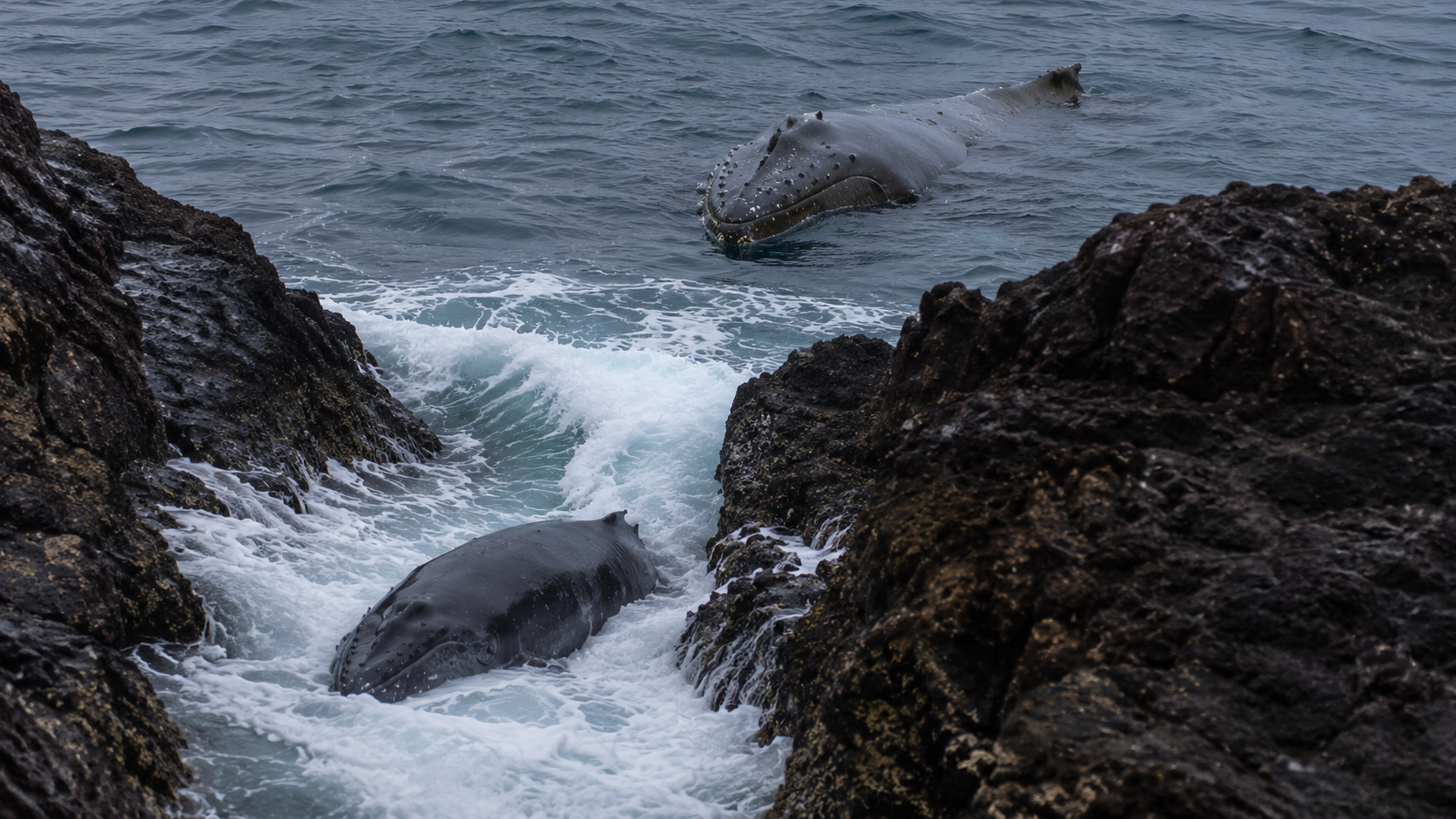
The first thing people noticed was that the calf was still breathing.
Every few moments, its dark head rose between the white foam, just high enough for the blowhole to clear the surface. Then another wave rushed into the narrow rocky channel and turned the water into a wall of noise.
The young humpback tried to move toward the open sea.
But the current pushed it back.
Again.
And again.
Just beyond the entrance, where the water became deeper and safer, an adult humpback remained almost motionless. She was large enough to enter the channel only at enormous risk. The rocks were sharp, the space was narrow, and the surf was breaking hard from both sides.
She faced the calf the entire time.
She did not leave.
A Mother Close Enough to See, Too Far Away to Help
From the shoreline, the distance between them looked small. In reality, the rocky gap created a dangerous barrier.
The calf was trapped in turbulent water close to the rocks. The mother was outside the channel in deeper water, rising and falling with the swell.
At times, she appeared to move closer to the entrance. Then a stronger wave broke across the rocks, and she drifted back into deeper water.
It was not abandonment.
It was caution.
An adult humpback can weigh many tons, but size does not make an animal safe in every environment. In a narrow rocky inlet, one powerful wave can push even a large whale against stone. For the mother, entering the channel could have left both whales trapped.
So she waited.
The calf kept trying.
Why the Calf Could Not Simply Swim Out
To someone watching a short video, the answer might seem simple: if the calf could breathe, why could it not just turn around and swim back to sea?
The problem was not only the distance.
The water inside the channel was moving in conflicting directions. As each swell entered, it compressed through the narrow opening and became more forceful. The calf would gain a little ground as the water pulled outward, then lose it when the next wave surged back in.
Its small body was being moved by the sea faster than it could correct its direction.
The calf was not lying still. It was making repeated attempts to leave.
Each attempt ended almost the same way.
It moved toward the opening.
Foam gathered around its head and shoulders.
A new wave arrived.
Then the calf disappeared backward into the channel.
For several seconds, only white water could be seen.
Then its head rose again.
Still breathing.
Still trying.
The Moment That Changed the Mood on Shore
People watching from the rocks had begun to understand the pattern.
The calf was not trapped by one large obstacle. There was no rope to cut, no net to remove, and no single rock that could simply be moved.
The entire channel had become the obstacle.
That made the situation more difficult. It also made human intervention dangerous.
Getting into the water could have placed rescuers directly between a frightened calf, an adult mother, heavy surf, and jagged rocks. Even a well-intentioned attempt could have caused the calf to panic or push deeper into the inlet.
For a while, the safest decision was also the hardest one.
Wait.
Watch.
Hope the water changed before the calf became too tired to keep lifting its head.
Then the calf made one stronger attempt.
As the water began to pull outward, it turned more directly toward the entrance. Its head pointed toward the mother, and for a few seconds the space between them seemed to shrink.
The mother moved closer.
The calf reached the narrowest part of the channel.
Then another wave struck the side of the rocks and broke across its body.
The calf vanished in the foam.
The mother remained at the entrance.
The next few seconds felt longer than everything that had happened before.
When the calf surfaced again, it was farther back than it had been moments earlier.
The ocean had pushed it away from its mother once more.
Was the Calf Becoming Too Weak?
Young whales depend heavily on their mothers, especially during the early part of life. A calf has less experience reading waves, currents, and coastal hazards. It also has less strength than a fully grown adult.
Every failed attempt cost energy.
The calf still showed signs of life, but its movements became slower. Instead of pushing forward immediately after each wave, it sometimes floated for a moment before trying again.
That pause worried the people watching.
The mother also changed her position.
She began moving across the entrance rather than staying in one place. She remained outside the rocks, but her body stayed oriented toward the calf. Each time the calf surfaced, she appeared to adjust again.
No one could know exactly what the two whales were sensing.
But the connection between them was impossible to miss.
The calf continued aiming toward her.
The mother continued waiting.
The Water Finally Began to Change
The sea did not calm all at once.
The change was subtle.
The strongest waves began arriving farther apart. Between them, the water inside the channel pulled outward for a few seconds longer than before.
That small difference created an opportunity.
The calf surfaced near the center of the channel. It remained still for a moment, then turned its head toward the opening.
The mother was directly outside.
This time, when the water began to flow outward, the calf moved with it instead of fighting across it.
It did not rush.
It did not leap.
It simply kept moving.
A wave entered behind the calf, but it was weaker than the previous ones. Instead of driving the calf all the way back, it lifted the young whale and carried part of its body toward the narrow exit.
For the first time, the calf did not lose all the distance it had gained.
The mother moved closer again.
The calf surfaced, breathed, and continued forward.
One More Wave
The final stretch was still dangerous.
The rocks were closest together near the entrance, and the water accelerated as it passed between them. The calf’s body turned slightly sideways, bringing it closer to one wall of the channel.
A dark wave rose behind it.
For a moment, it seemed the same cycle was about to repeat.
The calf would be pushed backward.
The mother would remain outside.
Everything would begin again.
But the wave broke differently.
Instead of crashing directly into the calf, it struck the rocks behind it and spread around both sides. The calf was lifted forward into deeper water.
Its back cleared the narrow entrance.
Then the tail followed.
The calf was out.
The mother immediately turned alongside it, placing her much larger body between the young whale and the roughest water near the rocks.
There was no dramatic breach.
No sudden performance.
The two whales simply moved away together.
The calf stayed close to the mother’s side.
Why This Scene Was So Difficult to Watch
Wildlife survival is often shown as a contest between predator and prey.
This was different.
There was no attacker.
There was only a young animal, a mother who could not safely reach it, and a natural barrier that kept changing every few seconds.
That helplessness made the scene more painful.
The mother was close enough to remain visible.
The calf was alive enough to keep trying.
Yet neither could immediately close the final distance.
The outcome depended on timing, strength, and a brief change in the water.
What the Story Reminds Us About the Ocean
The ocean can look open and endless, but coastlines create complex spaces where animals can become trapped. Narrow channels, sandbars, tides, waves, and shifting currents can turn a short distance into a serious danger.
For young animals, those conditions are even harder to understand.
The calf survived because it continued breathing, continued trying, and eventually moved with the outward flow at the right moment.
The mother survived because she did not enter a place that could have trapped her too.
Her waiting may have looked passive from shore.
It was not.
She stayed close.
She remained oriented toward the calf.
And when the opening finally came, she was there.
A Note About This Story
This article is a dramatized wildlife narrative inspired by real coastal hazards that whales and other marine animals can face. It is not presented as a report of one specific verified rescue event.
Its purpose is to show how quickly natural conditions can create danger, why intervention is not always simple, and how powerful the bond between a mother whale and her calf can appear during a crisis.
The most unforgettable detail was not the violence of the waves.
It was the fact that the mother never turned away.
