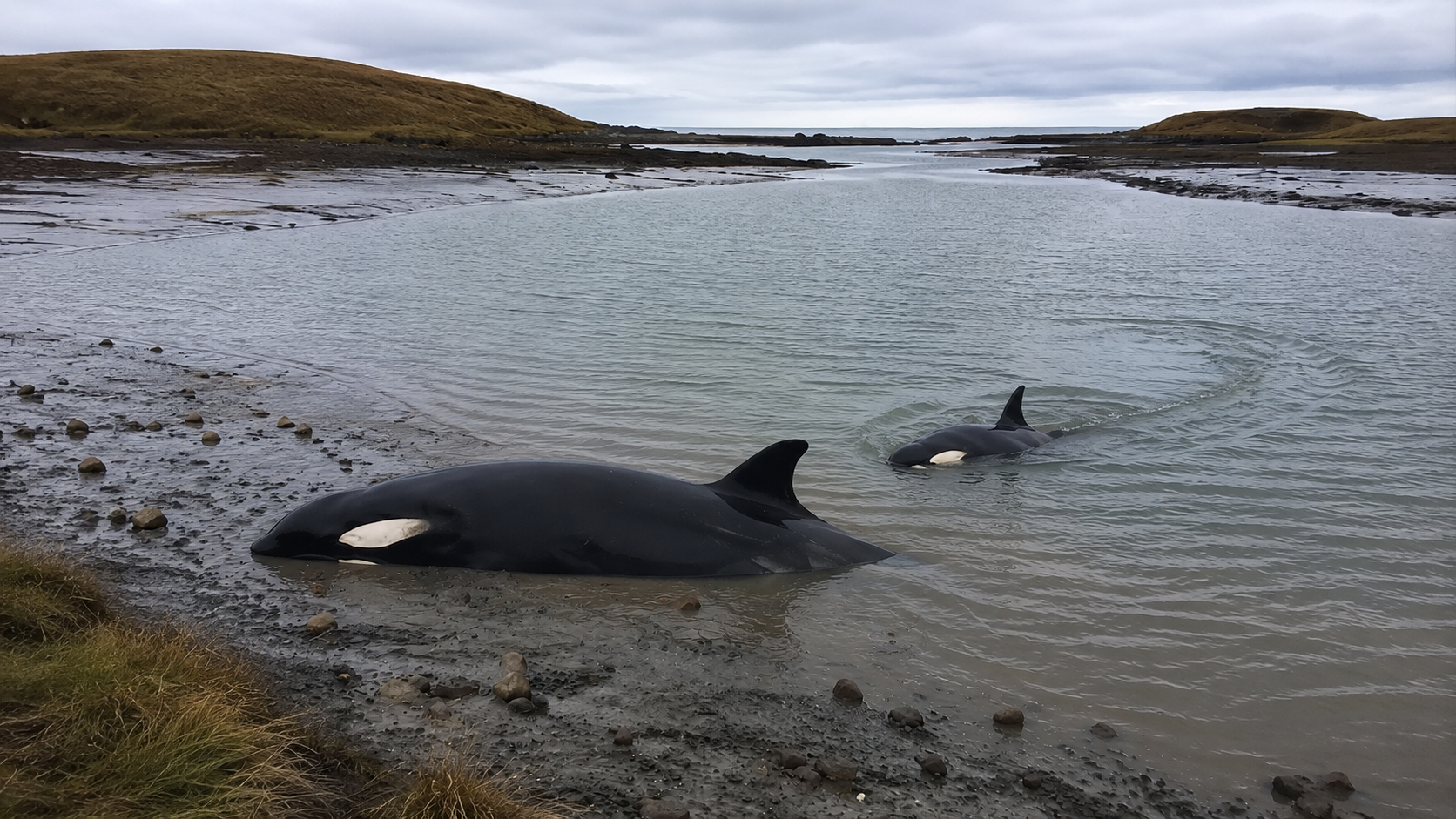
The calf could still swim.
Its mother could not.
In March 2024, inside a remote tidal lagoon on the northwest coast of Vancouver Island, an adult female orca became trapped as the tide fell around her. Her young calf remained in the water nearby, circling through the shallows while people onshore desperately tried to help.
The calf had enough water beneath her to keep moving.
She could surface. She could breathe. She could swim several metres away.
But she kept returning toward the place where her mother lay.
For those watching from shore, it was almost impossible not to wonder whether the calf understood that something was terribly wrong.
The Moment the Tide Turned Against Them
The two orcas had entered a tidal lagoon connected to Little Espinosa Inlet, near the community of Zeballos in British Columbia.
The mother was a 14-year-old Bigg’s killer whale identified as T109A3 and commonly known as Spong. Her daughter, T109A3A, was approximately two years old.
The pair may have entered the area while hunting marine mammals. But when the tide began to fall, the mother became stranded on her side in a shallow depression near a rocky sandbar.
Members of the Ehattesaht and Nuchatlaht First Nations rushed to help. They tried to keep her wet, support her body and position her head so she could continue breathing.
But the tide was working against them.
Despite the effort around her, the mother became weaker and died on March 23, 2024. A later examination revealed another painful detail: she had been pregnant while she was still nursing the calf beside her.
The calf remained in the lagoon.
Hydrophones captured her calls while she circled in the shallow water near the place where her mother had died.
She Could Swim—but She Could Not Simply Leave
From a distance, the situation looked confusing.
The calf was not lying helplessly on the beach. She was still moving through the water. At times, she appeared strong enough to swim away.
But swimming inside the lagoon and escaping into open water were two very different things.
To leave, the young orca had to navigate a shallow bottleneck between a gravel bar and a bridge. The route became usable only during a brief period around the highest tide, when there was enough water and the current was manageable.
Rescuers estimated that there could be only about 30 minutes on a suitable day when the conditions were right.
The calf also had to pass the exact area where her mother had died.
Whether grief, confusion, unfamiliar geography or the shallow passage kept stopping her could not be known with certainty. What people could see was that she repeatedly remained inside the lagoon instead of crossing into the inlet beyond it.
She was free enough to circle.
But she was not yet free.
The Community Gave Her a Name
The Ehattesaht First Nation named the young orca kʷiisaḥiʔis, a name commonly translated as Brave Little Hunter.
The name reflected both her vulnerability and the determination she showed while surviving alone.
Kʷiisaḥiʔis was a young Bigg’s killer whale, part of the mammal-eating orca population found along the Pacific coast. Orca calves normally depend on their mothers and extended family for protection, social learning and hunting experience.
Now she was alone in an unfamiliar lagoon.
The people working around her faced a difficult balance. They needed to help her survive without allowing her to become comfortable around boats and humans.
The ultimate goal was not simply to remove her from the lagoon.
It was to return her to the ocean with the best possible chance of finding other orcas.
Every Rescue Plan Carried a Risk
At first, teams attempted to encourage the calf to leave on her own.
Recorded calls from members of her extended family were played underwater. Ropes and specialised noise-making pipes were used to guide her toward the exit. Drums and other sounds were also tried.
But kʷiisaḥiʔis repeatedly avoided the route.
A more complicated rescue plan was eventually prepared. Boats, divers, nets, a fabric sling and specialised underwater equipment were brought into the lagoon. Roughly 50 people took part in an attempt to gently corral the calf into shallow water, lift her safely and transport her to the open ocean.
The young orca avoided them.
She moved around the boats, escaped the net and remained in the lagoon.
The failed attempt did not mean that the rescuers had been careless. It showed how difficult it is to predict the movement of an intelligent, frightened and powerful wild animal.
Forcing the operation too aggressively could have injured the calf, pushed her onto the shore or caused her to associate people with danger.
The team stopped and reconsidered its options.
The Calf Began Accepting Food
As the days passed, concern grew over whether a two-year-old orca could survive without her mother.
The calf was seen moving around the lagoon and appeared capable of hunting some small prey. Rescuers later offered pieces of harbour seal meat, food consistent with the diet of Bigg’s killer whales.
After several quiet attempts, she began accepting some of it.
That provided temporary reassurance, but feeding her was not a permanent solution. Every additional day inside the lagoon increased the risk that she could lose body condition, become habituated to humans or miss an opportunity to reconnect with her family.
More than four weeks had passed since her mother’s death.
People around the world were now following the story.
Yet the calf still had to make the most important part of the journey herself.
The Night Everything Changed
During the early hours of April 26, the conditions became unusually calm.
The tide was high. The surface was described as glass-like beneath a clear, star-filled sky.
A small monitoring team remained nearby.
At approximately 2:30 in the morning, kʷiisaḥiʔis approached the route that had stopped her for more than a month.
She swam past the sandbar where her mother had died.
Then she passed beneath the bridge.
For the first time since entering the lagoon, the calf reached Little Espinosa Inlet on the other side.
No sling carried her.
No net pulled her through.
She crossed the barrier on her own.
The people monitoring her watched as she continued down the inlet, moving closer to the open ocean.
After weeks of failed attempts, changing plans and painful uncertainty, the young orca had finally chosen the route everyone had hoped she would take.
Freedom Was Only the First Step
Leaving the lagoon did not instantly solve every problem.
Kʷiisaḥiʔis still needed to travel out of the inlet, find food and ideally reconnect with her extended family.
Officials and First Nations members asked boats to keep their distance. Too much human contact could distract her or interfere with her ability to hear and locate other orcas.
The hope was that her calls would eventually be heard by relatives travelling along the coast.
Later sightings indicated that the calf had survived the immediate period after leaving the lagoon. Researchers observed her alone but apparently capable of finding food.
However, her longer-term story remains uncertain.
The most recent authoritative public update I found, published by the Orca Behavior Institute in May 2025, said her last confirmed sighting had occurred in July 2024, with possible but unconfirmed sightings later that year. The organisation noted that Bigg’s killer whales can travel through remote areas and may go months or years without being individually documented.
A lack of sightings does not prove that she did not survive.
But it means that the final chapter of her story has not yet been confirmed.
Did the Calf Understand What Happened?
It is tempting to describe the calf’s behaviour using human emotions.
People watching the lagoon saw her circling, calling and remaining close to the place where her mother had died. To them, it looked like attachment, confusion and reluctance to leave.
Orcas form extremely strong and long-lasting family relationships. Calves learn from their mothers and often remain connected to relatives throughout their lives.
Still, no one can know exactly what kʷiisaḥiʔis understood during those first hours.
She may have been responding to her mother’s absence.
She may have been frightened by the shallow exit.
She may simply have been following the last movements and sounds she associated with safety.
What is certain is that she did not immediately abandon the lagoon after her mother died.
She stayed there for more than a month.
And when she finally left, she had to pass the same sandbar that had separated her from her mother.
Why the Story Reached So Many People
The danger was not caused by a predator, a fishing net or a deliberate act of cruelty.
It came from a falling tide and a landscape that changed faster than the whales could escape.
That made the story feel especially helpless.
The mother was one of the ocean’s most powerful predators, yet she could not lift her own body from the shallow depression.
The calf could still move, yet she could not understand or navigate the route that humans could clearly see from above.
People could watch.
They could plan.
They could bring boats, nets, equipment and specialists.
But in the end, the calf still had to decide when to cross.
The Image No One Forgot
For many of the people who followed the story, the most painful moment was not the rescue attempt or even the night of the escape.
It was the sight of the young orca remaining in the water beside her stranded mother.
The calf could still swim.
The mother could not follow.
And for a while, the baby kept returning.
More than a month later, kʷiisaḥiʔis finally passed under the bridge and continued toward the ocean alone.
She had lost her mother.
But she had not lost the instinct to keep moving.
And somewhere beyond the inlet, an entire coastline opened in front of the Brave Little Hunter.
