At first, it looked wrong.
The mother was not keeping her calf close in the open water.
She was pushing it away.
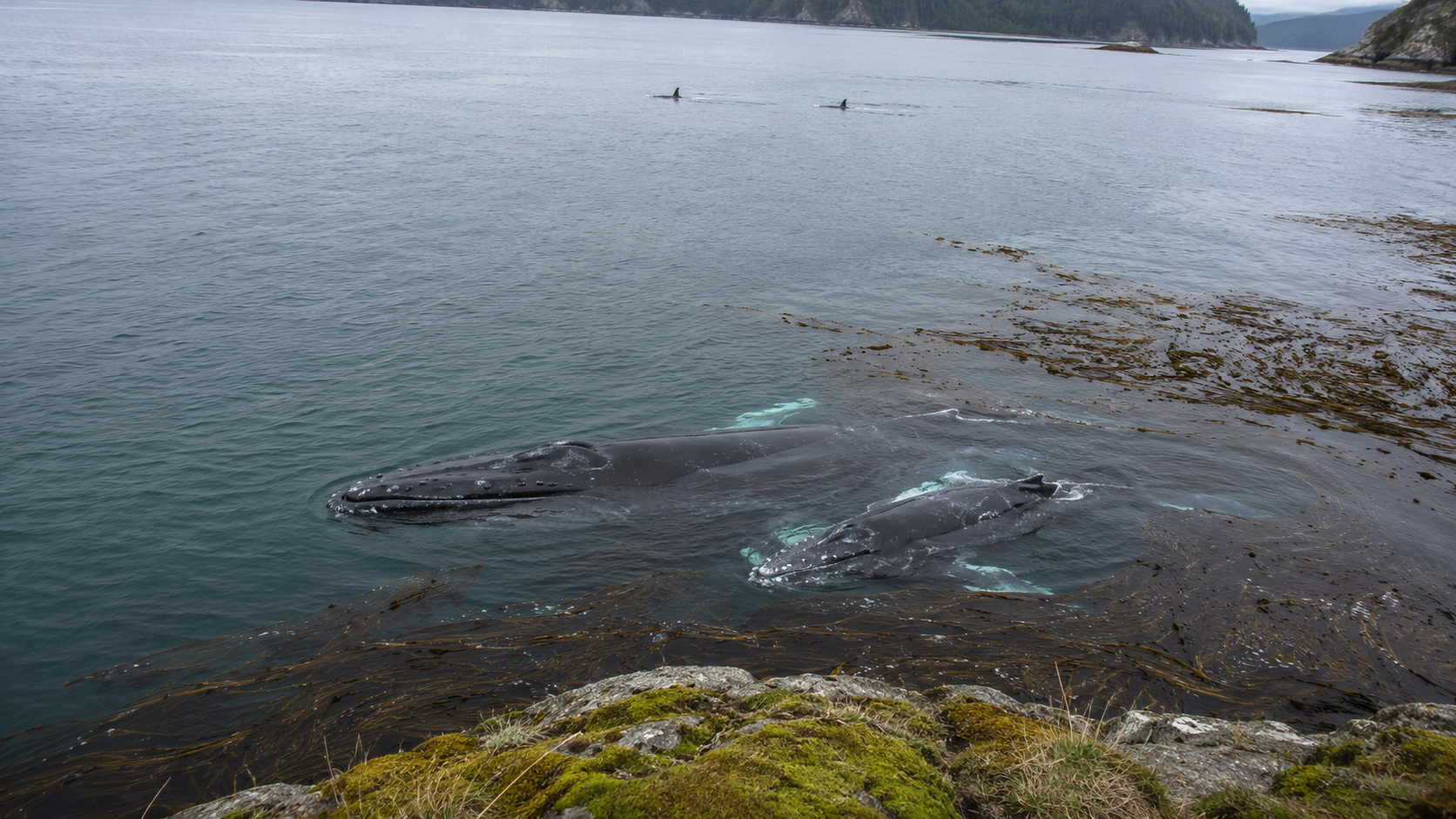
From the rocky shoreline above the bay, the people filming could see both whales clearly in the cold blue-green water below. The adult humpback moved slowly beside her calf, turning her massive body again and again toward the dark kelp that stretched along the edge of the rocks.
The calf was small.
Too small to understand what was happening.
Every time it drifted back toward open water, the mother moved behind it and guided it back toward the kelp.
At first, people watching from above thought the same thing.
Why is she doing that?
The calf was not trapped.
It was not injured.
It was not caught in a net.
There was no boat pushing them, no rescue crew nearby, no obvious danger in front of them.
Just a mother and her baby.
And a dark patch of kelp near the shoreline.
But the mother kept pushing.
Not violently.
Not in panic.
Slowly. Firmly. Again and again.
The baby tried to turn away from the kelp, as if it wanted the safety of open water. The mother did not let it go far. She slid her body between the calf and the wider bay, then nudged it back toward the darker water near the rocks.
To human eyes, it almost looked cruel.
The calf was confused. It lifted part of its back through the surface, then dipped again, turning in a small circle as if searching for a way around her. Its pale pectoral fin flashed beneath the water, bright against the cold green.
The mother stayed close.
But she did not comfort it in the way people expected.
She did not swim beside it calmly.
She kept forcing it toward the kelp.
That was when one of the people on the rocks lowered the camera slightly, trying to understand the strange movement. The calf was now close to the kelp forest, where long brown-green ribbons moved beneath the surface like shadows.
The mother turned her head toward the open bay.
And froze.
For a moment, nothing happened.
Only small waves touched the rocks. The forest on the far shore sat dark under the low clouds. The water looked empty.
Then a black fin broke the surface.
Farther out.
Then another.
Then a third.
The mood changed instantly.
The mother had not been leaving her calf.
She had been hiding it.
The black fins moved slowly through the deeper water, too far away to attack, but close enough to explain everything. Orcas.
From above, their movement looked almost silent. No dramatic splashing. No chaos. Just dark dorsal fins cutting through the grey surface, moving in the direction of the cove.
The calf did not understand.
The mother did.
She moved again, placing her own body between the calf and the open bay. This time, her movement no longer looked confusing. It looked deliberate. Every turn, every nudge, every slow push toward the kelp had been part of the same decision.
The open water was no longer safe.
The kelp was cover.
The mother pushed the calf deeper into the edge of the kelp forest, where the brown ribbons broke up the shape of its small body from a distance. The calf hesitated again, but this time it stayed closer.
The mother did not follow all the way inside.
She remained outside the kelp.
Between the calf and the black fins.
That was the part that made the people filming go quiet.
She had not hidden herself.
She had hidden the baby.
The orcas came closer, still far enough that the whole scene felt suspended in time. They did not rush. They did not explode through the water. They did not need to.
The pressure was enough.
Every animal in the bay seemed to understand what the humans were only beginning to understand: the most dangerous moment is not always the attack. Sometimes it is the waiting before it.
The mother surfaced again.
A slow breath rose into the cold air.
Then she turned sideways, showing the length of her body across the open water. She was larger than the calf, stronger, more visible. If the orcas were watching, they would see her first.
The calf stayed near the kelp.
Small. Still. Half-hidden.
The people above could barely see it now, only a dark young back and the pale flash of a fin beneath the surface when the kelp shifted.
For a few seconds, the mother drifted away from the calf.
That was the moment that would later be misunderstood.
In the video, it looked like she was leaving.
It looked like she had pushed the calf into the kelp and moved away.
But she had only moved far enough to draw attention away from it.
The black fins changed direction slightly.
The mother turned again.
Now the pattern was clear.
She was not abandoning her calf.
She was becoming the target.
The orcas remained in the distance, circling the edge of the wider bay. They were not close enough for a violent scene, but their presence turned every small movement into tension. The calf made one mistake and drifted toward open water.
Immediately, the mother came back.
She nudged it again.
Harder this time.
Not enough to hurt it, but enough to make the calf turn back toward the kelp.
The baby disappeared partly beneath the dark ribbons.
The mother stayed outside.
For several long minutes, nothing dramatic happened.
And somehow that made it worse.
The adult humpback held her position. The orca fins moved beyond her. The calf remained near the kelp, almost invisible unless the viewer knew where to look.
It was not a battle.
It was a decision.
A mother choosing the only cover the bay could offer.
The people on the rocks kept filming, but no one spoke much anymore. At the beginning, they had watched with confusion, maybe even judgment. Why would a mother push her baby into that dark, tangled water?
Now they understood.
She had seen the danger before they did.
The calf surfaced once more near the kelp edge. It was still close. Still safe for the moment. The mother moved across the front of it, broad and calm, blocking the line between the calf and the open water.
The orcas did not come closer.
Maybe the kelp made the calf harder to reach.
Maybe the adult humpback’s position changed the risk.
Maybe the orcas were only passing through.
No one could know.
But eventually, the black fins began to move farther down the channel.
One by one, they became smaller.
The mother waited.
She did not rush back to the calf immediately. She held her place until the fins were farther away, until the surface between them widened, until the bay began to feel less tight.
Only then did she turn toward the kelp.
The calf emerged slowly.
Still small.
Still unsure.
But still there.
The mother moved beside it, closer now, her body nearly touching the calf as they left the kelp edge. They did not swim quickly into open water. They moved carefully, staying near the rocks until the deeper channel looked empty again.
From above, the whole scene looked different now.
What had first looked like rejection had become protection.
What looked like a mother forcing her calf away had become the only way to keep it alive.
And that is why the video stayed with people.
Because the beginning made everyone judge her.
The ending made them understand her.
The mother had not left her calf.
She had pushed it toward the only place the black fins could not easily read.
She had used the kelp like a shadow.
Then she placed herself in the open water and waited for the danger to pass.
Nature does not always look gentle when it is saving something.
Sometimes protection looks like distance.
Sometimes love looks like force.
And sometimes a mother has to push her baby into the dark, because the real danger is coming from the light behind them.
