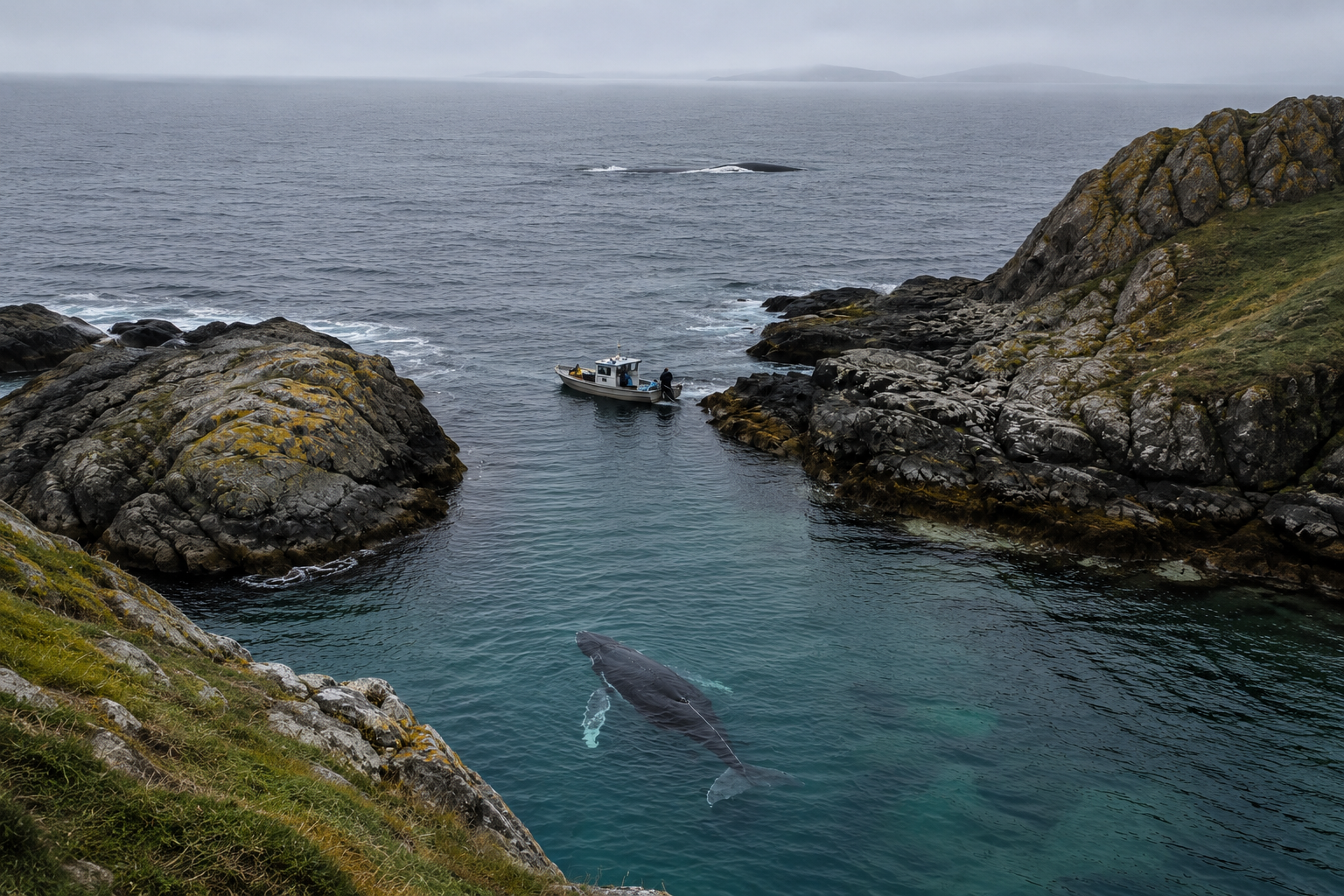
From the cliff above the bay, the problem looked painfully simple.
The calf was inside.
Its mother was outside.
Only a narrow opening between two dark rocky points separated them.
But from the water, the entrance was almost invisible.
The young humpback moved slowly through the cold blue-green cove, surfacing, turning and beginning the same wide circle again. Beyond the entrance, in deeper water, the adult female waited.
Occasionally, her dark back appeared above the gray sea.
Each time, the calf seemed to turn in her direction.
But it never found the passage.
Several small boats had entered the bay carefully. None moved fast. No one wanted to frighten the calf, push it toward the rocks or accidentally place it near a propeller.
The crews tried approaching from behind.
The calf turned away.
They tried leaving space near the entrance.
It circled back toward the center.
They stopped their engines and waited.
Still, the young whale did not leave.
Then someone suggested a completely different kind of rescue.
Instead of showing the calf where to go, they would try to let its mother tell it.
The mother was close—but the calf could not find her
The cove was not completely enclosed.
At high tide, ocean water moved freely through the narrow entrance. But the rocks on both sides distorted the shape of the shoreline, and the passage became difficult to recognize from inside the bay.
The calf was young enough that it would normally have remained close beside its mother.
A young humpback does not simply follow any large object it sees. It learns movement, surfacing rhythm and migration behavior by remaining with the adult female that feeds and protects it.
Now that relationship had been interrupted.
The mother could not safely enter the shallow inner cove without risking becoming trapped herself. The calf could not understand that the darker strip of water between the rocks was its path back.
The animals were separated by only a short distance.
But distance was not the real obstacle.
Direction was.
Why the boats could not simply herd it out
From shore, it may seem that several boats could form a line behind the calf and gently direct it toward the entrance.
In reality, that could make the situation worse.
A frightened whale may turn unpredictably, accelerate toward shallow water or repeatedly change direction. A boat attempting to block one route may accidentally remove the only route the animal was beginning to consider.
Noise also complicates the situation.
Humpback whales do not rely only on sight. They live in an acoustic environment where calls, water movement, wind and vessel noise all travel through the sea.
Research has shown that humpbacks produce many social sounds outside the famous songs associated mainly with males. Mother–calf communication includes comparatively quiet calls that help the pair maintain contact without broadcasting their position across enormous distances.
Those quiet signals can be especially vulnerable to interference.
Even one moving vessel can alter the underwater soundscape around a whale. Humpbacks have been observed changing elements of their calling behavior when natural or human-produced noise increases.
The rescuers therefore faced a contradiction.
They needed a boat to help the calf.
But every additional engine could make the acoustic situation more confusing.
The idea beneath the water
A small research boat remained outside the cove near the mother.
The team lowered a hydrophone—a microphone designed to record underwater sound.
They were not listening for the long, structured song most people associate with humpback whales.
They were waiting for something shorter and quieter.
A contact call.
Studies using acoustic tags on humpback mothers and calves show that both produce calls in specific behavioral contexts, and that sound plays an important role in maintaining their relationship. Researchers have also found that separated mother–calf pairs may increase how frequently they call rather than simply making their calls much louder.
After several minutes, the recording captured a low, brief sound from the adult female.
It was not dramatic.
A person standing on the deck could barely hear it when it was played through headphones.
But the calf did not need a dramatic sound.
It needed something familiar.
The recording was transferred to a second boat positioned near the entrance. A small underwater speaker was lowered carefully below the surface.
The engine was switched off.
For the first time that morning, every boat inside the cove became still.
The first playback changed nothing
The sound played once beneath the water.
The calf continued moving.
It surfaced, breathed and turned slightly away from the boat.
No one moved.
The recording played again, at a restrained level intended to resemble a real nearby call rather than an unnaturally powerful broadcast.
This time the calf slowed.
Its body remained almost completely below the surface, but its movement changed. The broad wandering circle tightened. The calf stopped advancing toward the inner shoreline.
Then it rotated.
Not toward the people.
Not toward the boat itself.
Toward the narrow entrance behind it.
From the cliff, the change was unmistakable.
For the first time, the calf appeared to have a direction.
It was not following the rescue boat
The boat began moving extremely slowly along the deeper side of the channel.
The underwater speaker remained below the surface.
The calf followed at a distance.
This distinction mattered.
It was not behaving like an animal attracted to humans. It was not swimming beside the hull, seeking food or reacting playfully to the wake.
The calf repeatedly aligned its body with the underwater sound source.
When the playback paused, it slowed.
When the sound returned from farther along the passage, it continued.
The crew were not pulling the calf or physically blocking its alternatives.
They were creating an acoustic path.
The method relied on one of the oldest relationships in the calf’s life: the connection between the sound of its mother and the direction of safety.
The most dangerous point
The entrance was narrowest near two partially submerged rocks.
Ocean swell entered from the outside and broke into irregular waves as it passed between them.
The rescue boat could move through the channel easily.
For the calf, the uneven current and unfamiliar rocks created a final barrier.
It stopped again.
Outside the cove, the mother surfaced.
Her exhalation appeared briefly as pale mist against the darker water.
A second low call travelled through the channel.
This one did not come from the speaker.
The calf answered with a short sound of its own.
Then it moved forward.
The boat continued into deeper water, leaving the narrowest part of the entrance clear. The calf passed the first rock, disappeared momentarily in a trough and surfaced again beyond the second.
It was outside the cove.
The moment the equipment was no longer needed
The speaker was switched off.
The calf no longer needed it.
The mother had already turned toward the entrance.
The distance between them closed quickly.
There was no dramatic leap, no enormous splash and no behavior that looked like a human celebration. The adult simply approached until the calf was once again moving beside her body.
Then they travelled together into deeper water.
From the cliff, the two dark backs gradually became smaller.
The boats remained behind.
The goal had never been to make the calf follow people.
It was to help the calf hear the direction it had been trying to find.
Could a rescue like this really work?
The specific sequence shown in the accompanying video is a dramatized reconstruction, not footage from a named, verified rescue operation.
However, the biological foundation is real.
Humpback mothers and calves communicate with social calls. Research suggests that very young calves and their mothers often use relatively quiet vocalizations, a strategy that may help them remain in contact while reducing detection by other animals.
Scientists also use acoustic playback experiments to investigate how animals recognize and respond to sounds. Modern underwater speakers, hydrophones and tracking devices make carefully controlled playback increasingly possible in marine research.
That does not mean rescuers can simply play any whale recording and expect a lost calf to follow.
A real operation would raise difficult questions:
- Was the sound definitely produced by the calf’s mother?
- Would playback attract the calf or frighten it?
- What volume would be safe and biologically realistic?
- Could the sound unintentionally direct the whale toward danger?
- Would vessel noise mask the playback?
- Could repeated playback alter the animals’ natural behavior?
Any real intervention would require experienced marine-mammal responders, acoustic specialists and legal authorization.
The method would have to be treated as a carefully controlled last option—not as a simple trick.
Why the mother’s call mattered
The emotional power of the story comes from a very small change.
The calf did not suddenly become stronger.
The rocks did not move.
The tide did not instantly open a new route.
The calf was given information it understood.
Humans often assume that rescuing a wild animal means physically taking control: lifting it, pushing it, towing it or surrounding it.
But sometimes the safest intervention may be much less visible.
Reduce the noise.
Create space.
Restore a missing cue.
Then allow the animal to make the final movement itself.
The boats did not carry the calf back to its mother.
They helped its mother’s voice reach the right place.
The sound that pointed home
For most of the morning, the calf had been only a short distance from safety.
It could surface.
It could swim.
It could see open water between the rocks.
But it lacked the one thing that transformed movement into direction.
A familiar signal.
The moment that signal reached the inner cove, the calf’s behavior changed. Its circles became a turn. The turn became a path. And the path led through the rocks toward the animal waiting beyond them.
To the people watching from shore, the rescue may have looked like a young whale following a boat.
But the calf was never truly following the boat.
It was following its mother.
