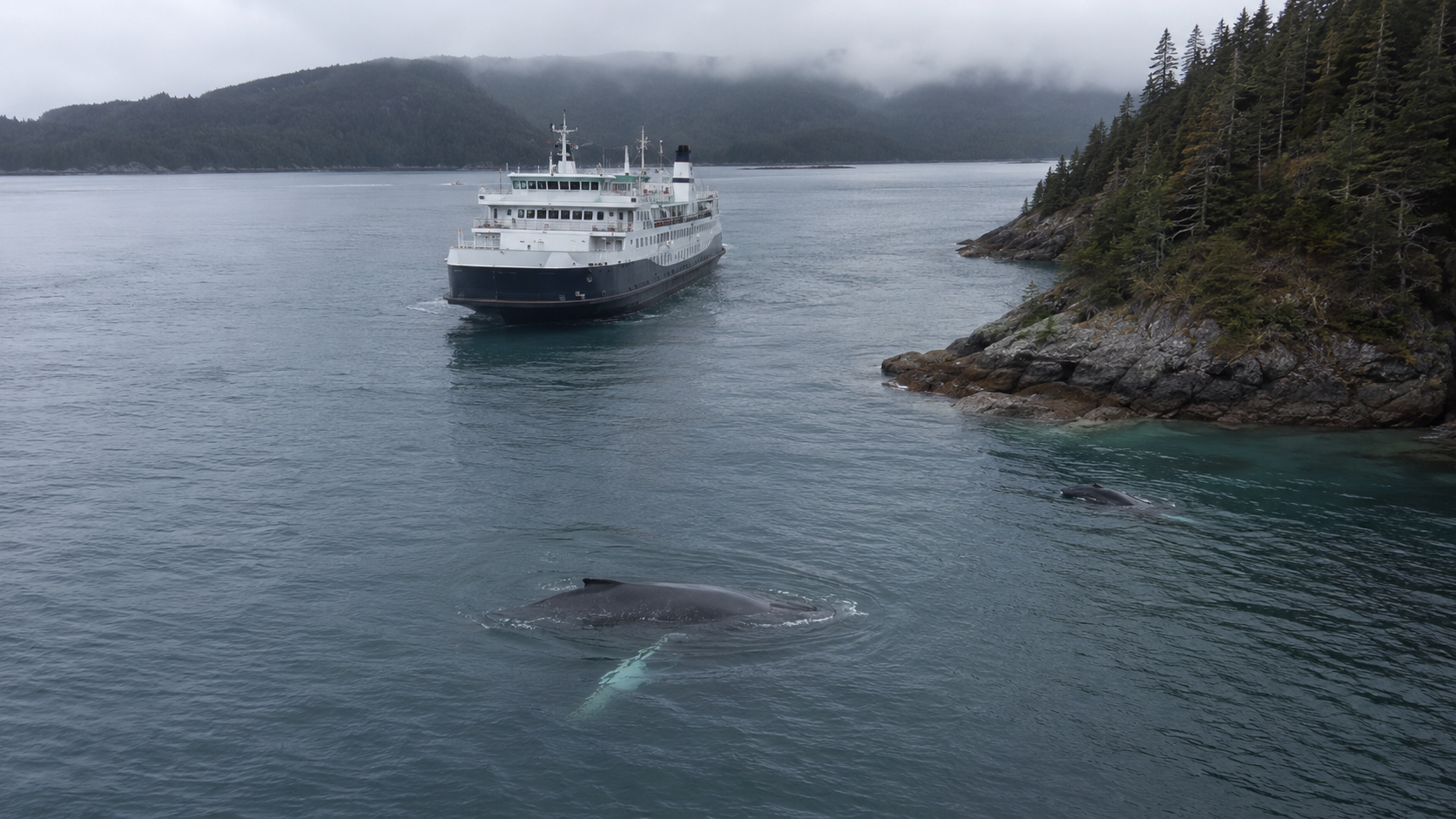
At first, everyone thought the whale was in the wrong place.
The ferry had already slowed as it entered the narrow channel, its white hull moving carefully through the cold blue-green water. On both sides, dark forested mountains rose into low clouds. Mist hung over the fjord, softening the shoreline until the whole place looked quiet, almost empty.
Then the ferry stopped moving forward.
Not because of the weather.
Not because of the rocks.
Because a whale was in the way.
A large humpback had surfaced directly ahead of the ferry, positioned across the channel as if she had chosen that exact place and refused to leave it. She did not breach. She did not slap the water. She did not panic or race away from the vessel.
She simply stayed there.
Passengers gathered along the railings, holding up phones, whispering to each other as the ferry’s engines softened. From the deck, it looked impossible. A massive animal floating between the ferry and the open route ahead, calm but unmoving, while the captain held the vessel back.
At first, people thought she might be lost.
Maybe she had entered the narrow channel by mistake. Maybe she was confused by the engine noise. Maybe she had followed fish too close to the rocky shoreline and now did not know which way to go.
But then the whale surfaced again.
And this time, she turned sideways.
Slowly.
Deliberately.
Her dark back rose through the water, and one pale pectoral fin glowed beneath the surface like a ghostly shape under glass. She placed herself between the ferry and the right side of the channel, where the rocks curved into a small protected pocket of water.
That was when one passenger noticed something near the shoreline.
A second shape.
Much smaller.
At first, it looked like a shadow against the rocks. Then a tiny back broke the surface, followed by a small ripple.
A calf.
The adult whale had not stopped in front of the ferry because she was lost.
She had stopped because her baby was behind her.
The calf was close to the rocky edge of the channel, near a place where the water was calmer but tighter. It was not stranded. It was not bleeding. It was not caught in a net.
But it was in a dangerous position.
The ferry was large enough to move the whole surface of the channel. Even at low speed, a vessel that size can push water, create wake, and change the movement around a narrow shoreline. For a young whale still learning how to hold position in cold, moving water, that sudden pressure could turn calm water into confusion.
The mother seemed to know that.
She remained in the channel.
Between the ferry and the calf.
The captain did not move.
For several long moments, the ferry floated in place while the adult humpback surfaced again and again in front of it. She was not attacking. She was not trying to touch the ship. She was not acting like something out of a movie.
That made it even more powerful.
She was calm.
And she would not move.
On the ferry deck, the mood changed. What had started as excitement became silence. People stopped speaking loudly. Phones were still raised, but now the scene felt different. The whale was no longer a strange obstacle.
She was a mother holding the line.
The calf surfaced again near the rocks, smaller and more vulnerable than anyone expected. Its movements were unsteady, not frantic, but uncertain. It lifted part of its back, dipped below, then came up again in almost the same place.
The mother turned toward it.
Then back toward the ferry.
That was the moment everyone understood.
She was watching both.
The ferry in front of her.
The calf behind her.
And the narrow water between them.
The captain waited.
The engine stayed low. The ferry’s wake faded until the water around the adult whale became almost smooth again. The vessel did not push forward. It did not try to steer around her. In a channel like that, there was no simple way around without moving closer to the calf.
So the ferry stayed where it was.
And the mother stayed where she was.
Minutes passed.
The fjord felt strangely still. Low clouds dragged across the mountains. Small ripples moved along the ferry’s black hull. The adult humpback rose at the surface, breathed, then settled again, her body heavy and steady in the water.
The calf drifted a little farther from the rocks.
Only a little.
But the mother noticed.
She shifted her body, no longer fully across the ferry’s path, but still close enough to block any forward movement. It was as if she was waiting for the calf to find the deeper part of the channel before she would allow the ferry to continue.
Of course, no one could know exactly what the whale was thinking.
But the pattern was hard to ignore.
Every time the calf moved closer to open water, the mother adjusted.
Every time the ferry held position, she stayed calm.
Every time the calf slipped back toward the rocky edge, she turned again and placed herself between the vessel and the shoreline.
The passengers watched a kind of communication that did not need words.
Not between humans and whales.
Between mother and calf.
The baby surfaced once more, this time farther from the rocks. A pale fin flashed beneath the cold water. Its small body angled toward the adult.
The mother turned.
For the first time since the ferry had stopped, she moved away from the center of the channel.
Not fast.
Not suddenly.
Just enough.
She glided toward the calf, crossed slowly through the water, and gave the ferry a little more space.
Still, the captain waited.
No one wanted to be the first thing to break that fragile moment.
The calf came closer to her.
The mother circled once, gently, placing her body on the outside of the calf, between it and the ferry again. This time, though, the calf was no longer pressed near the rocks. It was in deeper water.
The danger had changed.
The ferry was still there.
The mountains were still silent.
But the calf was no longer trapped against the edge of the channel.
The adult whale surfaced one more time, her back rising wide and dark under the grey sky. Then she began to move slowly away, guiding the calf toward the wider part of the fjord.
The ferry remained still until the distance grew.
Only when the two whales had moved clearly away from the route did the engines rise again, softly at first, then with careful control. The vessel did not rush. It moved like everyone on board understood they had just been allowed to pass.
Behind it, the mother and calf continued through the cold water together.
No dramatic rescue had happened.
No one jumped into the sea.
No one touched the whales.
There was no final moment made for a movie.
But that was exactly why people remembered it.
Because the most powerful part of the scene was not what the whale did violently.
It was what she refused to do.
She refused to leave the calf behind.
She refused to let the ferry come closer.
She refused to move until the baby had enough room to get away from the rocks.
To anyone watching from the deck or the shoreline, it looked at first like an animal blocking a ship.
But by the end, it looked like something much older and deeper than that.
A mother saw a danger moving toward her calf.
And she placed herself in the middle.
The ferry was larger than her.
The channel belonged to humans that day.
The schedule, the route, the engines, the passengers — all of it seemed bigger than a single animal at the surface.
But for those few minutes, none of that mattered.
The ferry waited.
Because the whale would not move.
And the whale would not move because her baby was still behind her.
That is what made the story unforgettable.
Not that a whale stopped a ferry.
But that the reason was hidden in the water behind her.
A small calf.
A rocky shoreline.
A mother who understood the danger before anyone else did.
The people on board thought they were watching a whale in the way.
Instead, they were watching a mother become the warning.
And only after the calf reached safer water did she finally let the ferry pass.
