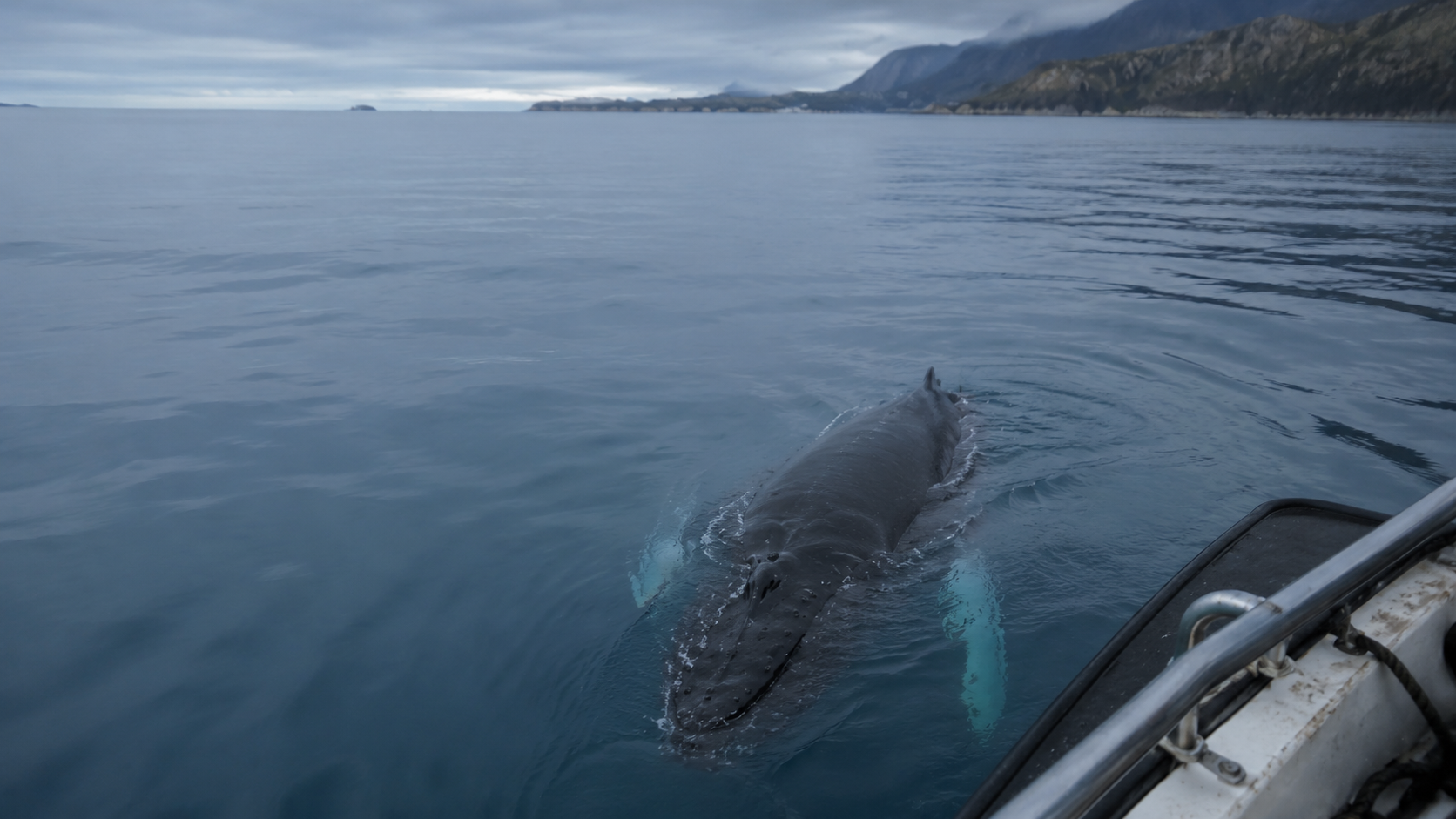
At first, it looked almost beautiful.
A small boat was moving slowly through the cold blue-green water, leaving a soft wake behind it. The sky was pale and overcast. The coastline sat far in the distance, quiet and grey, the kind of morning where every sound seemed to travel farther across the sea.
Then someone on the boat noticed movement behind them.
A dark shape rose just beneath the surface.
It was a young humpback whale calf.
At first, the people on the boat thought it was only passing by. Whale calves sometimes surface near boats. Sometimes they appear curious. Sometimes they move close enough to make everyone on board hold their breath.
But this calf did not pass by.
It stayed.
When the boat moved, the calf followed.
When the boat slowed, the calf slowed too.
When the engine hummed softly through the water, the calf kept coming after it, as if the sound meant something.
That was when the moment stopped feeling cute.
The baby whale was alone.
There was no mother beside it.
No large shadow moving underneath it.
No second blow in the distance.
No protective adult body between the calf and the open water.
Just one young whale, following a machine through the sea.
The people on the boat began to understand that something was wrong.
A humpback calf is not supposed to travel alone like that. In the early part of life, a calf depends heavily on its mother. She guides it, protects it, and keeps it close as it learns the ocean around it. A young whale does not simply choose a random boat as company for no reason.
But this calf kept following.
It did not jump.
It did not splash playfully.
It did not behave like an animal showing off.
Its movements were quiet, steady, and almost desperate.
The calf would fall slightly behind, then push forward again. Its back rose through the water, wet and dark. A pale pectoral fin flashed beneath the surface. Small ripples moved around its body as it tried to stay near the boat’s wake.
Every few seconds, it seemed to correct its direction.
Not toward land.
Not toward other whales.
Toward the boat.
The people on board faced a difficult question: should they stop, or would stopping make things worse?
If they kept moving, the calf might follow them farther away from the place where it had last been with its mother.
But if they stopped too suddenly, the calf might come dangerously close to the hull.
No one wanted to become the reason the baby whale moved farther from where it belonged.
So the boat slowed.
The engine dropped to a softer hum.
And the calf stayed behind them.
That detail mattered.
Because the calf did not seem to be following the people.
It was not trying to reach the boat.
It was not begging.
It was not looking up at human faces.
It was following something lower, deeper, and harder to see.
The sound.
Underwater, the world is not silent. It is full of vibrations, calls, echoes, and low sounds that travel through the sea. Whales live in that world of sound. A calf learns its mother’s presence not only by sight, but by movement, contact, breath, and sound.
To humans, the boat’s engine was only a machine.
To a lost calf, it may have become something else.
A low vibration moving through the water.
A steady noise to follow.
A direction in an empty sea.
Maybe it did not understand what the boat was.
Maybe it only understood that the sound was there, and the sound was moving, and being alone felt worse than following the wrong thing.
That was the heartbreaking part.
The calf was not choosing humans.
It was choosing not to be alone.
The boat slowed even more.
The people watched as the calf came closer, then drifted slightly back again. It seemed tired, but not injured. Its movements were still controlled. It was breathing. It was swimming. But there was a nervousness in the way it stayed near the boat, as if losing that sound would mean losing its only direction.
For several minutes, the boat barely moved.
The water grew quieter.
The engine was lowered to the softest possible movement, then cut.
Suddenly, the sound the calf had been following was gone.
The young whale surfaced behind the boat.
For the first time, it did not immediately continue forward.
It floated there in the cold water, surrounded by small ripples, as if the path it had been chasing had disappeared.
The people on the boat stayed silent.
No one shouted.
No one reached out.
No one tried to touch it.
They only watched.
The calf turned slightly, its body moving in a slow arc beside the boat’s wake. Without the engine sound, the animal seemed uncertain. It drifted, paused, and lifted its back through the surface again.
For a moment, it looked even more alone than before.
Then something changed.
Far across the water, beyond the boat and beyond the pale grey surface, a deeper sound carried faintly through the bay.
The people on the boat could barely hear it.
But the calf reacted.
Its body angled away from the boat.
Not quickly.
Not dramatically.
Just enough.
The young whale turned its head and body toward the open water, toward something the people could not see.
A second later, a distant blow rose near the horizon.
Then another.
Far away, a larger humpback surfaced.
The calf did not rush, but its direction changed completely.
It no longer followed the boat.
It began moving toward the distant sound.
That was when the people understood.
The calf had not been looking for them.
It had been looking for a voice.
The boat had only been the wrong answer.
Maybe the calf had been separated in the fog. Maybe it had followed the wrong vibration after losing contact with its mother. Maybe the low sound of the engine had filled the silence just enough to confuse it.
No one on the boat could know exactly what happened before they saw it.
But they knew what they had seen.
A baby whale alone in cold water.
A boat sound that became a false direction.
A calf that followed because following anything was better than drifting in silence.
And then, finally, a real sound from somewhere across the bay.
The calf moved slowly away.
The boat stayed still.
No one tried to follow it.
The people only watched as the young whale created a small wake of its own, heading toward the distant adult. The space between them was still wide, but now the calf was no longer trailing behind a machine.
It was moving toward the sea.
Toward the sound it should have been following all along.
The moment did not end with a dramatic rescue. There were no cheering people, no perfect close-up, no sudden reunion made for a movie.
Just a small whale turning away from the wrong sound.
Just a boat sitting quiet in the water.
Just the ocean becoming a little less empty.
And that is why the video stayed with people.
Because at first glance, it looked like a strange and beautiful encounter: a baby whale following a boat.
But the longer you watched, the more painful it became.
A calf does not need a boat.
It needs its mother.
It needs the low calls, the body beside it, the path through the water, the living presence that tells it where to go.
For a short time, that calf followed the wrong thing.
Not because it loved the boat.
Not because it trusted people.
But because somewhere in the cold water, a sound had fooled a lonely baby into thinking it was not alone.
And when the real voice finally came from the distance, the calf turned away.
That was the answer.
It was never looking for people.
It was looking for home.
