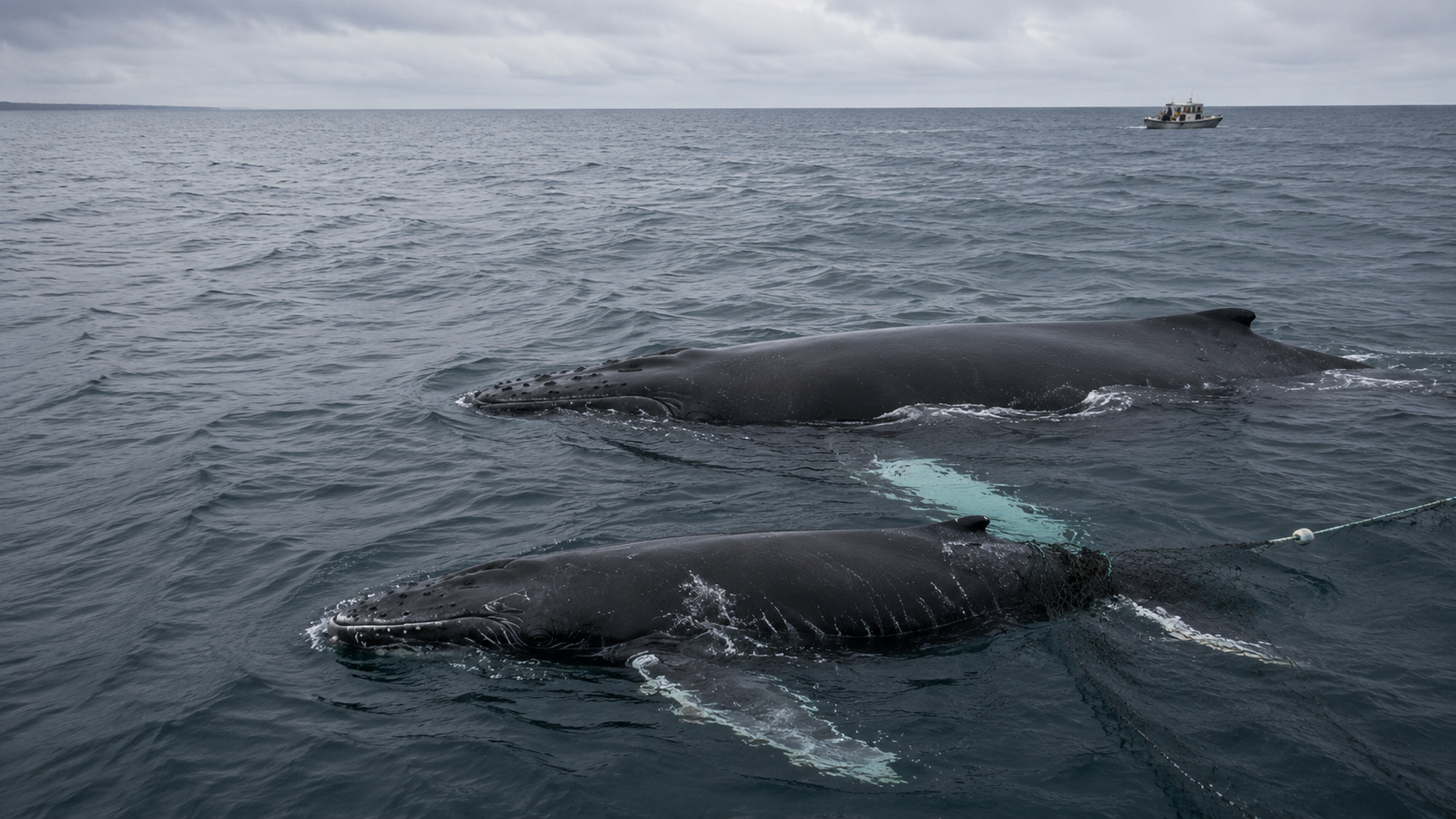
At first, it looked like a mother swimming beside her calf.
A huge humpback whale moved through the grey-blue coastal water, staying close to the smaller body near her side. From above, the scene could almost look calm — a mother and baby moving together during migration.
But something was wrong beneath the surface.
The calf was not swimming freely.
It was caught.
Dark lines of a shark-control net pulled against the young whale’s body, turning a normal migration moment into a fight for survival. The calf was alive, but trapped close to the surface, moving weakly in the water while its mother stayed nearby.
She could have swum away.
She did not.
Instead, she kept coming back.
That is what made the footage so painful. The mother humpback was not simply passing by. She stayed close to the calf, moving around it, returning to it, and coming near enough that she risked becoming trapped too.
In a reported incident near Noosa Main Beach on Australia’s Sunshine Coast, drone footage showed a humpback mother and calf entangled in a shark net. Reports said the mother appeared to wrap herself in the net while trying to reach her trapped calf, turning the rescue into an even more urgent situation.
That is the part that stops people.
The baby was trapped.
The mother came back.
And then the net threatened them both.
For a whale, a net is not just rope. It can become a moving wall under the water. It can tighten around a tail, a fin, or the body. It can drag, cut, exhaust, and panic an animal that must return to the surface to breathe.
A calf is especially vulnerable. It does not have the strength or experience of an adult whale. If it struggles too hard, it can make the entanglement worse. If it tires, it may not be able to surface properly. And if the mother stays close, the danger can spread from one whale to two.
That is exactly why mother-calf entanglements are so frightening.
The calf needs the mother.
But the mother’s instinct to stay close can put her directly into the danger.
Reports from Queensland have described multiple recent incidents involving humpback mothers and calves caught in shark nets during migration season. The Guardian reported that a mother and calf became entangled off Queensland, and that several humpbacks had been caught in shark nets over just a few days.
To understand why this keeps happening, you have to understand what shark nets are.
Despite the name, shark nets do not create a sealed wall protecting a beach. They are fishing-style barriers placed offshore to reduce shark risk near popular swimming areas. But large marine animals can become caught in them too. Queensland’s Department of Primary Industries tells people to report whales and other marine animals entangled in shark nets or drumlines, and warns the public not to approach entangled animals themselves.
That last part is important.
When people see footage like this, the first reaction is usually: why doesn’t someone jump in and help?
But rescuing a trapped whale is dangerous. A stressed humpback can weigh many tons. One movement of the tail can injure or kill a person. The net itself can trap rescuers. And if someone cuts the wrong part at the wrong time, the whale can panic, dive, or tighten the remaining gear around its body.
So rescuers have to wait, approach carefully, and work with trained teams.
That waiting is what makes the video feel unbearable.
The mother is there.
The calf is there.
The net is still there.
And the viewer has no answer yet.
Did the calf get out?
Did the mother get caught too?
Did rescuers reach them in time?
In the Noosa case, a contractor with Australia’s Shark Control Program later freed the mother and calf around 11:30 p.m., according to People’s report. But the situation was still serious, because the whales were reportedly seen later with some netting still attached.
That is why the story is not a simple happy ending.
They were freed.
But the danger did not look small.
And the fact that some gear may have remained attached shows how complicated these rescues can be. Even when a whale escapes the main net, leftover rope or mesh can still threaten its movement, feeding, and long migration.
Humpback whales migrate along Australia’s east coast every year, and mothers with calves are among the most emotionally powerful sights in the ocean. The calf stays close, learning the path, depending on the mother’s body, movement, and protection.
But when a net enters that path, the same closeness that keeps a calf safe can turn into danger.
The mother does what a mother does.
She comes back.
She stays near the baby.
She refuses to leave.
And that is exactly why the footage hurts.
She is not fighting the net like a superhero. She is not breaking it with one dramatic move. Real whales do not behave like movie characters. She is moving carefully, circling, returning, trying to stay with the calf while the net keeps turning the water around them into a trap.
In another Queensland report from Rainbow Beach, officials responded after a mother and calf became entangled, and rescue teams from the state’s shark control program and Marine Animal Release Team went to the scene.
These incidents also create a bigger debate.
Shark nets are placed for human safety, but they can catch animals that were never the target: whales, dolphins, turtles, rays, and other marine life. Conservation groups argue that the nets create a serious risk during whale migration season, especially when calves are moving along the coast with their mothers.
But the public debate is not simple.
Communities want swimmers protected. Marine advocates want non-lethal alternatives. Governments face pressure after shark incidents. And every entangled whale becomes a painful reminder that the ocean does not separate human safety from wildlife risk as neatly as people wish.
For the mother and calf in the footage, none of that debate mattered in the moment.
There was only the net.
The calf caught in it.
The mother coming back.
And the question of whether both would survive.
That is what makes this story different from a normal rescue clip. The emotional weight is not only that a baby whale was trapped. It is that the mother’s love, instinct, or attachment may have brought her into the same danger.
She could have stayed away from the net.
But her calf was there.
So she came back.
Again and again.
And for a moment, the story became almost unbearable to watch: one young whale caught, one mother close beside it, and a rescue that had not yet reached the ending.
The video does not need to show blood.
It does not need to show violence.
It is painful because every viewer understands the same thing:
A baby was trapped.
Its mother would not leave.
And nobody watching could know, in that moment, whether the ocean would give them both back.
In the reported Noosa incident, the mother and calf were eventually released, but the footage still raised concern about the risk of shark nets to migrating whales and their young.
That ending matters.
Because the video begins like a tragedy.
But the full story is more complicated.
There was fear.
There was waiting.
There was a mother who came too close.
There was a calf that could not simply swim away.
And then, after hours of uncertainty, there was a chance.
A chance that both whales could continue the migration they had started.
A chance that the calf could stay beside its mother.
A chance that the story would not end inside the net.
That is why people keep watching these moments.
Not because they want to see suffering.
But because they want to know whether the animal made it.
Whether the mother’s return helped or made things worse.
Whether the rescuers reached them in time.
And whether the ocean, after trapping them in one of its most painful human-made dangers, finally let them go.
The baby was caught in the net.
The mother came back.
And for a while, nobody knew if either of them would make it out.
