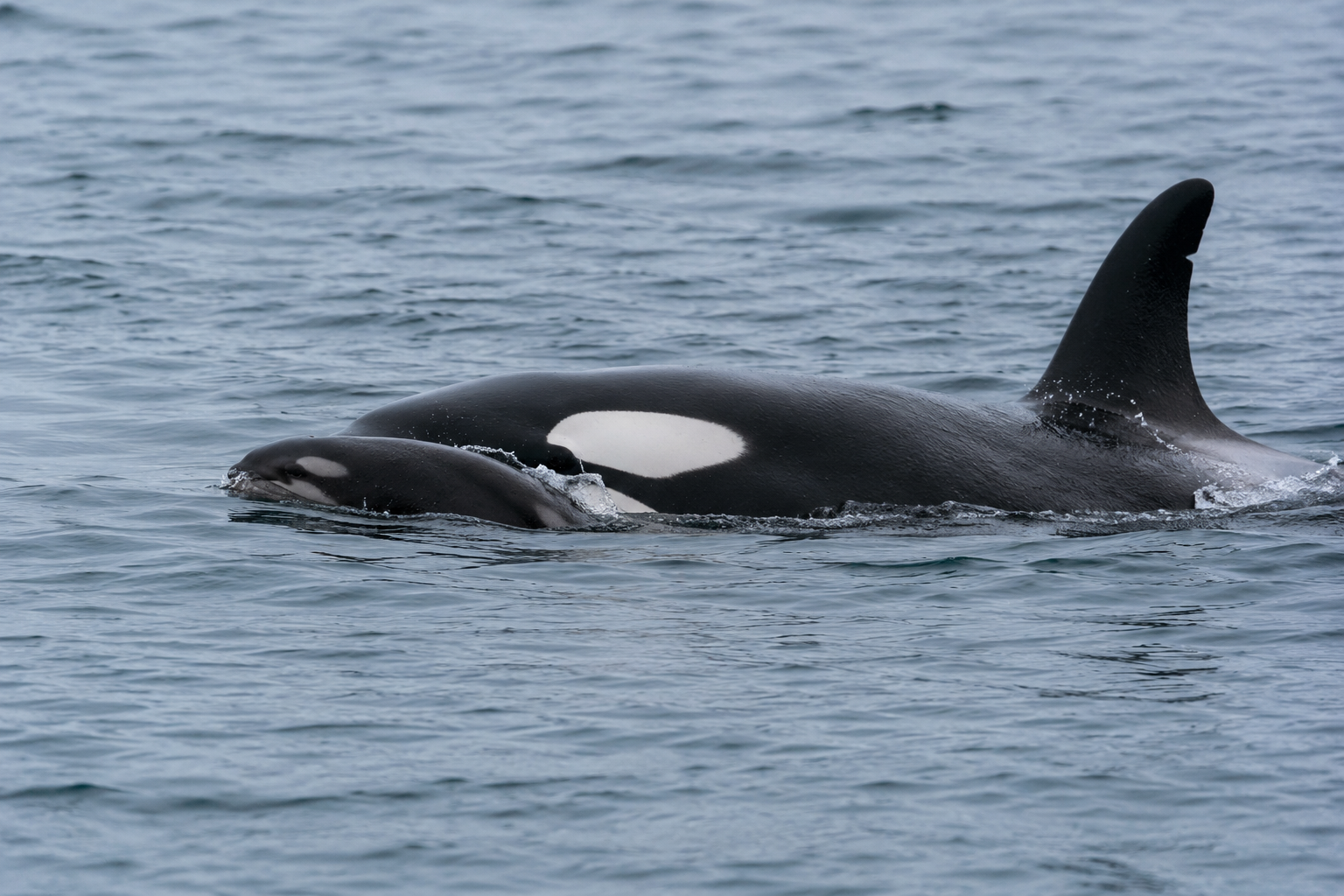
At first, the scene could have looked like an ordinary moment between a mother orca and her newborn.
The mother remained close, keeping the tiny calf beside her as the two moved through the cold water. But something was wrong.
The calf was not swimming.
It did not rise to breathe. It did not move its tail or respond when the waves rolled over its body. Each time it slipped beneath the surface, its mother slowed, turned back and carefully brought it up again.
The mother was J35, a Southern Resident killer whale better known as Tahlequah.
What observers witnessed that day would not end after a few minutes or even a few hours. Tahlequah would continue carrying her dead newborn for approximately 17 days, traveling more than 1,000 miles with her family while repeatedly preventing the calf’s body from sinking.
It became one of the most widely witnessed and emotionally powerful examples of a whale responding to the death of its young.
The calf had been alive only briefly
On the morning of July 24, 2018, a newborn calf was reported swimming beside Tahlequah and other members of J pod near the shoreline of Victoria, British Columbia.
Researchers from the Center for Whale Research immediately traveled toward the whales to document the birth as part of their long-running population census.
By the time they reached the group, the newborn had died.
The exact cause of death could not be determined because the calf’s body was never recovered for examination. Researchers reported that it had been alive only a short time before dying.
The body was already beginning to sink when Tahlequah moved underneath it.
She lifted the calf onto her forehead and rostrum—the front part of an orca’s head—and began pushing it through the choppy water. Whenever the small body slipped away, she dived beneath it and brought it back to the surface.
This was not a single rescue attempt.
She kept doing it throughout the day.
When the sun went down, she was still carrying her baby.
She refused to leave the body behind
A newborn orca cannot survive without remaining close to its mother. The calf depends on her for milk, protection, guidance and assistance in keeping pace with the pod.
Tahlequah’s calf, however, could no longer follow her.
To continue moving with J pod, the mother had to balance or push the small body while swimming. When waves or movement caused it to fall away, she had to stop, turn around and retrieve it again.
The following day, researchers found that she was still doing exactly that.
She supported the calf on her head, pushed it across the surface and repeatedly recovered it whenever it sank. The rest of the family continued traveling through the Salish Sea, and Tahlequah continued with them while carrying the additional burden.
Her behavior was physically demanding. She still needed to travel, breathe, search for food and remain connected with her pod. Carrying the calf interrupted the smooth, energy-efficient movement that orcas normally use while traveling.
Yet she did not release it.
Days passed, and the mother continued bringing the body back.
The answer was 17 days
The behavior continued much longer than researchers initially expected.
For approximately 17 days, Tahlequah transported the calf while J pod moved through the waters of Washington State and British Columbia. The Center for Whale Research estimated that the family traveled roughly 1,000 miles around the Salish Sea during what became known publicly as a “tour of grief.”
There was no single straight journey from one location to another. The whales continued following their natural routes, searching for salmon and moving through their habitat. Tahlequah carried the calf as she traveled with them.
The tiny body repeatedly slipped from her head.
She repeatedly returned for it.
From research boats and shorelines, people watched the same behavior happen again and again: the calf beginning to disappear, the mother turning, diving underneath it and lifting it back into the air.
Eventually, after more than two weeks, Tahlequah was observed without the body.
She had finally let it go.
No one knows exactly what caused that final moment. The calf may have become too difficult to carry, the body may have separated from her during deeper water or Tahlequah may have finally stopped retrieving it.
Scientists could document what she did.
They could not enter her mind and know precisely what she understood or felt.
Was Tahlequah grieving?
Many people described Tahlequah’s behavior as mourning or grief.
Scientists are usually more cautious with those words because an animal’s internal emotional experience cannot be directly measured. Instead, researchers sometimes describe this type of action as postmortem attentive behavior—continued attention, physical contact or caregiving directed toward a dead member of the same species.
A scientific review published in 2018 examined 78 documented cases of whales and dolphins responding to dead companions. Most involved toothed whales and dolphins, and among cases where the attending animal’s sex was known, adult females caring for dead calves or juveniles represented the majority.
Documented behaviors included:
- keeping a body from sinking;
- carrying it on the head, back or rostrum;
- pushing it through the water;
- remaining close for extended periods;
- performing actions resembling attempts to revive or protect it.
Researchers proposed several possible explanations. A mother may initially continue the caregiving behavior that would normally save a living calf. She may have difficulty recognizing or accepting that the calf can no longer recover. The behavior may also reflect the powerful attachment formed between a mother and her young—and something comparable to grief following the sudden breaking of that bond.
Those explanations are not mutually exclusive.
Tahlequah may have begun by attempting to help her calf and continued because the bond did not disappear when the calf stopped breathing.
NOAA Fisheries has also described her behavior as reflecting the strong lifelong bonds and grieving responses observed in killer whales and other highly social mammals.
Why the bond between an orca mother and calf is so powerful
Killer whales do not simply meet, reproduce and separate.
They live within complex family societies. Pods are largely composed of maternally related individuals, and whales often remain closely connected to their mothers and matrilines throughout their lives. Their calls, hunting knowledge and movement patterns are learned and passed between generations.
For Southern Resident orcas, both sons and daughters generally remain with their mothers rather than permanently leaving the family as adults.
A mother is therefore not caring for a calf only until it becomes independent. She may continue traveling, feeding and communicating with that offspring for decades.
The connection begins immediately after birth.
A newborn calf must remain beside its mother, learn when to surface and use the moving water around her body to reduce the energy required to swim. The mother protects it while it develops the strength and coordination needed to survive.
When Tahlequah’s newborn died, the physical caregiving stopped being able to save it.
But her behavior continued.
One calf’s death represented something even larger
Tahlequah belongs to the Southern Resident killer whale population, a fish-eating community composed of J, K and L pods.
The population was listed as endangered under the United States Endangered Species Act in 2005. NOAA Fisheries identifies three major, interacting threats to its recovery: insufficient prey—particularly Chinook salmon—pollution and contaminants, and noise and disturbance from vessels.
The July 2025 census counted only 74 Southern Resident killer whales.
In such a small population, every successful birth matters.
A newborn is not simply one more individual. It represents the possibility of another reproductive adult, another link in a family line and another chance for the population to survive.
That made the loss of Tahlequah’s calf painful on two levels.
It was the loss experienced by one mother.
It was also another failed birth for an endangered community struggling to replace the whales it continued to lose.
What happened to Tahlequah afterward?
After she stopped carrying the calf, Tahlequah remained with her family.
Two years later, in September 2020, researchers documented her with another newborn. The calf, identified as J57 and later given the name Phoenix, appeared active and healthy while swimming beside her.
The birth did not erase what happened in 2018.
But it showed that Tahlequah had survived the physically demanding journey and remained capable of producing and caring for another calf.
Her story was no longer only about death.
It also became a story of endurance.
The moment that changed how millions saw orcas
Tahlequah did not know that people were following her journey.
She did not carry the calf to make a statement or become a symbol. She was simply behaving in the only way she could at that moment—remaining with her newborn and repeatedly preventing it from disappearing beneath the surface.
But to the people watching, her actions made the emotional and social lives of killer whales impossible to ignore.
The most powerful part of the story was not a dramatic breach, an attack or an extraordinary display of strength.
It was the repetition.
The calf slipped away.
The mother turned back.
She lifted it again.
And for 17 days, she continued refusing to leave it behind.
