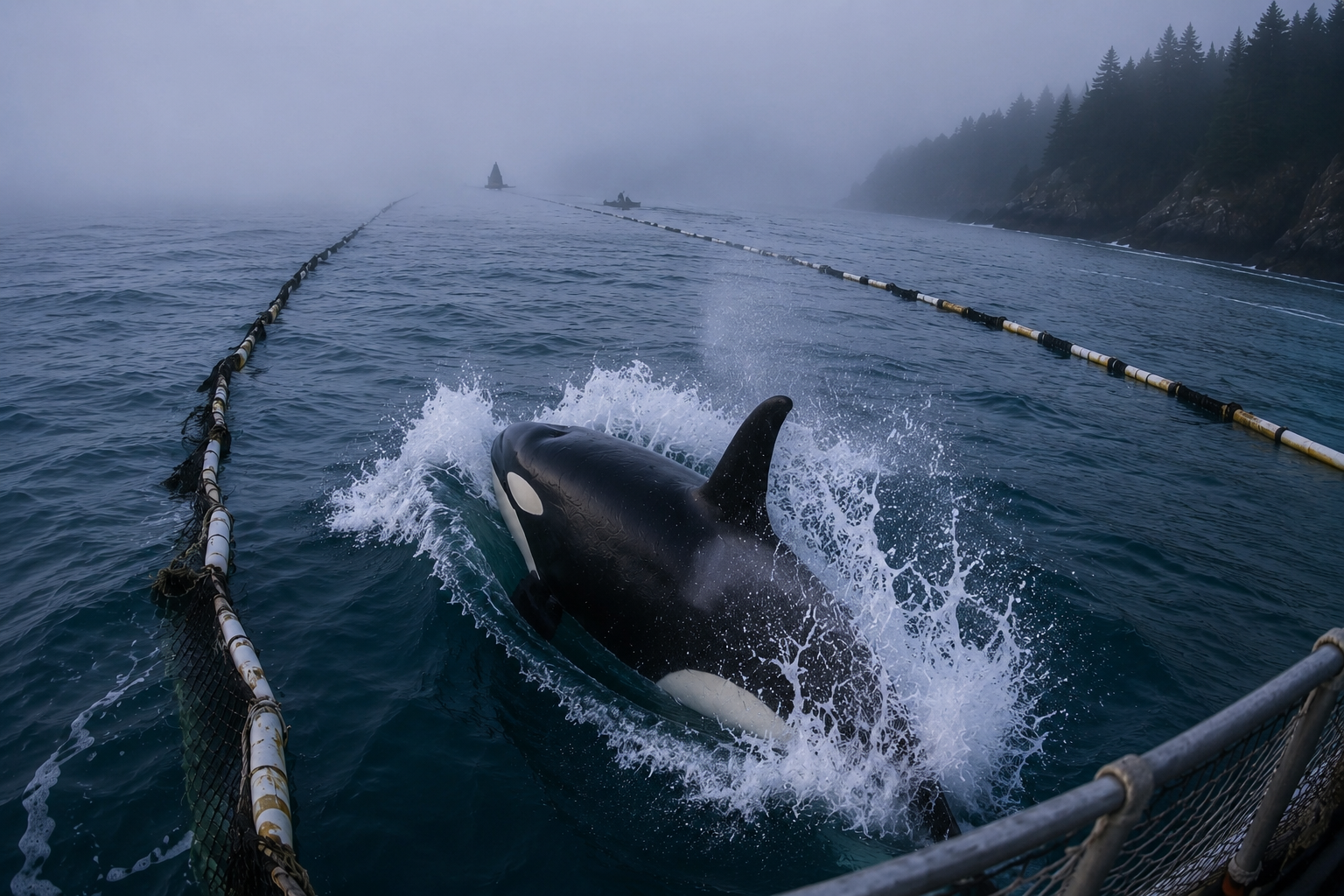
It was never supposed to be made public. A highly classified piece of security footage, captured by underwater monitoring cameras in a remote Norwegian fjord, has recently leaked online, sending shockwaves through the marine biology community and viral algorithms alike.
The video captures a massive, breathtaking, and terrifying moment: a mature female orca, known to researchers as “Lula,” launching her entire multi-ton body directly into heavy steel-reinforced barrier nets.
The Mystery of the Fjord Enclosure
For nearly three years, Lula had been kept in a semi-wild research enclosure in northern Norway. While the facility claimed she was being monitored for “behavioral adaptation studies” after a minor injury, local wildlife advocates had long argued that her captivity was unnecessary.
The facility was heavily guarded, and the public was rarely allowed near the deep-water pens. Researchers insisted that Lula was content, showing no signs of distress or desire to leave the quiet waters of the fjord.
However, on a foggy, overcast morning, the calm waters of the fjord turned into a battleground. Security cameras set up to monitor the perimeter of the enclosure captured Lula swimming at an unusually high, aggressive velocity. She wasn’t just swimming; she was charging.
With immense kinetic force, she rammed her body against the floating barrier nets. The impact was so violent that it shook the boat-mounted cameras nearby, sending massive plumes of icy sea foam into the air.
What They Really Heard From the Deep
While the visual footage of a giant predator breaking through steel nets is dramatic, it is what researchers recorded on their underwater hydrophones (acoustic microphones) just minutes before the breakout that tells the true, heart-wrenching story.
For days, the research team had noticed Lula acting restless, refusing food, and continuously placing her head near the outer barriers. When they analyzed the audio logs from that morning, they discovered the shocking truth:
- Faint Distant Calls: Deep-sea hydrophones picked up incredibly faint, high-pitched vocalizations coming from the open ocean outside the fjord.
- A Mother’s Recognition: The acoustic signature matched the unique “family dialect” of Lula’s original pod, which had been migrating past the outer coast of Norway.
- The Sound of a Calf: Most heartbreakingly, among the calls was a distinct, rapid acoustic pattern—the signature distress call of a young orca calf.
Lula hadn’t just decided to escape; she had heard the desperate cries of her lost baby calling out to her from the deep, vast ocean. The mother’s maternal instinct completely overrode any training or boundary she had known for the past three years.
The Climax of the Escape
According to leaked logs, the facility staff tried to use acoustic deterrents (devices that emit loud sounds underwater to keep whales away from nets) to stop her. But Lula completely ignored them.
Risking severe injury to her skin and dorsal fin, Lula used her massive tail flukes to drive herself over and through the tensioned nets. The barrier visibly bent and snapped under her weight.
The security footage cuts black shortly after the impact, a detail that led many to believe the facility tried to cover up the extent of the damage. Once past the broken line, she immediately dove into the deep, dark abyss of the North Atlantic.
The Global Reaction and Search
The leak of this video has sparked massive outrage online, with millions of people demanding the permanent closure of such marine research facilities. Activists argue that keeping highly intelligent and emotional creatures like orcas in isolation is a form of torture.
Following the incident, the research facility released a brief statement acknowledging a “barrier breach due to unusual environmental factors” but refused to comment on the audio recordings of the calf or Lula’s current whereabouts.
Fortunately, independent marine tracking groups had been monitoring the frequencies. The data received over the next 24 hours confirmed what everyone hoped for:
- High-Speed Transit: Lula swam at maximum velocity toward the outer shelf of the Norwegian Sea, covering over 80 miles in just a few hours.
- The Reunion: By midnight, satellite tags synced her perfectly with the coordinates of her original wild orca pod traveling north towards Iceland.
- A Happy Ending: Acoustic monitoring later captured the joyful, synchronized vocalizations of a mother and calf reuniting in the wild.
Lula is now far away from the concrete walls and metal nets of the research facility. She is back in the open ocean, exactly where she belongs, guiding her baby through the deep.
What do you think about Lula’s story? Should marine animals ever be kept in captivity for “research” or “conservation”? Let us know your thoughts in the comments below!
