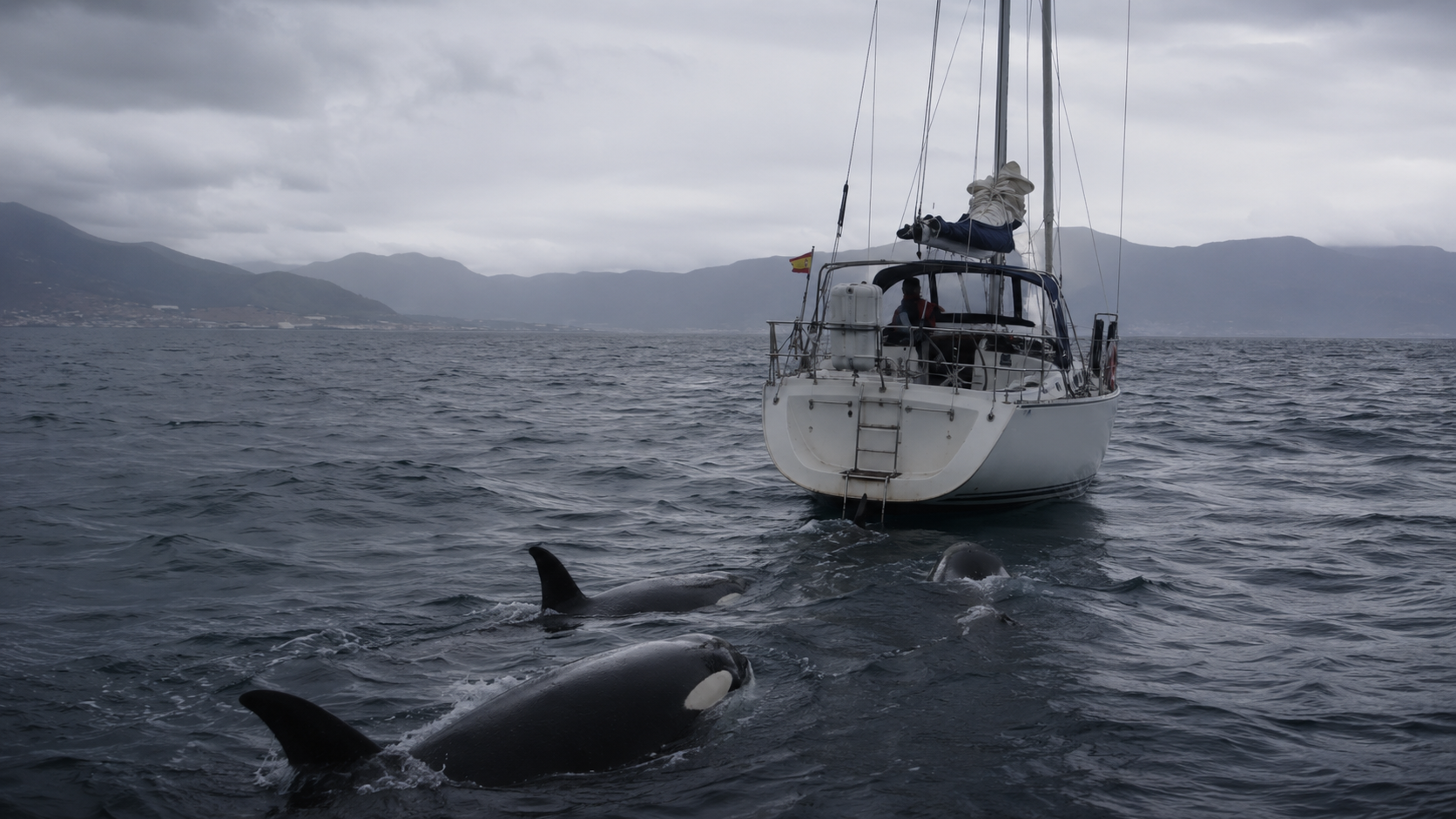
They are called killer whales for a reason.
So when black fins appeared behind a small sailing boat, it was easy to imagine the worst.
A few people on board.
Deep water underneath.
Several orcas moving close to the stern.
From the outside, the scene looked terrifying. A small yacht rocked in the grey Atlantic water while the ocean’s most powerful predators moved around it with calm, heavy confidence.
Anyone watching the video could think the same thing:
The orcas were attacking the boat.
But the strangest part of these encounters is not how close the orcas came.
It is what they ignored.
They were not coming for the people.
They were not trying to climb onto the deck. They were not chasing swimmers. They were not behaving like animals looking for a human target.
They kept going back to something else.
And that detail changes the whole story.
For years, sailors near Spain, Portugal, Morocco, and the Strait of Gibraltar have reported frightening encounters with Iberian orcas. Since 2020, these whales have been involved in repeated interactions with boats, especially sailing vessels. In many cases, the orcas approached from behind, contacted the boat, and left crews shaken. Some boats were damaged badly enough that they could no longer steer. A 2024 workshop report sponsored by Spanish and Portuguese authorities described these incidents as interactions where the whales often ram the rudder, sometimes breaking it and making the vessel unnavigable.
That word is important.
The rudder.
Not the people.
Not the deck.
Not the cabin.
The rudder.
A rudder is the part of the boat that controls steering. It sits in the water behind the vessel. When it moves, the boat turns. If it breaks, the boat can become almost impossible to control.
And that is exactly the part the orcas kept returning to.
To a person on board, it still feels like danger. There is no pretending otherwise. A large animal striking a boat in open water is terrifying. In 2024, AP reported that two people aboard a 15-meter boat in Moroccan waters requested help after an orca knocked the vessel several times, damaged the rudder, and caused a leak; the people were rescued, and the boat later sank.
So yes, the danger is real.
But danger does not always mean the same thing as a hunting attack.
That is the part people miss.
If the orcas were trying to hunt humans, the pattern would probably look different. But in these Iberian encounters, the repeated focus has been on the rear steering area of the boat. AP also reported that there have been no reports of attacks against swimmers, and that the boat interactions seem to stop once the vessel becomes immobilized.
That is why the story is stranger than the headline.
The orcas were close enough to frighten anyone.
But they were not acting like they were searching for people.
They were focused on the part of the boat that moves underwater.
The part that reacts.
The part that can be pushed, hit, bent, or broken.
The rudder may be the key.
Orcas are not random ocean monsters. They are intelligent, social animals. NOAA describes killer whales as highly social, usually living in pods, communicating with learned calls, and using hunting tactics shaped by culture. Different orca groups can have different diets, different behaviors, and different traditions.
That matters because the Iberian boat encounters may not be simple aggression.
A group of orca experts warned in an open letter that calling the interactions “attacks” can be misleading. They noted that much of the damage to rudders and keels appears to come from strikes or rams with the head or body, rather than the whales ripping the rudders apart as they might if it were hunting behavior. The same letter said the behavior may be frightening and costly for humans, but from the whales’ side, it seems to be somehow rewarding.
That does not make it harmless.
A damaged rudder can put people in danger.
A sinking boat is a serious emergency.
But it does mean the story is not as simple as “killer whales are attacking people.”
The orcas may be doing something far more unusual.
They may be playing.
They may be testing the moving part of the boat.
They may be copying one another.
They may have discovered that the rudder gives them a reaction.
Or they may be repeating a behavior that started with a few individuals and spread through the group.
Experts have compared the behavior to a fad — a strange behavior that appears in a population, spreads for a while, and may eventually disappear. The Animal Welfare Institute reported that these Iberian orca interactions appear to be play from the orcas’ point of view, even though the damage to boats can be serious.
That idea may sound strange to sailors who have lived through it.
But animal play is not always gentle.
A young predator can play with something and still destroy it. A large intelligent animal can be curious and still cause serious damage. From the orca’s point of view, the rudder may be interesting. From the human point of view, it can become an emergency.
Both things can be true at once.
The 2024 workshop report also warned that harmful reactions from people — such as firecrackers, electrocution, or other dangerous deterrents — could hurt the whales and may even make the situation worse. The report recommended avoiding known hotspots where possible and moving away if an encounter begins, while using methods that do not harm the whales or the environment.
This is especially important because the Iberian orcas are not a huge population. The workshop report described them as critically endangered, with probably fewer than 40 individuals.
That makes the whole situation more complicated.
The same animals that frighten sailors are also animals conservationists are trying to protect.
They are powerful enough to disable a boat.
But vulnerable enough that bad human reactions could threaten their future.
That is why the detail matters.
The video may look like an attack at first.
Black fins.
A small boat.
Orcas close behind.
People trapped above deep water.
But when you look closer, the story changes.
They were not coming for the people.
They were going back to the same part of the boat.
The underwater steering blade.
The rudder.
That one detail turns a simple fear story into one of the strangest ocean mysteries in the world.
Why that part?
Why not the people?
Why return to it again and again?
Why do some interactions stop when the boat can no longer steer?
No one can say with complete certainty what the orcas are thinking. Scientists are careful not to turn the animals into villains or heroes. The experts behind the open letter warned people not to project revenge stories or dramatic human motives onto the whales, because the real reason is still not fully known.
But the pattern is hard to ignore.
The orcas are not behaving randomly.
They are not simply exploding with violence.
They are repeatedly focusing on one specific part of the vessel.
And that is why these videos are so powerful.
They scare people first.
Then they confuse them.
Because if the ocean’s most famous predators were close enough to attack the people, but kept returning to something else, then the real question becomes impossible to ignore:
What did they want from the boat?
The answer may be hidden under the stern.
In the one part of the yacht most viewers never notice.
The rudder.
And until researchers fully understand why the orcas are so drawn to it, every video of black fins circling a small boat will continue to feel like something between a warning, a mystery, and a reminder.
The ocean does not always explain itself.
Sometimes it only shows us enough to make us afraid.
Then it leaves one detail behind — the detail that changes everything.
