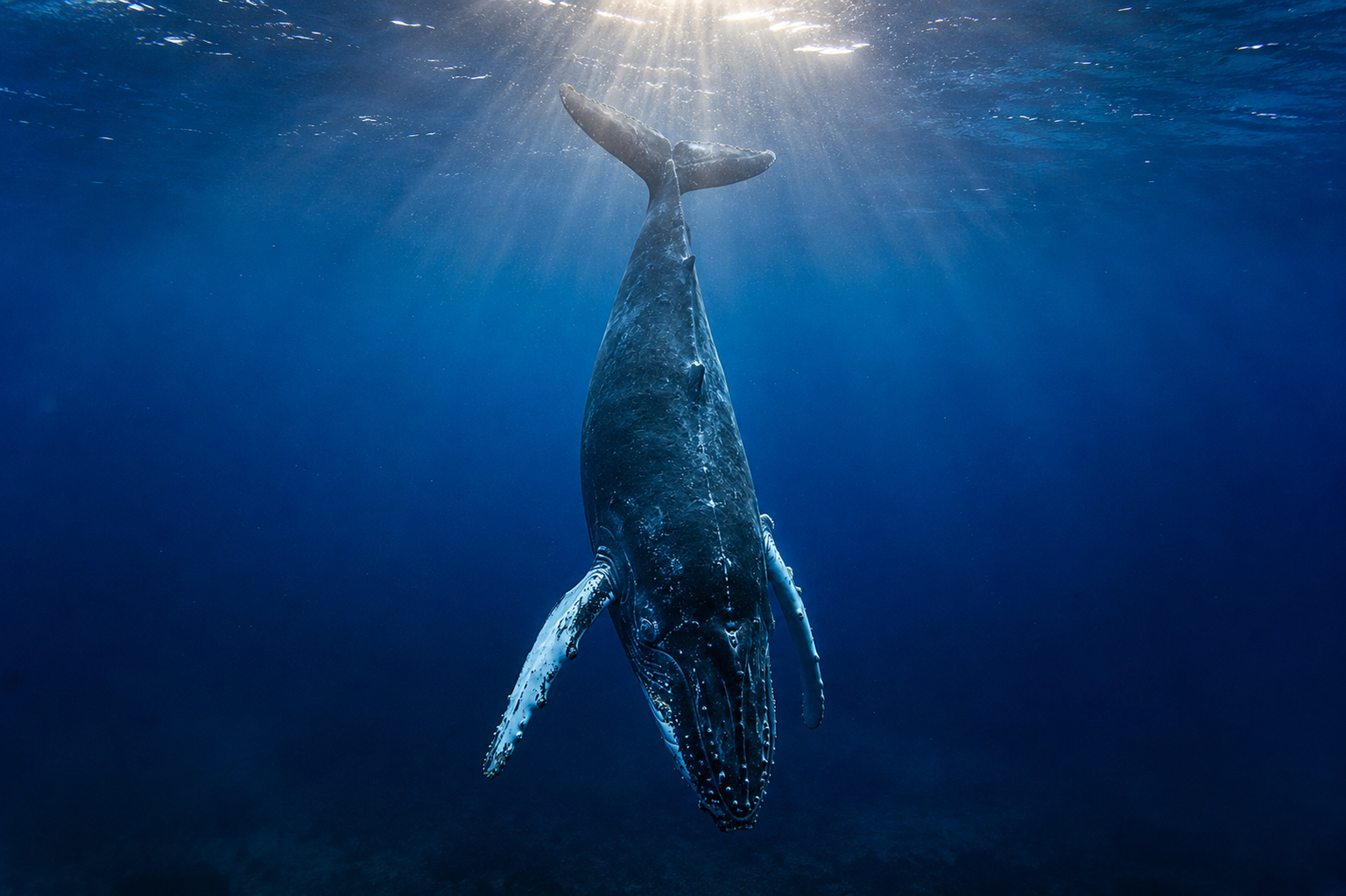
Somewhere off the eastern coast of Australia, a male humpback whale hangs almost motionless in the deep blue.
He is not swimming. He is not feeding. He is not going anywhere.
His head is angled downward, his tail slightly higher, his long white pectoral fins drifting open like wings. He is fourteen metres of muscle and old scar tissue, suspended in the water column like a cathedral organ waiting to be played.
And then he begins to sing.
The sound does not come out of his mouth the way a human voice does. Humpbacks have no vocal cords. The song is produced deep inside the body, forced through air passages, and it moves out of him and into the water in long, low, complex phrases — moans, cries, groans, rising figures that repeat and build. A single song can last twenty minutes. He may repeat it for hours.
Water carries sound roughly four times faster than air, and low frequencies travel enormous distances underwater. His voice does not stay near him. It spreads.
For a long time, that was the end of the story as most people understood it: whales sing, and it is beautiful, and we do not entirely know why.
But that is not the strange part.
The strange part is what happens to the song after it leaves him.
The thing researchers noticed
Humpback whale song is not random noise. It has structure — units arranged into phrases, phrases arranged into themes, themes arranged in a fixed order. Every male in a population sings essentially the same song at the same time. It is shared, learned, and remarkably consistent.
But it does not stay the same. It changes. Slowly at first, then all at once.
Researchers listening to humpback populations across the South Pacific began to document something they had not expected. They were recording the songs of whales off eastern Australia. Then they recorded whales off New Caledonia. Then Tonga. Then Niue. Then the Cook Islands. Then French Polynesia — thousands of kilometres east, a completely different population, whales that had never been observed mixing with the Australian group.
And they found the same song.
Not a similar song. Not a song with a comparable structure. The same song, with the same themes, in the same order — as if a piece of music had been carried across the ocean and reproduced note for note.
Then they looked at the dates.
The song appeared off eastern Australia first. It appeared in New Caledonia later. Tonga later still. It arrived in French Polynesia roughly two years after it began, having travelled east across the South Pacific in a chain — one population to the next, in sequence, over a distance of thousands of kilometres.
The whales at the far end of that chain were singing a song that had been invented by whales they had almost certainly never met.
Nobody taught them
This is where the story stops being about music and starts being about something else entirely.
The song did not spread the way a bird call spreads, through inheritance. It did not spread through instinct. Every male in a population abandons his old song and takes up the new one — and the new one is not his own. It came from somewhere else. He learned it.
Scientists studying this pattern reached for a word that is not usually applied to animals.
Culture.
The songs, researchers concluded, are transmitted horizontally — learned from peers rather than inherited from parents — and they move across the ocean in waves. When a population drops its existing song entirely and adopts a new one from another region, researchers call it a song revolution. The term is not decorative. It is describing a complete, rapid replacement of one shared behaviour with another, spreading through a population and then jumping to the next.
It is, as far as we can tell, the largest known example of cultural transmission in any species other than our own.
Consider what that requires. A whale must hear a song that is not his. He must recognise it as different. He must learn it — not approximately, but with enough precision that the version he sings can be matched to the original on a spectrogram years later and thousands of kilometres away. And then he must sing it in place of the song he already knew, along with every other male around him.
No teacher. No school. No boat carrying the recording east. No shared language in any sense we would recognise.
And yet it moved.
It gets stranger
If the story ended at the South Pacific, it would already be remarkable. It does not end there.
Research published in Royal Society Open Science documented song sharing between humpback populations in entirely different ocean basins — whales off Brazil in the South Atlantic and whales off Madagascar in the southwest Indian Ocean, singing songs with shared themes despite being separated by the width of an ocean.
How the song crossed is not settled. Perhaps whales from the two populations overlap somewhere in Antarctic feeding waters, where different groups converge in the southern summer, and songs are overheard there. Perhaps individual whales wander between populations and carry the music with them. Perhaps the low frequencies simply travel far enough, in the right conditions, for a song to be heard across distances we have not properly measured.
Every explanation is plausible. None of them is proven.
The question that will not close
What we can say with confidence is small and strange:
A whale invents something. Other whales copy it. The copy spreads outward through populations that do not appear to mix, moving in a direction, over years, across thousands of kilometres of open ocean — and arrives intact.
That is not instinct. Instinct does not travel in one direction on a timeline. That is transmission. That is a behaviour being passed from individual to individual, across a distance, until an entire ocean basin is doing the same thing.
We have a word for that when humans do it.
The male humpback off eastern Australia does not know that he is at the beginning of something. He hangs in the blue, head down, fins open, and he sings the song he has learned, the way every other male around him sings it.
Somewhere east of him, in water he has never seen, another whale is listening.
And in two years, that whale will be singing this song.
We still do not know how.
