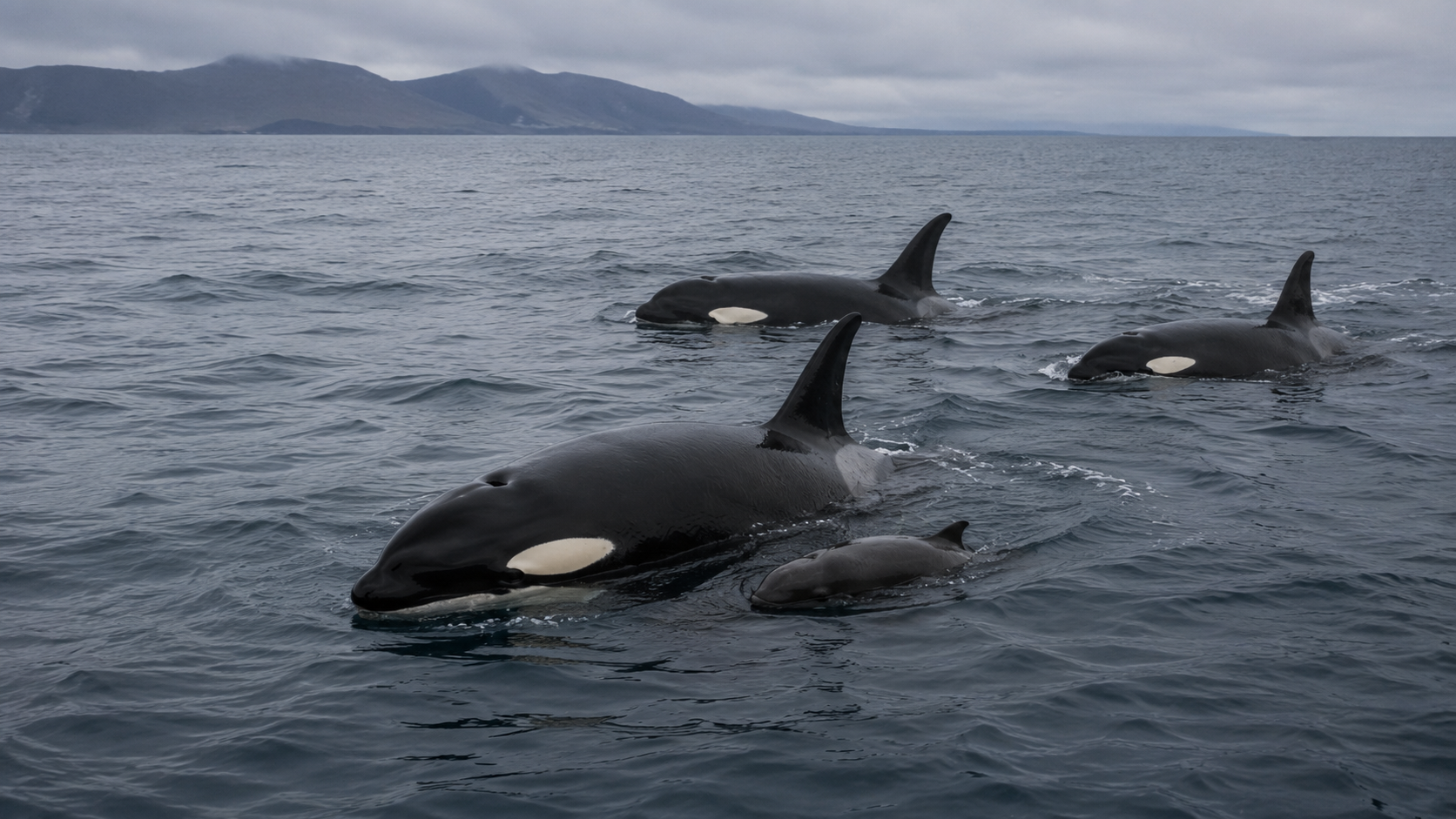
At first, it looked like a normal orca sighting.
A small group of killer whales moved through the cold water off Iceland, black backs breaking the surface, white eye patches flashing in the grey light. For researchers watching from a boat, the scene looked familiar: wild orcas traveling together, feeding, surfacing, and moving as a group.
Then one of the animals beside them caught their attention.
It was tiny.
Too tiny.
At first glance, it seemed like a young orca calf swimming close beside the pod. But something was wrong. The baby did not have the markings of an orca calf. It did not have the white eye patch. It did not have the black-and-pale-orange coloring seen in very young orcas. Its body was dark, compact, and different.
The baby whale swimming with the orcas was not an orca at all.
It was a newborn long-finned pilot whale.
That single detail turned an ordinary wildlife observation into one of the strangest marine mammal mysteries researchers have documented in recent years.
Scientists studying orcas off South Iceland observed unusual interactions between killer whales and newborn long-finned pilot whales between 2021 and 2023. The encounters involved different pilot whale calves and different orca groups, and researchers later described the cases in a 2025 study in Ecology and Evolution.
What makes the mystery so powerful is not just that two species were near each other. Animals share the ocean all the time. The strange part is where the baby was swimming.
In these sightings, the newborn pilot whale was not far away from the orcas. It was close beside them, sometimes next to an adult female in what scientists call an echelon position — the same kind of position a calf might use while swimming near its mother. Scientific American reported that in the observed cases, a weeks-old pilot whale swam beside and slightly behind a female killer whale, and in some cases the orcas nudged the calf along.
That image is what stops people.
A baby whale, not an orca, swimming as if it belonged beside an orca.
But did it belong there?
That is the question.
One possible explanation is the darkest one: predation.
Orcas are apex predators, and some orca populations hunt marine mammals. A helpless newborn pilot whale would be vulnerable. It is possible that the orcas had taken the calf and were keeping it close before killing or eating it. But researchers are careful here, because the Icelandic orcas involved are mostly known as fish-eating orcas, and the observed behavior did not look like a clear aggressive hunt. Scientific American reported that the orcas did not show obvious aggressive behavior toward the calves, making predation less likely, though not impossible.
That is what makes the story complicated.
If the orcas were hunting, why keep the baby close for so long?
If they were not hunting, why was the baby there at all?
A second possibility is play.
Orcas are intelligent, social animals. They explore, manipulate objects, interact with other species, and learn behaviors from one another. Young orcas, especially, can engage in behavior that looks strange to humans because it may involve practice, curiosity, or social learning.
The baby pilot whale may have been caught up in something like that — not a clear rescue, not a clear adoption, but an unusual interaction where the orcas treated the calf as something to move, nudge, follow, or investigate.
This would not make the encounter harmless. Play between large predators and a tiny newborn whale could still be dangerous. Even without a direct attack, the calf would be separated from its own mother and from the milk it needed to survive.
A third possibility is the one that people find most emotional: nurturing.
Maybe the orcas were responding to the baby as if it were a calf. Maybe a female orca’s parental instincts were triggered. Maybe the calf’s behavior, size, and position beside the adult created something that looked almost like care.
But even this explanation has limits.
Researchers have warned against calling it true adoption too quickly. The interactions appeared short-lived, and newborn pilot whales need milk. Scientific American reported that none of the female orcas were lactating at the time, and the calves would likely have died without milk.
That is the painful part of the mystery.
Even if the orcas were not attacking the baby, even if the behavior looked gentle or curious, the calf still may not have survived.
No one knows exactly where the babies came from.
No one knows whether they were lost, abandoned, separated, taken, or encountered by chance.
And no one knows what happened to them afterward.
Study co-author Filipa Samarra, principal investigator at the Icelandic Orca Project, raised the central unanswered questions: were the calves lost or abandoned, or did the orcas actively approach to take them? Researchers also wondered whether the calves escaped, died, were killed, or were eaten.
That is why this story is so much stronger than a simple “orca adopted a baby whale” headline.
Because the truth is not that simple.
It could be care.
It could be play.
It could be hunting practice.
It could be predation.
Or it could be something that combines more than one of those things.
One researcher quoted by Scientific American said the explanations may not be mutually exclusive: some orcas may have encountered the calf opportunistically, some individuals may have played with it, and others may have tried to nurture it.
That uncertainty is the heart of the story.
Orcas are not simple animals. They are not mindless killers, and they are not gentle cartoon heroes. They are intelligent predators with cultures, family bonds, hunting traditions, and social behaviors that scientists are still trying to understand.
Pilot whales are also highly social animals. A newborn pilot whale would normally be near its own mother and group, not alone beside a completely different species. So when one appears in the middle of an orca pod, something unusual has already happened before the camera ever starts recording.
That is what makes the sighting so haunting.
The video shows the mystery, but it does not solve it.
A tiny dark calf moves beside a large female orca. The orca does not immediately attack. The baby stays close. The pod continues through the cold water. For a moment, it almost looks like the calf is part of the group.
But it is not.
And that is what researchers noticed.
The baby did not match the pod around it.
It belonged to another species.
Off Iceland, long-finned pilot whales and killer whales do interact, and earlier research has found that interactions between the two species can often be antagonistic, with killer whales avoiding pilot whales or moving away at high speed. That makes the newborn calf sightings even more unusual. These were not simply adult pilot whales and orcas passing each other in the ocean. These were tiny calves close beside orcas in a position that looked strangely intimate.
There may also be a larger environmental context. Some researchers have suggested that changing ocean conditions could bring species into closer contact more often. Scientific American reported that pilot whales may be moving farther north as prey such as mackerel shift into warmer waters, increasing overlap with Icelandic orcas.
That does not explain everything.
But it may explain why such encounters could become more visible.
As the ocean changes, old boundaries between species may shift. Animals that rarely met in certain places may cross paths more often. And when intelligent social animals meet under unusual conditions, their behavior can surprise us.
The baby pilot whale mystery is not just about one calf.
It is about how little we still know.
Humans like clean explanations. We want to label the behavior quickly: adoption, kidnapping, play, rescue, hunting. But the ocean rarely gives us answers that simple.
What researchers saw was a real event.
A newborn pilot whale was swimming with orcas.
The baby was not an orca.
The orcas kept it close.
And the reason remains uncertain.
That uncertainty is not a weakness in the story. It is the story.
Because the most fascinating wildlife moments are not always the ones where we know exactly what happened. Sometimes the most powerful moments are the ones that force scientists to ask new questions.
Why was the calf alone?
Why did the orcas keep it near them?
Were they curious?
Were they practicing?
Were they nurturing?
Were they waiting?
Or were we watching a behavior that does not fit neatly into any human category?
For the people who saw it, the moment began as confusion. A calf looked wrong. A pod looked normal, except for one small animal that did not belong. Then the truth became stranger than the first impression.
It was not an orca calf.
It was a baby from another species, moving beside one of the ocean’s most powerful predators.
And somewhere in that cold Icelandic water, for a short time, the baby stayed close.
Maybe it was being protected.
Maybe it was being played with.
Maybe it was in danger.
Maybe all three possibilities were closer together than we want to admit.
That is why this story stays with people.
Not because it gives an easy answer, but because it leaves us staring at the ocean with a question we still cannot fully answer:
Why did the orcas keep a baby whale that was not their own?
