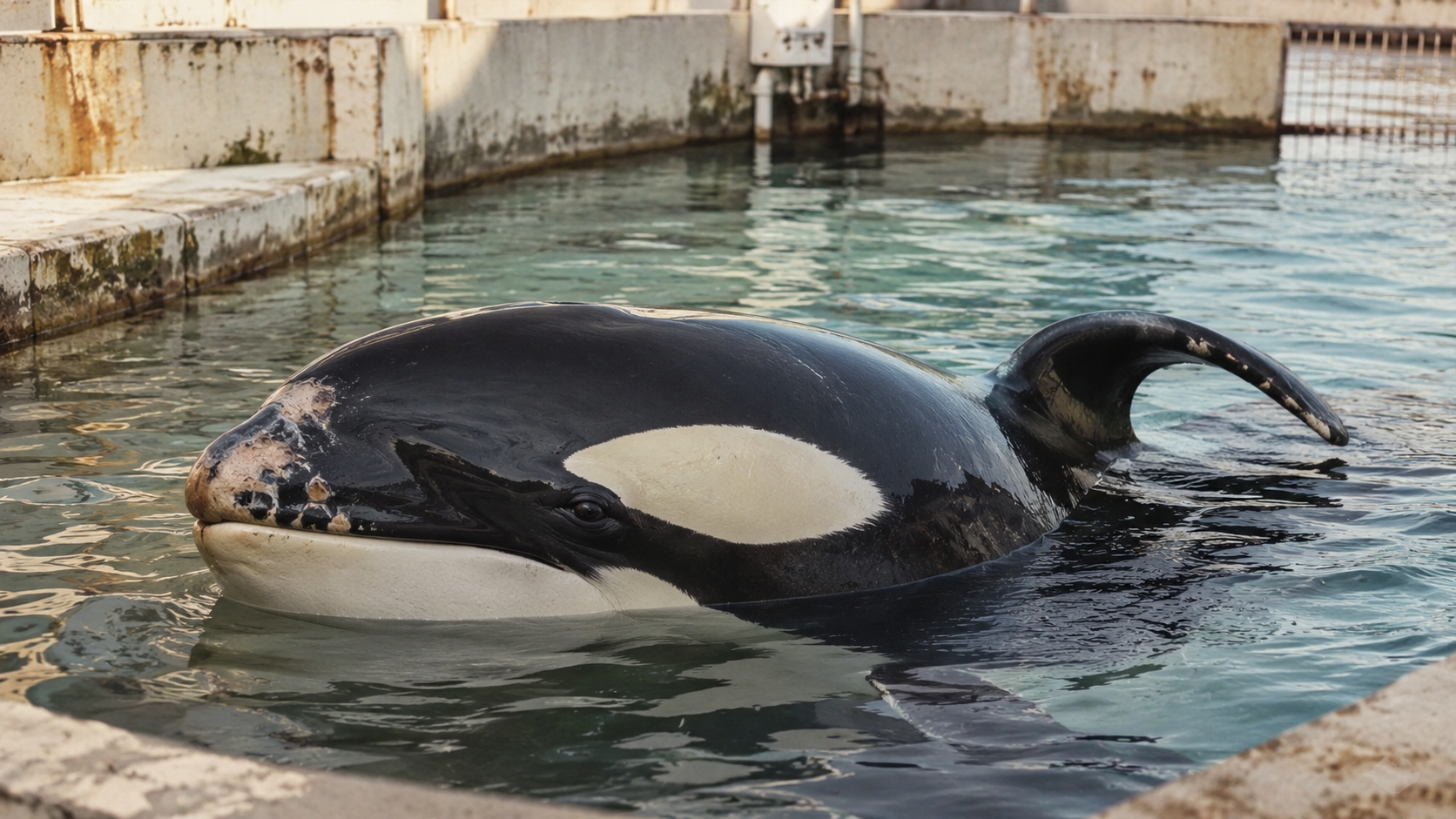
Hugo was a young orca captured from the waters of Washington and sent to Miami Seaquarium. His life in captivity became one of the darkest stories ever told about captive killer whales.
Hugo’s story is not as famous as Tilikum’s, but for many people who study orcas and captivity, it remains one of the most disturbing stories ever connected to a marine park.
He was not born in a concrete tank. He was not born to perform for crowds. He was born in the cold, open waters of the Pacific Northwest, where orcas live in family groups, travel long distances, communicate through complex calls, and spend their lives moving through an ocean that is almost impossible to imagine from inside a pool.
But Hugo’s life changed when he was still very young.
According to multiple accounts of his history, Hugo was captured in 1968 from the waters of Washington State, when he was only about three years old. He was taken from the wild and eventually sent to the Miami Seaquarium in Florida, far from the cold waters and family structure he had known as a calf. World Animal Protection describes him as having been captured from Vaughan Bay off Washington in February 1968 and held first in a small pool known as the “Celebrity Pool.”
For a young orca, that change was enormous.
In the ocean, killer whales can travel many miles in a single day. They live in social groups with deep family bonds. They communicate through sound, hunt together, rest together, and learn from older members of their pod. Hugo was taken from that world and placed into a human-made environment where everything was smaller, louder, and controlled.
At Miami Seaquarium, Hugo became the park’s first orca. He was presented to the public as a powerful and impressive animal, a symbol of entertainment and human control over the ocean. But behind the shows and the photographs, his life was shaped by confinement.
The tank could never offer the space, depth, distance, or social world of the ocean.
Two years after Hugo arrived, another young orca entered the Miami Seaquarium: Tokitae, later known to the public as Lolita. She had also been captured from the Pacific Northwest, during the infamous Penn Cove capture in 1970. NOAA Fisheries describes Tokitae as a Southern Resident killer whale captured from Penn Cove, Washington, and later held at the Miami Seaquarium.
For a time, Hugo and Tokitae became the orca pair associated with the park.
To visitors, they were performers. To the business, they were attractions. To the public, they appeared in a show that seemed exciting and extraordinary. But to people who later looked back at their lives, Hugo and Tokitae became symbols of a much darker question: what happens when highly intelligent ocean animals are forced to spend their lives in tanks?
The answer, in Hugo’s case, became painful.
Reports about Hugo’s behavior describe an orca who did not adapt well to captivity. He was said to have repeatedly struck his head against the walls and viewing windows of his tank. The Dolphin Project wrote that Hugo was commonly reported to bash his head against the tank walls and that one incident left him with a serious rostrum injury after he broke a hole in the plastic viewing window.
The rostrum is the front part of an orca’s head, an extremely important and sensitive area. In Hugo’s story, injuries to that part of his body became one of the most haunting details people remember.
A captive orca with a damaged head, a collapsed dorsal fin, and a body confined inside concrete became an image many people could not forget.
Some people have described Hugo’s repeated head-banging as suicide. That word is powerful, and it is easy to understand why people use it when they hear the story. But scientifically, we have to be careful. We cannot know exactly what Hugo understood, intended, or felt in human terms.
What we can say is that his behavior was abnormal, distressing, and repeatedly associated with injury.
That alone is enough to make the story tragic.
Hugo was not an old animal when he died. He died on March 4, 1980, at around 15 years old. His reported cause of death was a brain aneurysm. Several sources discussing his life connect that aneurysm to his history of repeatedly hitting his head against the tank walls, although the exact medical relationship is difficult to prove from public records alone. World Animal Protection says Hugo died of a brain aneurysm at only 15 and describes the death as likely connected to repeated head-bashing in the tank.
For an orca, 15 is young.
In the wild, orcas can live for decades. Females can live especially long lives, and even male orcas commonly survive far beyond their teenage years when conditions allow. Hugo’s life ended before he had even reached what should have been the mature middle of his life.
That is one reason his story still feels so heavy.
It was not only that he died in captivity. It was that his life seemed to show visible signs of distress long before the end came.
The smallness of the tank matters in this story. When people see old images or recreations of Hugo’s environment, what stands out is the contrast between the animal and the space around him. An orca is not a small creature. A male killer whale can grow to great size, with a powerful body built for movement, speed, depth, and distance.
Inside a concrete pool, that body becomes almost too large for the frame.
Every turn is limited. Every movement is repeated. The wall is always there. The sound is different. The water is not the ocean. The animal can swim, but he cannot travel. He can surface, but he cannot leave. He can hear, but not the living soundscape of his home waters.
That is the emotional center of Hugo’s story.
It is not just a story about one injury or one death. It is a story about a wild animal placed into a world too small for him.
After Hugo died, Tokitae remained at Miami Seaquarium for decades. Her life later became one of the most famous captivity cases in the world. The Whale Sanctuary Project describes Tokitae/Lolita as having spent more than 50 years in what it calls the smallest orca tank in North America, widely known as the “whale bowl.”
Hugo, however, was gone much earlier.
His death did not become a global movement at the time in the way it might today. There was no massive social media campaign. There were no viral videos reaching millions of people overnight. There was no instant public pressure from around the world.
But the story stayed alive.
Animal advocates, researchers, writers, and people who care about orcas continued to mention Hugo because his life represented something difficult to ignore. He was an early warning. He showed what could happen when a powerful, intelligent marine mammal was kept inside a space designed for human entertainment rather than animal welfare.
One of the most painful details often repeated about Hugo concerns what happened after his death. Some reports say his body was disposed of without ceremony, and some accounts claim his remains were taken to a county landfill. Because details vary across sources, the safest way to describe this is carefully: Hugo’s death was followed by reports that his body was disposed of in a way many people later saw as deeply disrespectful. A Miami Herald historical summary described Hugo as having died in 1980 of a brain aneurysm, possibly after years of head-bashing, and reported that he was laid to rest without fanfare, reportedly in a county landfill.
Whether someone hears that detail for the first time or the tenth, it is hard not to feel the contrast.
In life, Hugo was advertised as something extraordinary. In death, he was reportedly treated like something disposable.
That contrast is why his story still hurts.
People often ask why captive orcas develop collapsed dorsal fins, damaged teeth, repetitive swimming patterns, or unusual behaviors. Not every captive animal has the same experience, and every facility history is different. But Hugo’s story is one of the cases that made many people question whether these animals can ever truly belong in small artificial enclosures.
Orcas are not only large. They are socially and mentally complex. Their lives are shaped by family, sound, movement, memory, and learning. To remove a young orca from the ocean is not simply to move an animal from one place to another. It is to remove him from a culture of sound and relationship that humans are still trying to understand.
That is why Hugo’s story should not be reduced to shock value.
The real horror is not only the final moment. The real horror is the years before it.
The years inside walls. The repeated contact with concrete. The injuries to his rostrum. The collapsed fin. The performances. The fact that the ocean he came from was thousands of miles away. The fact that, even with another orca beside him for part of his life, the environment was still fundamentally not his world.
When people watch a recreation of Hugo today, they may notice the wall first. Then the damaged-looking head. Then the fin. Then the eye.
That is the moment the story becomes more than history.
Because the eye of an orca does something powerful to people. It reminds us that this was not a machine in a show. This was not a character. This was not a prop. Hugo was a living animal with a body built for the sea and a life that ended inside a tank.
The question Hugo leaves behind is uncomfortable:
How much suffering does an animal have to show before people believe it?
For years, marine parks told stories about education, wonder, and connection. Many people truly did fall in love with whales because they saw them in captivity. But stories like Hugo’s forced the public to look at the other side of that experience. The wonder people felt in the stands may have come at a terrible cost to the animal in the water.
Today, public opinion about orca captivity has changed dramatically compared with the era when Hugo was captured. More people understand that seeing an orca perform tricks is not the same as understanding or respecting an orca. More people ask where the animal came from, how it lives, how much space it has, and what kind of life it would have had in the wild.
Hugo did not live long enough to see that change.
He died young, far from his home waters, after years in captivity.
But his story is still remembered because it says something that should not be forgotten: some animals are too intelligent, too social, and too wild to be turned into entertainment.
Hugo was not born for concrete walls.
He was born for the ocean.
And the tragedy of his life is that he never found his way back.
