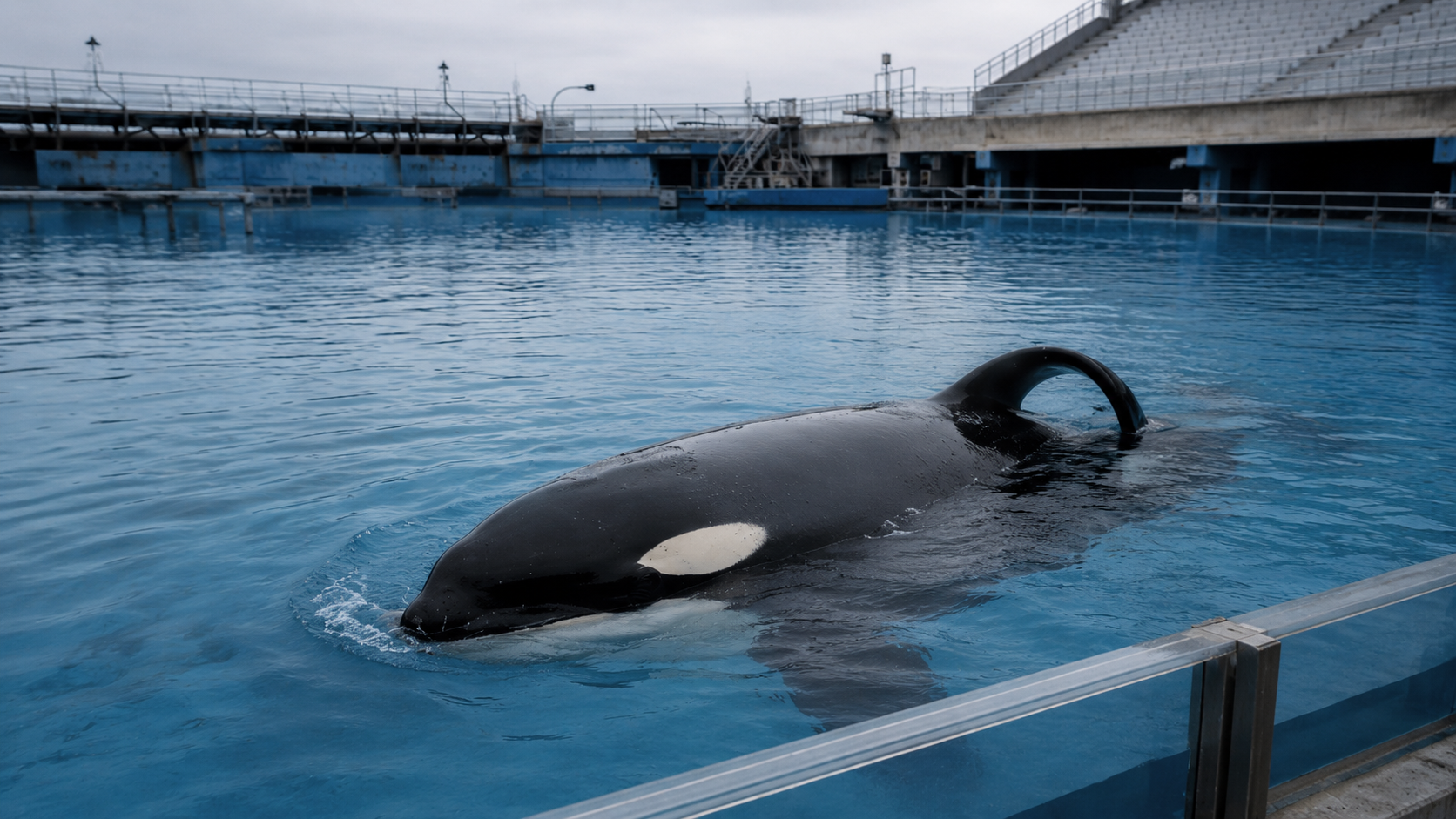
For years, the world knew his name for one reason.
Tilikum.
The giant orca at SeaWorld Orlando. The whale connected to headlines, controversy, fear, and one of the most powerful documentaries ever made about animals in captivity.
To many people, he became known simply as dangerous.
But that word never told the whole story.
Because behind the headlines was not a monster from the ocean. Behind them was a massive, intelligent, social animal who had spent most of his life inside tanks — far away from the open waters his species was built for.
And when people look back at Tilikum today, the question is not only what he did.
It is what happened to him.
A Young Orca Taken From the Ocean
Tilikum’s story did not begin in Florida.
It began in the cold waters near Iceland, where he was captured in 1983 when he was still young. After being held in Iceland, he was later sent to Sealand of the Pacific in Canada before eventually being moved to SeaWorld Orlando. By the time the public knew him as one of the most famous orcas in captivity, his life in the wild was already far behind him.
For a wild orca, that separation matters.
Orcas are not solitary animals. They are highly social whales that live in family groups called pods, and many populations are built around strong family bonds. NOAA describes killer whales as highly social animals, often living in pods with complex social structures.
That is what makes Tilikum’s story so difficult to reduce to a headline.
He was not just a large animal in a tank.
He was a member of one of the most socially complex species in the ocean.
The Image People Could Not Forget
One of the most recognizable things about Tilikum was his dorsal fin.
In the wild, adult male orcas are known for their tall, powerful dorsal fins. But Tilikum’s fin was fully collapsed, hanging heavily to one side. For many people, that image became a symbol of captivity itself: a huge ocean animal, physically changed by a life lived in an artificial world.
The fin was not the whole story. But visually, it said what words often could not.
He looked enormous.
He looked powerful.
And yet, inside the tank, he also looked confined.
That contrast is why Tilikum’s image still affects people years later. A giant black-and-white body moving through pale blue water. Concrete walls nearby. A collapsed fin above the surface. A whale built for distance, rhythm, depth, and family — living in a controlled space made for human viewing.
It was hard to look at him and not feel that something was wrong.
The Headlines That Defined Him
Tilikum became infamous because he was involved in human deaths, including the death of SeaWorld trainer Dawn Brancheau in 2010. Those events were tragic, serious, and cannot be ignored. They changed public discussion around captive orcas and raised difficult questions about safety, captivity, and the pressure placed on both animals and trainers.
But the problem with headlines is that they flatten everything.
They turn a life into a label.
Dangerous.
Aggressive.
Killer whale.
But Tilikum’s story was more complicated than that.
To understand why people still talk about him, we have to look at the full picture — not just the moments that shocked the public, but the years of confinement, performance, breeding, isolation, and debate that surrounded his life.
He did not become famous because he lived a normal life.
He became famous because his life forced people to ask whether a place built for entertainment could ever truly meet the needs of an animal like him.
The Whale Behind Blackfish
In 2013, the documentary Blackfish brought Tilikum’s story to a much wider audience. The film focused on orca captivity, SeaWorld, and the events surrounding Tilikum’s life. It pushed millions of viewers to think differently about animals they had once seen mainly as performers.
For some, the documentary was the first time they understood how intelligent and social orcas are. For others, it raised questions they had never asked before: What happens when an animal that travels through vast ocean spaces is kept in a tank? What happens when a social predator is placed into an artificial environment? What happens when entertainment and animal welfare collide?
SeaWorld strongly disputed parts of the film and defended its animal care. But whether people agreed with every part of Blackfish or not, the impact was undeniable. In 2016, SeaWorld announced that the orcas in its care would be the last generation at the company and that it would end all orca breeding.
That decision showed how much public opinion had changed.
And Tilikum was at the center of that shift.
The Tank Was Never the Ocean
The most haunting part of Tilikum’s story may be the simplest.
He was an ocean animal living in a tank.
That sentence alone carries the weight of the whole debate.
In the wild, orcas travel, hunt, communicate, dive, and live within social worlds that humans are still trying to understand. Their lives are shaped by sound, movement, memory, and family. A tank can provide food, medical care, and observation — but it cannot become the ocean.
That is the emotional core of Tilikum’s story.
Not just that he was famous.
Not just that he was controversial.
But that a massive animal, born for open water, spent decades in a human-made space where every wall reminded viewers of the distance between captivity and the wild.
People called him dangerous.
But many also began to ask whether danger was the only word that mattered.
Was he dangerous?
Or was he damaged?
Was he unpredictable?
Or was he a wild animal placed in a life no wild animal was designed to live?
Those questions are uncomfortable.
But they are the reason his story still matters.
His Final Years
In 2016, SeaWorld said Tilikum’s health was deteriorating and that he was being treated for a serious lung infection. On January 6, 2017, SeaWorld announced that Tilikum had died. Reports at the time said he had been treated for a persistent and complicated bacterial lung infection before his death.
He was estimated to be about 36 years old.
By then, he had become more than a single orca. He had become a symbol — of captivity, controversy, grief, anger, and change.
Some people remembered him with fear. Some remembered him with sadness. Some saw him as a victim of a system that asked too much from animals. Others defended the care he received and focused on the people harmed in the tragedies connected to him.
All of those emotions still surround his name.
That is why Tilikum’s story is not simple.
And maybe it should not be.
More Than a Headline
The easiest version of Tilikum’s story is the one told in a few words:
A dangerous killer whale.
But the real story is heavier than that.
Tilikum was a captured orca. A performer. A breeding male. A controversial animal. A symbol in a global debate. A whale whose life changed the way millions of people looked at marine parks.
He was also a living animal who spent decades in captivity.
That does not erase the tragedies connected to him.
But it does force us to look deeper.
Because wildlife stories are rarely simple when humans are part of them.
Tilikum’s life asks a painful question: what happens when one of the ocean’s most powerful, intelligent animals is placed inside a world built for people?
The answer is still being debated.
But one image remains hard to forget.
A giant orca.
A collapsed fin.
A concrete tank.
And a name that the world still remembers — not only because of what he did, but because of what his life made people finally see.
