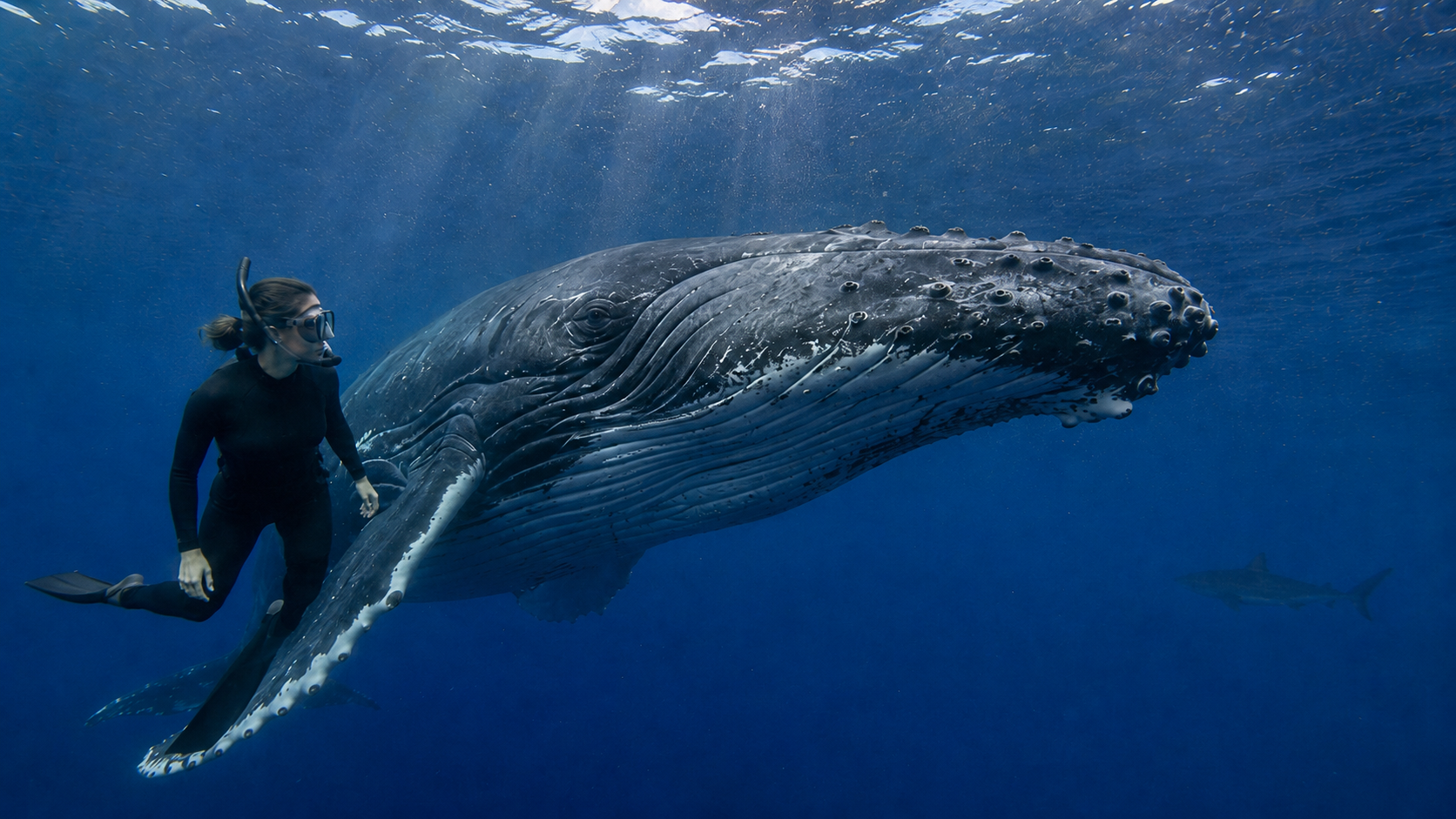
A strange encounter between a humpback whale and a diver became one of the most discussed whale stories ever. At first, the whale’s behavior looked confusing — but what appeared in the water changed everything.
At first, the moment looked almost peaceful.
A diver was floating in the open blue water, close enough to a massive humpback whale to see every movement of its enormous body. The ocean around them was calm, the surface light was shining through the water, and nothing seemed unusual. Encounters with humpback whales can feel slow and graceful from the outside. These animals are huge, but they often move with a quiet gentleness that makes them look almost weightless.
But then the whale started acting differently.
Instead of simply swimming past, the humpback stayed close to the diver. It moved toward her again and again. It seemed to push her through the water, using its body and long pectoral fin to guide her away from one area. To anyone watching only the first few seconds, the behavior might have looked strange, even frightening. A whale that size does not need to be aggressive to be dangerous. One accidental movement from a 40-ton animal can seriously injure a person.
That is what made the encounter so confusing.
Why would a humpback whale keep moving so close to a human diver? Why would it seem to block her path, lift her, and push her through the water? Was the whale curious? Was it disturbed? Or was it reacting to something the diver had not yet seen?
The real story behind this kind of encounter is connected to marine biologist and whale researcher Nan Hauser, who has spent decades studying whales in the wild. In 2017, while working around Rarotonga in the Cook Islands, Hauser entered the water to film humpback whales. She had been around whales for many years, but what happened that day was unlike anything she had experienced before.
According to Hauser’s own account, one of the humpback whales suddenly came very close to her. It began pushing her through the water and tried to tuck her beneath its large pectoral fin. At first, she did not understand what was happening. As a scientist, she knew how important it was to stay calm around an animal that large. Even a gentle whale can be dangerous simply because of its size.
She tried to move away, but the whale kept coming back.
For several minutes, the whale stayed beside her, nudging her and guiding her. From the surface, people on the boat could see that something unusual was happening. Underwater, Hauser was trying to understand the whale’s behavior while also avoiding being struck by its body, tail, or fin. A humpback whale can be longer than a school bus, and its flippers alone can stretch several meters. Being that close to one is breathtaking, but it is also risky.
Then the moment changed.
Hauser later said she noticed another shape in the water. At first, she thought it might be another whale. But then she saw the movement of the tail. Whales move their tails up and down. Sharks move theirs side to side. That detail made her realize that the shape behind her was not another whale.
It was a tiger shark.
That detail is what turned the encounter from strange to unforgettable. The whale may not have been bothering the diver at all. It may have been trying to move her away from danger.
Tiger sharks are among the larger shark species in the ocean. They are powerful predators and are known for investigating a wide range of prey. Most sharks do not actively hunt humans, and many shark encounters end without injury. Still, being in open water near a large tiger shark is a serious situation, especially when a diver is focused on a whale and may not notice what is approaching from behind.
Hauser believes the humpback whale saw the shark before she did.
That idea is what made the story spread around the world. People were fascinated by the possibility that a whale had recognized danger and tried to protect a human. The image is powerful: a giant animal, often seen as gentle and mysterious, using its massive body not to attack but to shield.
Of course, scientists have to be careful with stories like this. We cannot know exactly what the whale was thinking. Animals do not explain their motives. A whale’s behavior can look emotional to humans, but researchers try to describe what they can observe: movement, position, reactions, timing, and context.
Still, humpback whales have been observed doing something that makes Hauser’s story even more interesting. In different parts of the world, humpbacks have been documented interfering when killer whales attack other marine animals. Researchers have studied cases where humpback whales approached or disrupted attacks involving seals, sea lions, gray whales, and other species. Some scientists describe this as mobbing behavior, and others discuss whether it could be a form of interspecies altruism.
In simple words, humpbacks sometimes appear to step into dangerous situations even when the animal being attacked is not their own calf.
Why would they do that?
One possible explanation is that humpback whales have evolved strong defensive reactions because killer whales sometimes attack humpback calves. When a humpback hears or sees a predator attack, it may respond automatically, rushing toward the disturbance and using its size to interfere. If the victim happens to be another species, the result can look like a rescue.
Another possibility is that humpbacks are more socially complex than we fully understand. Whales are intelligent mammals with long lives, strong communication abilities, and deep social behaviors. Humpbacks sing, migrate across huge distances, recognize patterns in their environment, and show behaviors that continue to surprise researchers. It is not impossible that some individuals react to distress in ways that seem protective.
But the honest answer is that we still do not fully know.
That uncertainty is part of what makes the story so powerful. The ocean is filled with moments that humans can observe but not completely explain. We can watch the whale push the diver. We can notice the shark in the background. We can understand why the diver felt frightened, confused, and then overwhelmed. But the whale’s inner reason remains a mystery.
What we do know is that Hauser survived the encounter, and she has said she believes the whale protected her. She has also warned people not to treat the story as a reason to chase whales or enter the water recklessly. Wild whales are not pets. They are not performers. They are massive animals that deserve distance and respect.
That point is important.
A viral video can make a whale encounter look magical, but real wildlife encounters are unpredictable. Humpback whales may be gentle in many situations, yet they are still powerful enough to injure a person by accident. Responsible researchers and wildlife teams follow strict rules around whales because the goal is not just human safety. It is also to protect the animals from stress, disturbance, and harmful contact.
The lesson of the story is not that humans should swim up to whales.
The lesson is that the ocean is far more complex than it looks from the surface.
In the video recreation, the most important detail is not only the whale beside the diver. It is what appears behind her. That small shape in the blue water changes the way the whole scene feels. At first, the whale’s actions seem strange. Then they start to look purposeful. The closer the whale stays, the more the moment begins to feel less like an accident and more like a warning.
The diver may have thought she was being pushed away from the whale.
Instead, the whale may have been pushing her away from something else.
That is why this story continues to fascinate people. It sits between science and emotion. It has enough real behavior to be taken seriously, but enough mystery to make people wonder. Was it instinct? Was it protection? Was it a coincidence? Or did the whale understand more than we expect?
For Nan Hauser, the meaning of the encounter was deeply personal. She had spent much of her life studying whales, but this moment changed the way many people saw her work. The story was not only about danger. It was about connection. A human entered the world of a whale, and for a few intense minutes, the whale’s behavior seemed to change the outcome of the day.
There was also another detail that made the story even more emotional. Hauser later described seeing the same whale again more than a year after the encounter. She said she recognized markings on the whale’s body and tail. For people who love wildlife stories, that reunion made the original moment feel even more extraordinary.
Whether someone believes the whale intentionally saved her or simply reacted to the shark, the encounter still shows something important: wild animals often notice more than we do.
A diver in the water sees only part of the ocean. Visibility changes. Light bends. Shapes appear and disappear in the blue. But a whale lives in that world. It feels movement, sound, vibration, pressure, and distance in ways humans cannot fully imagine. What looked confusing to the diver may have made perfect sense to the whale.
That is why the final seconds of the video matter so much.
Once viewers notice the shape behind the diver, the entire scene changes. The whale is no longer just a huge animal moving too close. It becomes the center of a mystery — a giant body between a human and a possible threat.
And maybe that is why stories like this travel so far online. They remind people that the ocean is not empty space. It is a living world filled with intelligence, danger, instinct, and moments that can still leave us speechless.
A humpback whale kept pushing a diver through the water.
At first, nobody understood why.
Then they noticed what was behind her.
