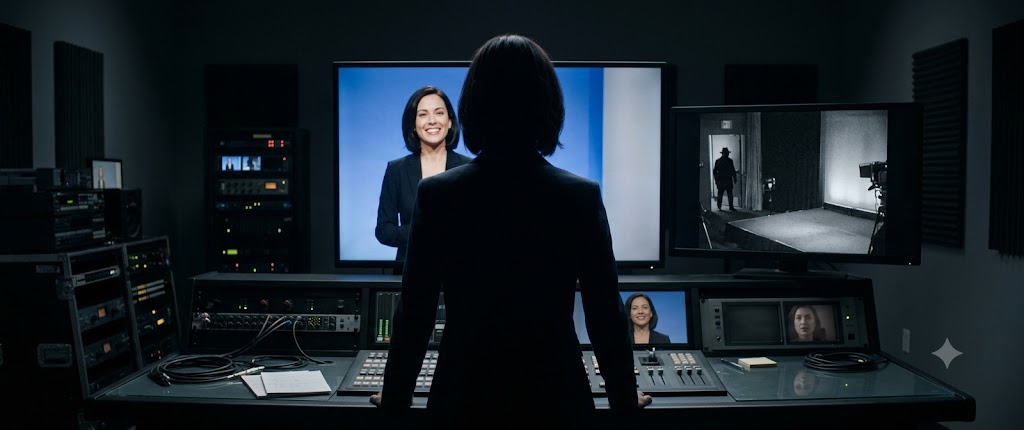
This is a work of short fiction — a story written to entertain. It did not really happen. Any resemblance to real people is coincidental.
She was twenty-three, filming a casual video on her couch the way she did most nights — a few minutes of talking to the camera for friends, lamp on, blanket over her knees, completely at ease in her own apartment. It was the kind of clip thousands of people record and forget about by morning.
She had no idea anyone would ever slow the footage down. No idea that, frame by frame, something was happening behind her that she could not see. And she certainly had no idea that this ordinary Tuesday-night video would become the most-watched thing she ever recorded — for all the wrong reasons.
To understand why it unsettled so many people, you have to watch it the way the internet eventually did: not at normal speed, where it looks like nothing at all, but slowly. Carefully. Paying attention to the one place she never thought to look — directly behind her own head.
A Completely Ordinary Beginning
For the first several seconds, there is genuinely nothing to see. She is mid-sentence about her day, laughing at something, glancing occasionally at her phone. The apartment behind her is warm and lived-in: a soft lamp in the corner, a couple of framed photos, and a dark hallway doorway leading deeper into the apartment.
That doorway is the whole story. So fix your eyes on it.
At the start, it is empty. Just a rectangle of shadow, the way any unlit hall looks at night. Nothing about it draws the eye. That is exactly why it works — because by the time you realize you should have been watching it, it is already too late to un-see what comes next.
The Shape That Was Not There
Somewhere around the eight-second mark, in the deepest part of that shadow, a shape appears.
And the word that matters is appears. It does not walk in. There is no movement, no figure stepping into frame, no sound she reacts to. It is simply absent in one frame and present in the next — still, dark, and unmistakably facing her. If you scrub back and forth across those two frames, you can find no transition. One moment the doorway is empty. The next, something is standing in it.
People argued about it for days. A trick of the compression. A coat on a hook. A shadow from a passing car. Every reasonable explanation was offered, and every one of them fell apart on the same detail — the detail that turned a blurry shape into something that crawled under people’s skin and stayed there.
It only moved when she looked away.
It Only Moved When She Looked Away
Go back and time it yourself. Every time she glances down at her phone, the next clear view of the doorway shows the shape a little closer. Not lunging. Not rushing. Just… advanced. A step nearer than it was a moment ago. And the instant she looks back up toward the camera — toward the room, toward it — it stops. Perfectly still. Patient.
It is the patience that frightens people most. This was not something clumsy or mindless. Whatever it was, it understood her. It understood the rhythm of her attention, the small habitual glances down at her screen, the half-second windows when she wasn’t really looking at the world around her. And it used every one of them. It moved only in the gaps she left open, and it held itself motionless the rest of the time, content to wait, because it seemed to know she would keep leaving those gaps open.
We do that, all of us, a hundred times a day. We glance away. We trust the room behind us. We assume that what we cannot see is simply not there. This video took that small, universal habit and made it feel like the most dangerous thing in the world.
The Flicker
Just past the ten-second mark, her lamp flickers — once.
It is brief, barely a stutter of light, the kind of thing you wouldn’t notice if you weren’t already staring at the screen with your heart climbing into your throat. The room dims for a fraction of a second. And when the light steadies, the doorway is empty again.
For a single beat, that emptiness feels like relief. The shape is gone. Maybe it was nothing after all.
And then the obvious, terrible problem settles in. It didn’t leave. There was nowhere for it to go but forward. The doorway is empty because, in that flicker of darkness, it stepped out of the doorway — out of the part of the room the camera could see, and into the part it couldn’t. Which means that for the final seconds of the video, it is no longer safely framed in a distant shadow. It is somewhere in the room with her. Close. Just outside the narrow edge of the phone’s view.
She keeps smiling for a second or two longer, still talking, still unaware. And then she stops.
The Moment She Knew
You can see the exact instant something reaches her — not the camera, her.
The smile fades first. Then her eyes change, losing their focus, the way anyone’s do when they hear a sound behind them that the body understands before the mind catches up. There is a primal part of us, older than language, that knows when it is being watched. You can watch that ancient part of her wake up in real time. Her shoulders tense. Her head lifts slightly, listening.
And then, slowly, she begins to turn to look behind her.
The video ends there. A hard cut to black, mid-turn, in the instant before she sees whatever is standing in the corner of her own living room. No scream. No struggle. Just sudden, total black, and then nothing.
For most people, that is where it stops — and that abrupt ending is a large part of why the clip spread so far. The human mind cannot stand an unfinished story. We are built to need the resolution, to know what was behind her. The cut to black hands that need to you and refuses to satisfy it, and so you watch again. And again. Looking for the answer in a video that was designed never to give you one.
But the original recording did not actually end at the cut to black. It continued for a few more seconds. And those few seconds are the reason this story is still told.
What the Last Few Seconds Show
When the surviving footage is allowed to run past the cut, it shows something that is difficult to describe in a way that does it justice, because nothing happens in the way you brace for.
She finishes turning. She looks directly at the empty corner of her own living room — the corner where, by every law of the flicker and the shadow, something should be standing. And she smiles.
Not a frightened smile. Not a confused one. A wide, warm, genuine smile, the kind you give someone you love when they walk through the door. As if she had turned around and found, standing in the corner, not a stranger and not a threat, but someone she recognized. Someone she had been waiting for.
Then she reaches over, calmly, unhurried, and turns the camera off herself.
There is no further footage. There is no follow-up. The people who knew her offer no tidy explanation, and the few who have seen the full clip tend to go quiet when asked about it, as though describing it out loud gives it a weight they would rather not carry.
The Detail No One Can Explain
Everyone who studies the footage eventually gets stuck on the same small thing. It isn’t the shape in the doorway. It isn’t the way it moved only when she looked away. It isn’t even the flicker, or the smile.
It is the reflection.
In the final frame before she switches off the camera, her dark phone screen catches a faint reflection of her face — the way any black screen will, like a dim mirror. And for exactly one frame, her reflection is not doing what she is doing. She is smiling at the corner. Her reflection is staring straight ahead, into the camera, into you.
And it is not smiling at all.
That is the frame people screenshot. That is the frame that ended up shared a million times over, passed from phone to phone late at night with the same three words attached: look at the reflection. No one has ever satisfyingly explained it. A glitch, some say. A trick of the compression, the same easy answer offered for the shape in the doorway, and just as unconvincing.
Because compression glitches do not look back at you. And they do not wait, patiently, in the dark, for you to finally turn around.
This story is a work of fiction, written to give you chills — nothing more. Did you spot the shape before she turned around? Did you catch the reflection? Tell us your theory in the comments below, and share this with someone brave enough to watch it alone at night. 👁️
