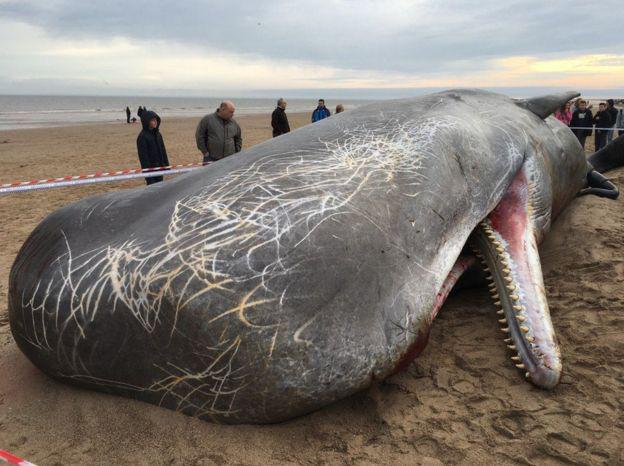
For decades, it was one of the strangest puzzles in the ocean. Whales and dolphins kept appearing with bizarre wounds on their bodies — small, almost perfectly round craters, as if someone had pressed an apple-corer into their flesh and scooped out a clean circle.
They appeared on sperm whales, humpbacks, dolphins, seals — even on the tough hides of other sharks. Sailors who saw them were baffled. Early scientists were stumped. What could possibly leave such precise, geometric marks on the largest animals on Earth? For years, the wounds whispered of something hidden in the deep, something no one had ever caught in the act.
The answer, when it finally came, was far stranger than anyone had imagined.
A Wound Like No Other
The marks are unmistakable. Each one is a shallow, round or oval crater, roughly five centimeters across — a near-perfect circle of flesh cleanly removed, as though carved out with a tool. On a living whale, healed scars show up as pale white discs scattered across the dark skin. On heavily targeted animals, they can number in the dozens or even hundreds across a single body.
In one famous study, researchers examined hundreds of whales brought into a whaling station in South Africa back in the 1960s and found the strange craters again and again — on sperm whales, fin whales, sei whales, and others. The wounds were so common, and so distinctive, that the unknown attacker earned an ominous nickname among scientists: the “demon whale-biter.”
For a long time, the craters were blamed on everything imaginable — parasitic worms, lampreys, bacteria, invertebrates, even disease. None of the explanations quite fit. The marks were too clean, too round, too deliberate. And the culprit was almost never seen, because it struck in darkness, far from any human eyes, and then vanished.
The Tiny Hunter of the Deep
The culprit turned out to be a shark — but not the kind anyone expected. It is called the cookiecutter shark, and the most astonishing thing about it is its size. This fearsome flesh-carver of the great whales is barely the length of your forearm, usually just 42 to 56 centimeters long — about the size of a small house cat stretched out.
This little shark lives in the deep, dark waters of the open ocean. During the day it lurks far below, often more than a kilometer down, and it has been recorded at depths approaching 3.7 kilometers — well over two miles beneath the surface. Then, as dusk falls, it begins one of the most extreme daily commutes in the animal kingdom, rising up through the water column toward the surface to hunt, before sinking back into the abyss with the dawn. It may travel several kilometers vertically every single night.
It is, in effect, a parasite that attacks animals enormously larger than itself — whales, dolphins, tuna, seals, even great white sharks. And the way it feeds is the reason for those perfect circular scars.
How the Bite Works
The cookiecutter shark’s mouth is a marvel of grim engineering. Its lower jaw carries a single connected row of large, razor-sharp, triangular teeth — and relative to its body size, these are the largest teeth of any shark on Earth. Its upper jaw holds smaller teeth used for gripping.
When the shark finds a victim, it presses its thick, fleshy lips against the body and creates a powerful suction seal, almost like a kiss. It anchors itself with the small upper teeth. Then it sinks the blade-like lower teeth into the flesh and spins its entire body in a circle. The result is a clean, round plug of flesh carved out and swallowed whole. That spinning motion — combined with two different sets of teeth — is exactly what leaves the cookie-shaped wound that gives the shark its name.
The shark even has another strange habit. Unlike most sharks, which lose their teeth one at a time, the cookiecutter sheds its entire lower row in a single piece — and then swallows it. Scientists believe it does this to recycle the precious calcium back into its body, deep in an ocean where every nutrient counts.
A Glowing Lure in the Dark
What makes the cookiecutter shark even eerier is how it draws its giant prey close enough to bite. Its entire underside is covered in light-producing organs called photophores, which glow a soft green in the darkness. This is bioluminescence — and in the cookiecutter, it is the strongest known glow of any shark, so persistent that it can continue for hours even after the animal has died.
At first glance, glowing seems like a terrible idea for a predator trying to ambush prey. But the trick is in what doesn’t glow. The shark keeps one patch of skin near its throat dark, forming a small shadow roughly the shape and size of a little fish.
Scientists believe this dark “collar” acts as a lure. A larger predator swimming up from the black depths sees what looks like a small, easy meal silhouetted against the faint light filtering down from the surface. It rushes upward to attack — and the momentum of its own charge helps the tiny shark latch on. In that instant, the hunter becomes the hunted. The would-be predator swims away with a perfect circular bite carved from its body, and the little shark slips back into the dark, its meal complete.
It Even Bites Submarines
The cookiecutter shark’s appetite for taking circular chunks out of things is so indiscriminate that it has even caused trouble for the world’s most advanced militaries.
In the 1970s, United States Navy submarines began suffering mysterious damage. Bites were appearing in the soft rubber coatings of their sonar domes, and even in electrical cables and rubber components. For a while, the cause was a genuine puzzle — what could be gnawing on a nuclear submarine in the open ocean? The answer turned out to be the same little shark, mistaking high-tech naval equipment for something to eat. The damage was serious enough that the Navy had to redesign and reinforce parts of the affected gear. The cookiecutter had, in a sense, attacked the United States Navy and won.
It has been recorded biting undersea cables, oceanographic instruments, and just about anything else that drifts through its territory. To this little shark, the entire ocean — flesh, rubber, or steel — seems to be a potential meal.
A Mark of the Mysterious Deep
So those haunting circular scars are not the work of some colossal sea monster lurking in the abyss, as sailors once feared. They are the calling card of one of the ocean’s smallest and most ingenious predators — a glowing, deep-dwelling shark that rises each night, takes a single perfect bite from creatures many times its size, and disappears back into the dark before dawn.
For the great whales, these wounds are rarely fatal. The animals are so enormous that a five-centimeter bite, however startling, is little more than a nuisance. Most heal over time, leaving behind the pale rings that now dot the skin of whales across the world’s tropical and temperate seas.
In a strange twist, scientists have even turned the cookiecutter’s handiwork to good use. Because the scars are unique in their pattern and placement on each animal, researchers use them almost like fingerprints — counting and mapping the white rings to identify individual whales and dolphins, and to track their movements and migrations across entire oceans. The demon whale-biter, it turns out, unintentionally helps us understand the very giants it feeds upon.
The Ocean Still Keeps Its Secrets
There is something humbling in the truth of these scars. The largest creatures in the sea — sperm whales the length of a bus, capable of diving thousands of meters into crushing blackness — still carry the marks of a hunter barely bigger than a ruler, one they almost never see coming. Strength and size, in the deep ocean, are no guarantee of safety.
And the cookiecutter shark itself remains, in many ways, a mystery. Scientists still know relatively little about how it lives, how it breeds, or how many of them drift through the deep waters of the world. It is rarely caught, almost never observed hunting in the wild, and spends most of its life in a part of the ocean that humans have barely begun to explore.
For centuries, those circular wounds on stranded whales fueled legends of sea monsters and unseen horrors lurking below. The reality is smaller, but no less wondrous: a tiny, glowing shark with the largest teeth for its size in the ocean, a built-in lure, and a hunting strategy so bold it takes bites out of whales and submarines alike.
The next time you see a photograph of a great whale dappled with pale circular marks, you will know exactly what left them. But you will also know this — that the deep ocean is still full of creatures stranger than our imaginations, and that we are only beginning to understand what truly lives below.
