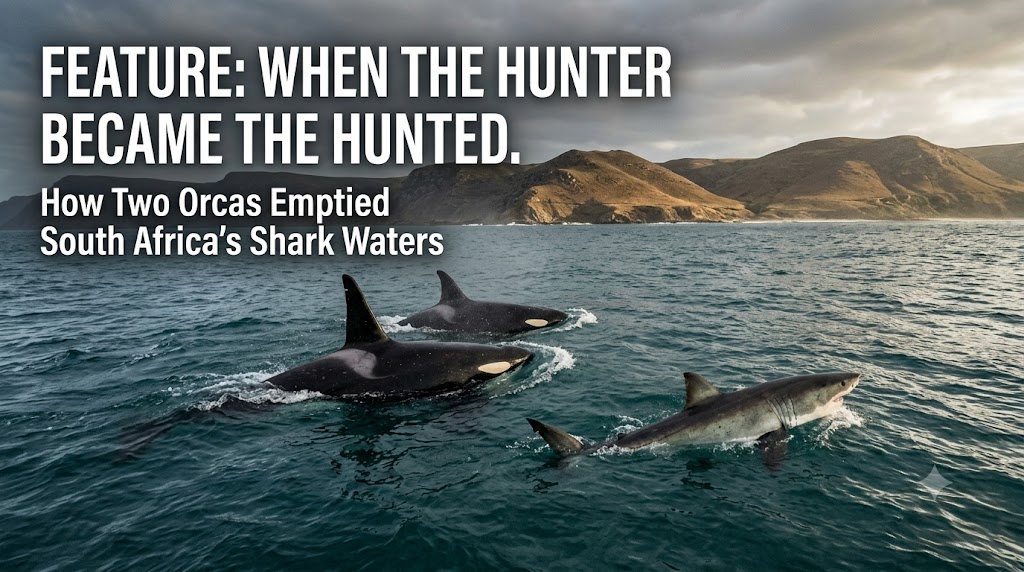
For as long as anyone could remember, the great white shark ruled the cold, productive waters off South Africa’s southern coast. Places like False Bay and Gansbaai were among the most famous shark destinations on Earth — waters so reliably full of great whites that tourists travelled from across the globe to watch them breach and to cage-dive among them. The great white was the undisputed king of this sea, an apex predator with nothing to fear.
And then, almost overnight, the kings vanished.
It is one of the most remarkable wildlife mysteries of the last decade — a true story that has reshaped how scientists think about the balance of power in the ocean. Because what finally drove the world’s most feared shark out of its own kingdom was not pollution, not overfishing alone, and not warming seas. It was a pair of killer whales with a taste for one very specific prize.
A Kingdom That Emptied Out
For years, the shoreline town of Gansbaai called itself the “great white shark capital of the world.” Seal Island in False Bay hosted one of the most intensively studied populations of great whites on the planet. Divers regularly counted dozens of sharks on a single trip.
Then, starting around 2017, the sharks began to disappear. At first, individual great whites would simply fail to show up for weeks at a time. Then the absences stretched into months. At some of the most famous aggregation sites, sightings collapsed to nearly zero. For a place whose entire identity — and a good part of its economy — was built on the presence of these animals, it was both baffling and alarming.
Early theories pointed to the usual suspects: shifting water temperatures, changes in fish stocks, human fishing pressure. All of these play a role in the broader, slow decline of sharks worldwide. But none of them could explain why the great whites would empty out of a thriving region so suddenly, almost as if they had fled in fear.
The real answer arrived, grimly, on the beaches.
The Evidence on the Sand
Great white shark carcasses began washing ashore — and they told a chilling story. In 2017, five white sharks were found stranded along the coast near Gansbaai. They ranged from about 3.6 to 4.9 meters long, both males and females. And nearly all of them shared the same eerie wound: a clean tear at the pectoral girdle, the area between the shark’s front fins, and a missing liver. One shark was also missing its heart.
The precision was astonishing. These were not messy, chaotic kills. Something had opened each shark almost surgically, removed the large, fat-rich liver, and left most of the rest of the body untouched. On two of the carcasses, scientists found telltale “rake marks” — the distinctive scratches left by the teeth of a killer whale.
The conclusion was inescapable. Orcas had done this. And not just any orcas.
Meet Port and Starboard
Marine biologists soon identified the culprits: a pair of adult male killer whales already known in the region, instantly recognizable because of a rare feature. Both have collapsed dorsal fins — one bent over to the left, the other to the right. For that reason, researchers gave them the nautical nicknames Port and Starboard.
These two had been seen in South African waters for years, first noted off the coast around 2009 and increasingly linked to shark predation from about 2015 onward. What set them apart was their specialty. While killer whales around the world eat a wide range of prey — fish, seals, dolphins, even other whales — Port and Starboard had developed a refined, almost specialized technique for hunting sharks and harvesting one particular organ: the liver.
Marine biologist Alison Towner, who has studied the phenomenon for years, described it as a novel and specialized behaviour that scientists had simply never documented in this way before. As she put it, the orcas weren’t just tearing the sharks open at random — they were going exactly where the liver starts. The skill involved was, in her word, incredible.
Why the Liver?
Of all the parts of a shark, why would orcas target the liver with such determination?
The answer lies in energy. A shark’s liver is enormous and extraordinarily rich. It can make up as much as a third of the animal’s entire body weight, and it is densely packed with fats and oils — a concentrated source of calories that the orcas use to build their own blubber. For a predator that needs to fuel a massive, warm body in cold water, a great white’s liver is essentially a high-energy meal in a single organ.
There may be a clever efficiency to it, too. Shark skin is rough and abrasive, and tearing a shark apart bite by bite would quickly wear down an orca’s teeth. By opening the shark precisely at the pectoral girdle and slurping out the liver, Port and Starboard get the richest possible reward with far less effort and far less damage to their teeth. It is, in a sense, the smartest way to eat a shark.
To do this safely, the orcas appear to flip the sharks over. When a shark is turned upside down, it can fall into a strange, trance-like state called tonic immobility — effectively paralyzed and unable to fight back. In that moment, the orcas can extract the liver with their unsettling, surgical precision.
Fear Itself
Here is the part that turned a series of kills into a full-blown mystery: the great whites didn’t just die. They fled.
Researchers tracking tagged sharks documented something remarkable. Over five years, they followed 14 GPS-tagged great whites and watched them rapidly abandon entire regions the moment orcas appeared. After a single attack, the survivors would scatter and stay away — not for days, as they once might have after a disturbance, but for weeks, months, sometimes entire seasons.
Part of this may be chemical. Sharks are acutely sensitive to substances in the water, and compounds released by a dead, decomposing shark can trigger powerful avoidance behaviour in others. A single orca kill doesn’t just remove one shark — it can effectively empty an aggregation site, sending a warning that spreads invisibly through the water. This same flight response had been seen before, on the other side of the world, at the Farallon Islands off California, where a single orca encounter could clear great whites from the area for the rest of the season.
In South Africa, though, Port and Starboard kept coming back. And so what began as temporary displacement hardened, in some places, into something that looked like permanent abandonment of waters the sharks had ruled for generations.
A Kingdom Rearranged
When a top predator vanishes, the effects ripple outward through the whole ecosystem. With great whites gone, other species moved into the vacuum. Bronze whaler sharks began appearing in areas the great whites had abandoned — only to find themselves on the orcas’ menu as well. Cape fur seals, no longer kept in check by the great whites, changed their behaviour, spending more time in places they once avoided and putting new pressure on vulnerable species like the endangered African penguin.
It is a vivid, real-world demonstration of how tightly the ocean’s web is woven. Remove one strand — even the most fearsome one — and the entire structure begins to shift.
The Mystery That Remains
Even now, much about Port and Starboard remains unknown. Scientists aren’t certain how old they are, exactly where they came from, or how they first learned this extraordinary hunting technique. Genetic work has suggested the two may be related — possibly half-brothers. And there are hints that the behaviour may be spreading, with evidence that the pair could be teaching the technique to other orcas, a possible example of culture passing through a population of wild animals.
It is also important to be honest about the science. While Port and Starboard are clearly a major driver of the great white shark’s disappearance, researchers caution that they are not the whole story. Climate change, shifting prey distributions, and fishing pressure were all at work before the orcas arrived, and they continue to shape these waters. The truth is a layered one — but the dramatic, sudden flight of the great whites points squarely at the two killer whales.
What is certain is this: in the waters off South Africa, the natural order was rewritten. The great white shark, long imagined as the ultimate ocean predator, turned out to have a predator of its own. And the next time we are tempted to crown any animal the undisputed king of anything, the empty blue waters off Gansbaai are there to remind us that in the ocean, the hierarchy is never quite as settled as it seems.
