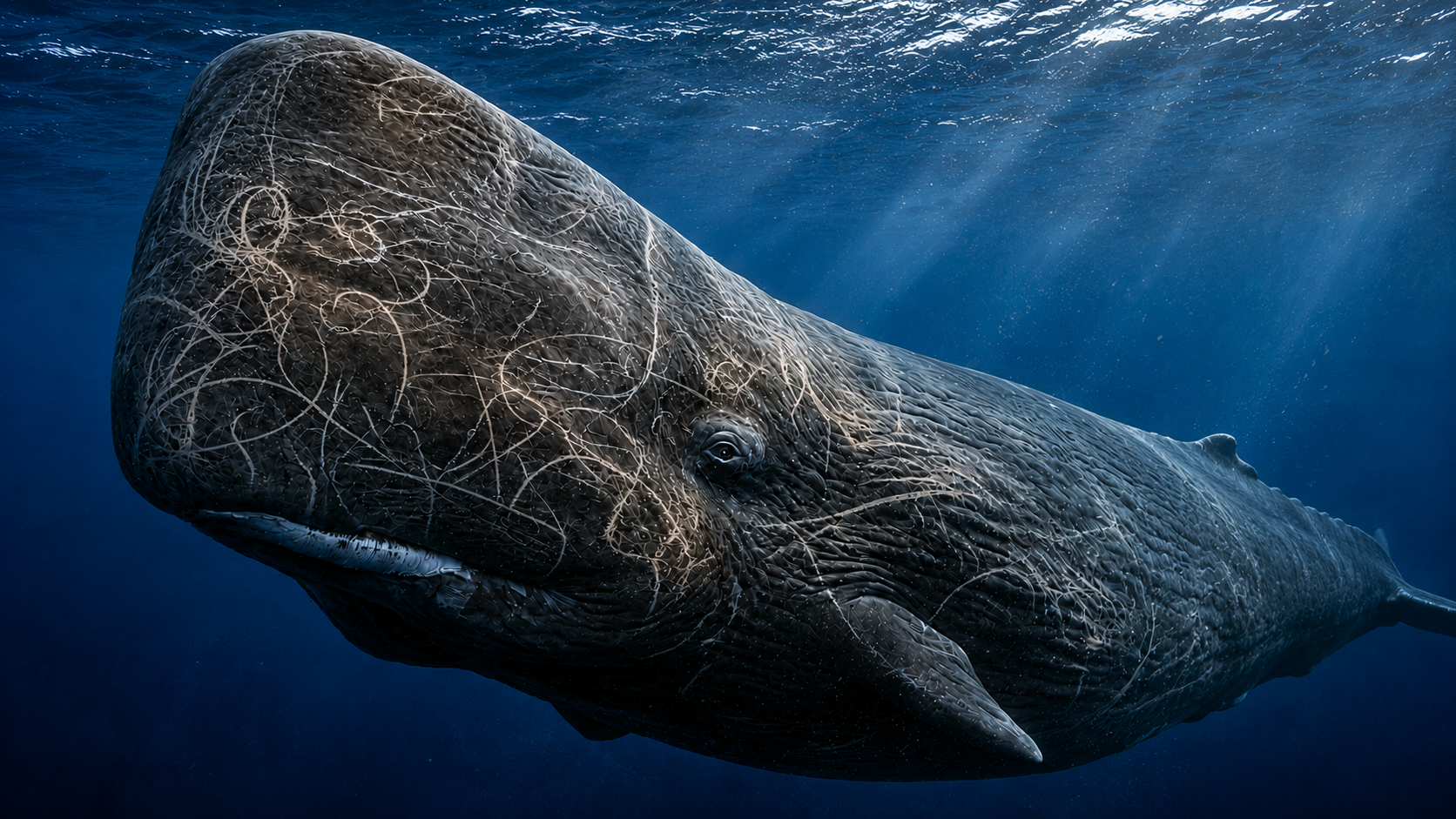
Half a mile beneath the waves, in a darkness no sunlight has ever touched, the largest predator with teeth on Earth descends to hunt — and the scars on his skin tell the story of what he finds down there.
There is a place in the ocean where the sun never reaches.
It begins around 1,000 meters down and stretches into a cold, crushing blackness that covers most of our planet — and yet remains one of the least explored places we know of. The pressure there is enough to crush a submarine like an empty can. The temperature hovers just above freezing. And almost nothing that lives up here in the light could survive down there for a single minute.
But one giant goes there on purpose. Again and again. By choice.
The deepest-diving giant on Earth
The sperm whale is the largest toothed predator that has ever lived. Males can reach 18 meters long and weigh as much as 50 tons, with a colossal square head that takes up nearly a third of their entire body. That head isn’t just for show — it houses the most powerful natural sonar in the animal kingdom, along with a strange, waxy organ that scientists believe helps the whale control its buoyancy as it dives.
And dive it does. A sperm whale can plunge more than 2,000 meters into the deep — that’s well over a mile straight down — holding its breath for up to 90 minutes at a time. As it descends, its heart rate slows, its body conserves oxygen with ruthless efficiency, and its rib cage actually flexes inward to cope with the mounting pressure.
Down there, in water as black as ink, eyesight is almost useless. So the whale hunts the only way that works: by sound. It sends out powerful clicks — the loudest sound produced by any animal on Earth — and listens for the echoes bouncing back off whatever is moving in the darkness. In effect, it “sees” its prey by listening to the shape of the world around it.
[EMBED YOUR VIDEO HERE]
The marks of an ancient war
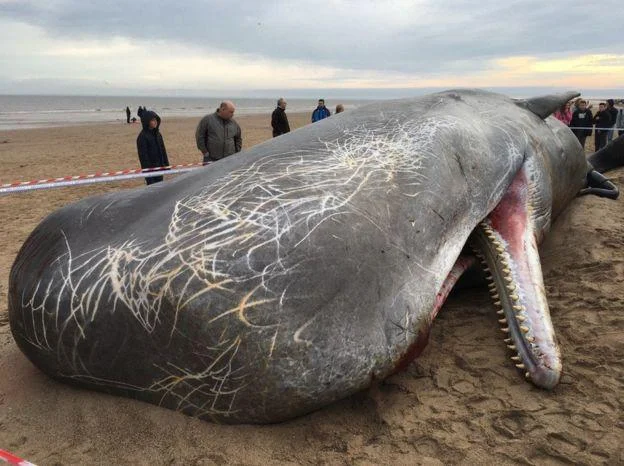
If you ever see an old male sperm whale up close, you’ll notice something written across his skin: scars. Pale, circular, ring-shaped marks scattered over that massive head — and long, tangled white scratches running the length of his body.
These are not random blemishes. They are battle wounds.
They are left behind by the suckers and hooks of the creatures the whale dives down to hunt: deep-sea squid, including the legendary giant squid and the even larger, more mysterious colossal squid. These animals are armed with long tentacles lined with rows of sucker rings — some ringed with tiny teeth, some tipped with rotating hooks — and they do not surrender quietly.
A large old bull may carry hundreds of these scars, layered over decades of hunting. Each ring is a record of a struggle that took place in total darkness, far beyond the reach of any human observer. When researchers study these markings, they are effectively reading a diary written on the whale’s own skin — a lifetime of encounters with the monsters of the deep.
The creature in the black
Here is what makes this one of the ocean’s greatest mysteries: we have almost never actually seen it happen.
The giant squid can grow longer than a school bus, with eyes the size of dinner plates — the largest eyes in the entire animal kingdom, evolved to gather the faintest glimmer of light in a world that has almost none. The colossal squid, found in the freezing waters around Antarctica, is heavier and more powerful still, with swiveling hooks on its arms instead of simple suckers.
For most of human history, these animals were dismissed as the stuff of sailors’ nightmares — the “kraken” of legend, said to drag entire ships beneath the waves. Serious scientists doubted they even existed. And remarkably, despite being one of the largest invertebrates on the planet, the giant squid was not filmed alive in its natural deep-sea habitat until 2012. That’s right: we had high-definition images of the surface of Mars long before we had footage of a living giant squid in the deep.
So when a sperm whale dives into the black to find one, it is descending into a battle we can barely study — between the largest toothed predator on Earth and one of its most elusive and least-understood adversaries. We know it happens. We can read it in the scars, and in the beaks of squid found in the stomachs of sperm whales. But the fight itself unfolds in a darkness almost no one has ever truly witnessed from beginning to end.
How a whale wins in the dark
So how does the battle actually go?
Scientists piece the story together from indirect evidence, and what emerges is fascinating. The sperm whale’s greatest weapon may not be its teeth at all, but its sound. Some researchers believe the whale’s intense bursts of clicking may be powerful enough to stun or disorient prey, giving the hunter a crucial advantage in the dark.
When the whale closes in, it uses its narrow lower jaw — lined with conical teeth that can each weigh as much as a kilogram — to seize the squid. The squid fights back with everything it has: wrapping its powerful arms around the whale’s head, digging in its suckers and hooks, leaving behind those telltale rings. But the sperm whale is vastly larger and far more powerful, and the vast majority of these encounters end with the squid as the meal.
Even so, the scars remain. They are proof that the prey does not go without a fight — and that even the ocean’s mightiest hunter pays a price for descending into a world it was never meant to conquer easily.
A world we’ve barely begun to explore
It’s easy to assume we’ve explored our own planet by now. We haven’t — not even close.
More than 80% of the ocean remains unmapped, unobserved, and unexplored. The deep sea is the single largest living space on Earth, and it is still, in countless ways, a mystery. New species are discovered there constantly. Entire ecosystems thrive in places we once assumed were lifeless. And creatures we’ve only glimpsed in blurry fragments — like the colossal squid — may have behaviors, populations, and lives we know almost nothing about.
The sperm whale connects these two worlds. It breathes the same air we do at the surface, then vanishes into the crushing dark to live a part of its life in a place we may never fully reach. It is a living bridge between the sunlit ocean and the abyss below.
And every time an old bull rises back to the surface with a fresh ring of scars across his skin, he carries a quiet reminder with him: that far below everything we know, a hidden world is still going about its ancient, unwatched existence — vast, mysterious, and very much alive.
We’ve sent people to the Moon and landed robots on Mars. But the question of what truly lives in the deepest dark of our own ocean? We are only just beginning to find the answer.
If this gave you a new sense of how mysterious our oceans still are, share it. The more people are amazed by the deep, the more we’ll care about protecting a world we’ve barely begun to explore — and the giants who carry its secrets on their skin.
