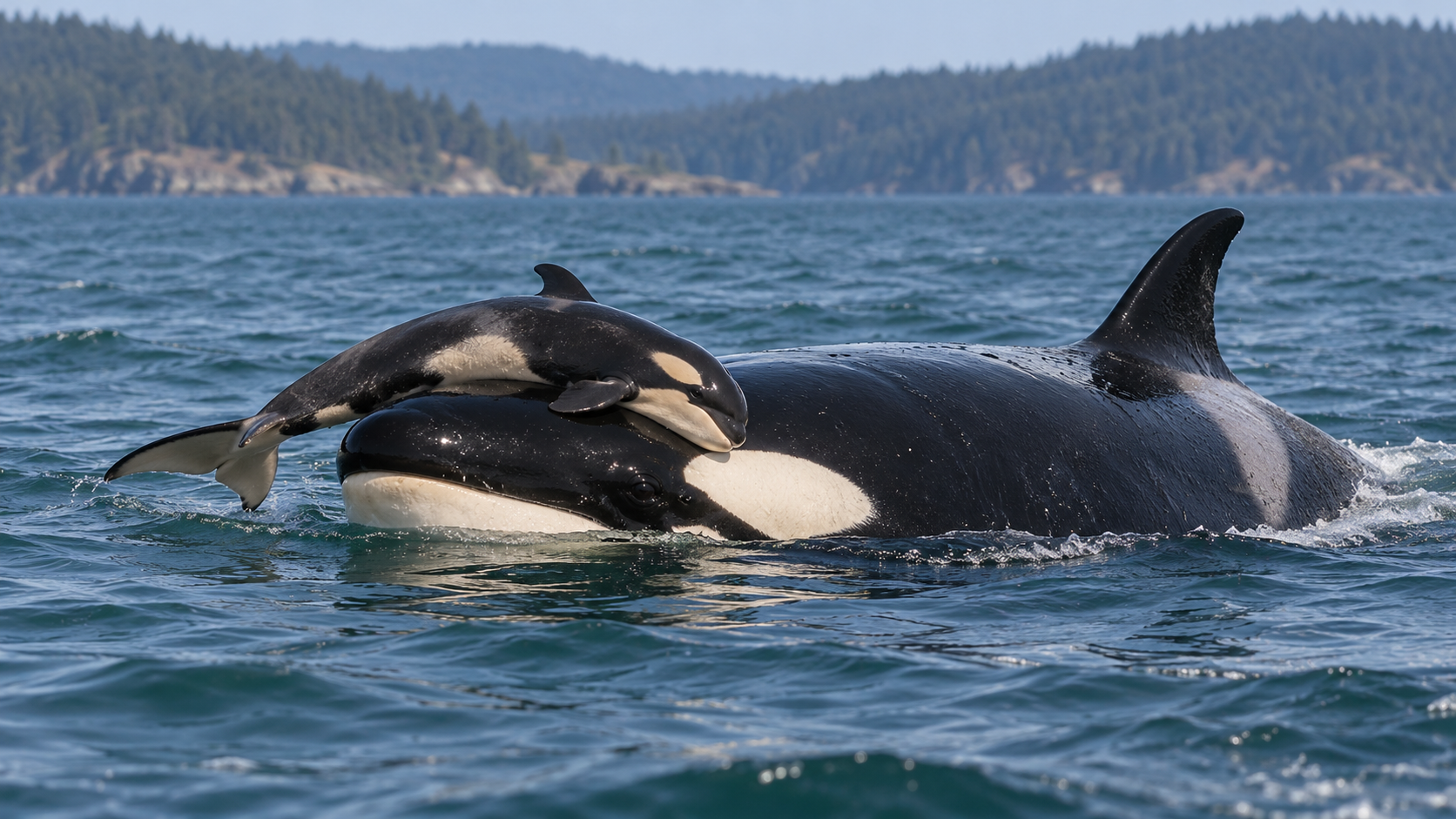
The little body slipped beneath the surface, and its mother went after it. She brought her calf back up and supported her near the air, continuing through the waters of the Salish Sea.
The newborn was already dead. The mother was Tahlequah, the Southern Resident orca researchers identify as J35. Her repeated retrievals were documented by the Center for Whale Research.
As the days accumulated, the image became harder to look away from. A moment that might have passed unnoticed offshore had become a prolonged encounter with a mother’s attachment.
People following her story kept returning to one question: Would Tahlequah ever let her baby go—and what would happen to her when she did?
A Birth That Became a Loss
On July 24, 2018, Tahlequah gave birth to a female calf near Victoria, British Columbia. Reports initially described the newborn alive beside her mother. By the time researchers reached the whales, the baby had died.
NOAA’s account places the death shortly after birth. For the scientists tracking this endangered community, a new calf represented a possibility worth following closely. The beginning of one life could matter to a family and to the population around it.
That possibility had disappeared almost as soon as it arrived. Yet the mother and calf had not separated.
This is where the story becomes difficult to summarize with the word “loss.” The baby was dead, but the relationship remained visible in the mother’s actions. A person seeing the pair without knowing their history might have needed a moment to understand what was happening.
The crucial detail was that only one of those bodies was doing the work.
The Work of Keeping Her Near
Carrying a calf through moving water demands more than staying beside it. There are currents to move against, waves to negotiate, and a living animal’s continuing need to reach the surface and breathe.
Writing during the journey, SeaDoc Society science director Joe Gaydos emphasized the physical effort involved. His account described a mother carrying her calf across substantial distances while her family continued traveling.
The water did not become still because something devastating had happened. Tahlequah had to keep adjusting to it.
That gave the images their painful repetition. The action was small enough to understand immediately: a mother maintaining contact with her baby. Its persistence was what made it extraordinary.
A photograph could hold one position forever. Tahlequah could not. Whatever her internal experience, she was a living animal in an environment that required movement, breathing, and energy. Each new observation belonged to a continuing physical effort rather than a frozen scene.
A Family, Not an Isolated Animal
Tahlequah belonged to J pod. Understanding that family setting matters, because an orca’s life extends far beyond the individual body visible above the waves.
NOAA describes killer whales as highly social animals that often remain with their original pods. Their underwater calls, clicks, and whistles help maintain group contact. Pacific Northwest pods have distinctive learned sounds passed between individuals.
The sea may look empty from shore, but those waters contain relationships, communication, and shared activity. A single dorsal fin can belong to a much larger social world.
There were also reports of direct care around Tahlequah. Gaydos wrote that relatives had been observed bringing her salmon while she carried her calf.
That detail changes how the scene can be understood. This was a mother enduring a loss within an existing family. The carrying drew attention to her; the presence of others widened the picture.
She still had a place among the living whales traveling around her.
Why the Passing Days Raised Concern
One day became several. The duration eventually associated with Tahlequah’s journey was approximately seventeen days, according to NOAA, whose response team monitored her condition.
With each passing day, attention extended beyond the baby to the mother carrying her. The calf could no longer recover. Tahlequah still needed to sustain herself.
That difference made the story increasingly difficult to follow. People could recognize the tenderness of the contact and, at the same time, worry about the effort behind it.
The images did not reveal everything she did between sightings. They offered pieces of a journey that continued beyond any observer’s view, leaving room for questions about her condition and activity.
The concern was now directed toward two very different outcomes. Nothing could change the death of the calf. But the mother’s future was still unfolding, one that involved the living family moving around her.
What would the next clear sighting reveal about Tahlequah herself?
What Science Can Say About Mourning
Calling the behavior “grief” makes emotional sense to many people. Scientists also have reasons to take that possibility seriously, while recognizing the limits of what an observer can know.
A peer-reviewed study published in 2018 examined 78 records of whales and dolphins responding to dead members of their own species. Adult females attending dead calves or juveniles were prominent among the cases where the animals’ sex was known.
The researchers discussed several explanations, including strong attachment, possible grieving, and difficulty recognizing or accepting death. They also emphasized the limitations of the available evidence.
Those distinctions are important. We cannot turn an orca’s actions into an exact human sentence or know what she understood at each moment.
But uncertainty about her thoughts does not make the behavior insignificant. The physical attention continued after the calf’s death. That is the observation any explanation must address.
There is room for scientific care and human compassion in the same account.
The Threats Beyond This One Mother
The images focused attention on one calf, but the Southern Residents’ survival problems were larger than a single event.
NOAA’s recovery work identifies three major pressures: the availability of prey, vessel traffic and noise, and contaminants. Protecting the salmon the whales depend on is part of protecting the whales themselves.
These are practical conditions of life in the same water where Tahlequah was carrying her baby. They affect the opportunities an orca has to feed, communicate, and reproduce.
They should not be used to invent a precise diagnosis for this individual calf. A population’s threats and the confirmed cause of a particular death are different kinds of knowledge.
Still, the broader context explains why an image of attachment also became an image of vulnerability. The question was no longer only how long one mother could carry one small body.
It was whether the living family around her would have what it needed to survive.
A Sighting Was Not Yet an Answer
The eventual answer required a clear observation, and the sea did not always provide one.
The Whale Sanctuary Project’s contemporary updates recorded a sighting in which poor visibility prevented confirmation of whether Tahlequah still had the calf. That limitation matters: seeing a whale is not automatically the same as seeing everything happening beside or beneath her.
A brief glimpse could leave the central question unresolved. The absence of a visible small body in one view might not settle what the mother was doing.
By then, the significance of the next clear sighting was enormous. It needed to show more than a familiar fin breaking the surface.
Was she still carrying the calf? If the calf was gone, was the mother active and able to continue with her family?
When a sufficiently clear observation finally came, the answer included something people had been hoping to see alongside the end of the carrying.
What Researchers Finally Saw
Yes. Tahlequah eventually let her calf go.
On August 11, 2018, the Center for Whale Research confirmed that she was no longer carrying the baby. Researchers saw her actively pursuing salmon with her pod in Haro Strait. Their update described her apparent physical condition as good.
The report answered both immediate questions: the carrying had ended, and the mother was engaged in active life with her family.
The exact moment when she stopped carrying her daughter was not established by that sighting. The confirmation came through what researchers could see afterward: a mother moving without the small body she had kept beside her.
They could describe her activity and condition. The meaning of that moment to Tahlequah remained her own.
After the prolonged attention to a mother holding her baby above the water, that observation offered a different image: Tahlequah moving with the pod and pursuing food.
Her calf was gone. The mother was still there.
What Letting Go Does—and Does Not—Mean
It is easy to treat the end of the carrying as the clean ending of the story. Human readers want reassurance, especially after watching something so painful for so long.
The documented outcome does offer reassurance about Tahlequah’s activity at that time. It does not erase what happened or permit anyone to measure the significance of the calf to her mother.
That is why the story retains its force beyond the question of seventeen days. The number gives the event a scale. The repeated care gives it an emotional meaning people can recognize without pretending to understand every part of an orca’s mind.
For those who first encountered the story through an image or a short video, the answer is worth knowing accurately. She did stop carrying her calf. She was seen swimming and hunting with her family.
Continuing to live was the observable ending. Forgetting was never something an observer could confirm.
