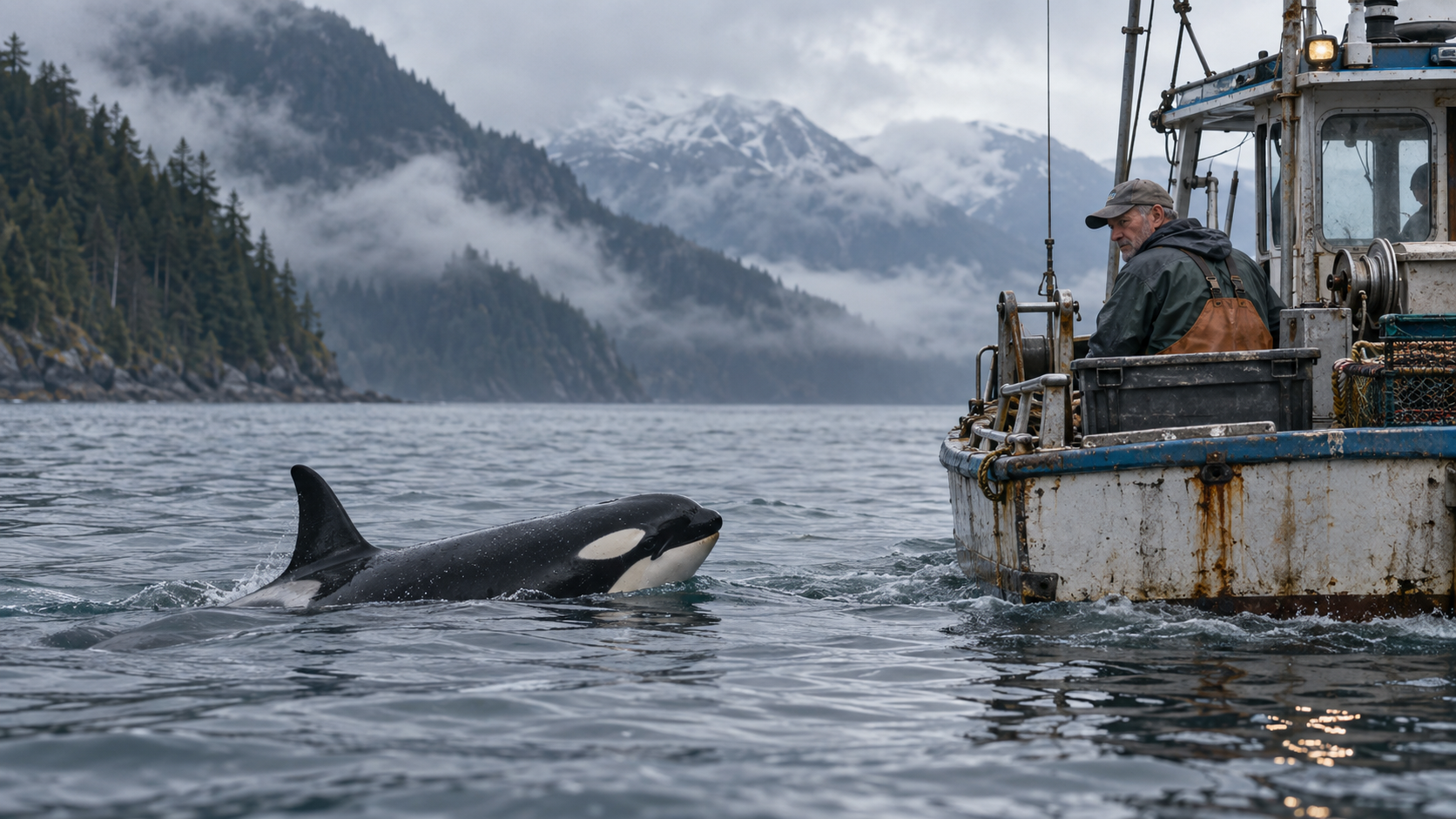
At first, the fishermen thought the young orca was simply curious.
She appeared beside their boat one cold morning in a remote Pacific Northwest fjord, surfaced twice near the stern, and disappeared beneath the grey water.
The next morning, she came back.
Then again the morning after that.
She never begged for fish.
She never tried to touch anyone.
She simply followed.
Sometimes for a few hundred metres.
Sometimes until the boat reached the mouth of the inlet.
And when the fishermen finally turned toward shore, the young whale often remained behind in the open water.
Calling.
At first, nobody understood what she was doing.
But over the following weeks, something about those calls began to change.
And when researchers finally listened closely, they realized the lonely young orca may have been learning a completely new way to make sure someone answered.
She Should Not Have Been Alone
Orcas are not solitary animals.
In many populations, family relationships can last for decades.
Calves grow up surrounded by mothers, siblings, aunts and other relatives.
They travel together.
Rest together.
Hunt together.
And perhaps most importantly, they remain in constant acoustic contact.
A young orca does not grow up in silence.
Its world is filled with calls.
Specific sounds.
Repeated patterns.
Voices associated with the animals it knows best.
That is why the sight of a juvenile travelling alone through a remote fjord immediately worried the small research team monitoring the area.
She appeared young.
Healthy enough to swim strongly.
But there were no other orcas around her.
No mother.
No siblings.
No pod.
Just one black dorsal fin moving through miles of cold grey water.
Researchers could not determine exactly how she had become separated.
A storm had passed through the outer coast several days earlier.
It was possible the group had split temporarily.
It was possible she had followed prey into the wrong inlet.
It was possible something else had happened farther offshore.
Nobody knew.
But every morning, the result was the same.
She was still alone.
At First, She Called for Orcas
The research team lowered hydrophones into the fjord.
Almost immediately, they began recording the young whale.
She was vocal.
Far more vocal than observers expected from a solitary animal.
At dawn, she produced short contact calls.
Later in the day, she called again.
Sometimes she repeated nearly the same sequence several times in a row.
Then she would pause.
Listen.
And wait.
No orca answered.
The pattern continued for days.
Call.
Silence.
Another call.
More silence.
Researchers avoided assigning human emotions to the behavior.
Nobody could say that she was “crying.”
Nobody could know exactly what she expected.
But the purpose of contact calls in social animals is not difficult to understand.
They help individuals locate one another.
They keep groups connected.
And this young whale had no group around her.
Then the fishermen began noticing something strange.
The Same Boat Started Getting Her Attention
A small commercial fishing boat entered the fjord most mornings around the same time.
Its diesel engine had a deep, uneven rhythm.
The engine could be heard long before the boat appeared around the bend.
The first few times, the young orca approached cautiously.
Then she began meeting it farther from shore.
She surfaced beside the stern.
The fisherman at the back of the boat would turn around.
Sometimes he spoke to her.
Nothing complicated.
“Morning.”
“There you are.”
“Still following us?”
The words meant nothing to the whale.
But the response did.
When she appeared, someone looked back.
When she surfaced, someone spoke.
When she followed, the boat remained nearby for several minutes.
For perhaps the first time since her separation, something in the fjord was responding to her presence.
And soon, the fishermen began hearing a sound they had not noticed before.
Her Calls Were Beginning to Change
It started as a low, unusual vocalization.
Part orca call.
Part something else.
The researchers heard it too.
At first they thought it was coincidence.
Then it happened repeatedly.
The young whale produced the strange call most often when the fishing boat was nearby.
The sound had a rough, pulsing quality.
It was not a perfect imitation of an engine.
It was not exactly a boat horn.
But the rhythm was different from the cleaner contact calls she had produced during her first days alone.
Some researchers wondered whether repeated exposure to the same boat had influenced the sound.
Orcas are sophisticated vocal learners.
They can modify calls.
They can imitate unfamiliar sounds.
And young social animals pay extraordinary attention to the acoustic world around them.
The whale had spent days calling into an empty fjord.
Nothing answered.
But when she approached the boat, people turned toward her.
Then something remarkable happened.
She Started Using the New Sound When the Boat Was Gone
One evening, the fishing boat returned to port earlier than usual.
The fjord became quiet.
Near sunset, observers saw the young orca approaching the empty dock.
She surfaced.
Looked toward the harbour.
Waited.
Then she made the strange new call.
Once.
Silence.
She surfaced again.
The call came a second time.
Still nothing.
The boat was not there.
The people who usually appeared on the deck were gone.
For several minutes, the whale remained near the harbour entrance.
Then she slowly moved back into deeper water.
The next morning, the fishing boat returned.
Before it reached the dock, the whale appeared beside it.
The old fisherman heard her surface and turned around.
“There you are.”
The researchers listening through headphones heard the young orca make the strange call again.
This time, someone answered.
Researchers Found Something in Her Older Calls
Weeks into the observation, the team began comparing the young whale’s earliest vocalizations with recordings collected from wild orcas outside the fjord.
Some of the acoustic patterns appeared similar to calls used by a particular regional family group.
It was not enough to prove identity.
But it offered a possibility the team had hoped for from the beginning.
Her pod might still be alive.
And somewhere outside the fjord, they might still be travelling.
The researchers contacted teams working along the outer coast.
Hydrophones were checked.
Recent sighting reports were reviewed.
Then, one evening, a recording arrived.
A group of orcas had passed through offshore waters.
Among their calls were patterns strikingly similar to those the juvenile had produced during her first days alone.
For the first time, researchers considered that the family she had been calling for might not be gone.
They might simply have been somewhere else.
Then the Fjord Went Quiet
The next several days brought no sightings.
Weather deteriorated offshore.
The fishing boat stopped operating temporarily.
The little harbour became unusually still.
The young orca continued appearing.
But her behavior had changed.
She spent more time near the route normally taken by the boat.
Her original contact calls became less frequent.
The strange low call appeared more often.
The researchers noticed the pattern.
Early in the story, she had called toward the open water.
Now, when the fjord was quiet, she increasingly called near the harbour.
It was impossible to know what that meant.
Perhaps she was simply experimenting with sound.
Perhaps the boat had become an important stimulus.
Perhaps she had learned that one kind of sound produced a more predictable response than another.
Then, late one afternoon, the hydrophone picked up something different.
A distant orca call.
A Voice Came From Outside the Fjord
The sound was faint.
Very faint.
But it was unmistakably another killer whale.
The juvenile was swimming near the centre of the inlet when the call travelled through the water.
She stopped.
Her body changed direction.
For several seconds, she faced toward the mouth of the fjord.
A second call followed.
Farther away.
Researchers watching from shore said she remained almost motionless.
Then she answered.
Not with the strange boat-like call.
With one of the cleaner contact calls recorded during her first days alone.
The team waited.
Nothing.
Then, once more, a distant whale answered from beyond the inlet.
For the researchers, it was the moment they had wanted for weeks.
Another orca was out there.
Possibly more than one.
The juvenile began moving slowly toward the mouth of the fjord.
Then a different sound entered the water.
The Fishing Boat Engine Started
Behind her, near the harbour, the familiar diesel engine turned over.
The sound travelled across the surface and through the water.
The juvenile stopped.
For several seconds, she remained between two directions.
Open ocean ahead.
The familiar harbour behind.
Another distant orca call came from outside the fjord.
Then the fishing boat moved away from the dock.
The young whale turned.
Not quickly.
Not dramatically.
She simply changed direction.
And began swimming toward the boat.
The researchers could not know why.
Maybe the distant whales were too far away.
Maybe the engine was louder.
Maybe the juvenile had simply learned to associate that boat with immediate social contact.
But the contrast was difficult to ignore.
Weeks earlier, she had repeatedly called toward the ocean and received silence.
The humans had answered.
The boat had slowed down.
People had looked back.
Someone had always been there.
And now, when two worlds seemed to call at the same time, she moved toward the one that had become predictable.
The Saddest Part Was Not That She Followed Humans
It would be easy to tell the story as though the orca had somehow chosen people over her own kind.
That would be too simple.
Wild animals do not experience relationships exactly as humans do.
And nobody could know what the whale understood about the sounds around her.
But the behavior illustrated something much more uncomfortable.
Social animals adapt.
When one source of connection disappears, they may seek another.
When one call receives no answer, another behavior may become more useful.
The young orca had not been trained to approach boats.
Nobody had deliberately taught her a new call.
Nobody had asked her to wait near the harbour.
She had simply spent too long alone in an environment where humans became the most reliable source of response.
The fishermen did not replace her pod.
They never could.
But for a young animal built to live inside a social world, perhaps even an imperfect response was better than silence.
Maybe That Is Why Her Story Hurts
The most painful detail is not that a wild orca learned to approach people.
It is that she may have learned why.
At first, she called into the ocean.
Nothing answered.
Then she called near the boats.
Someone always turned around.
Maybe that was all it took.
A repeated sound.
A familiar engine.
A human voice saying something she could never understand.
But at least it was a voice.
And for an animal whose world had suddenly gone silent, perhaps being answered mattered more than who was answering.
