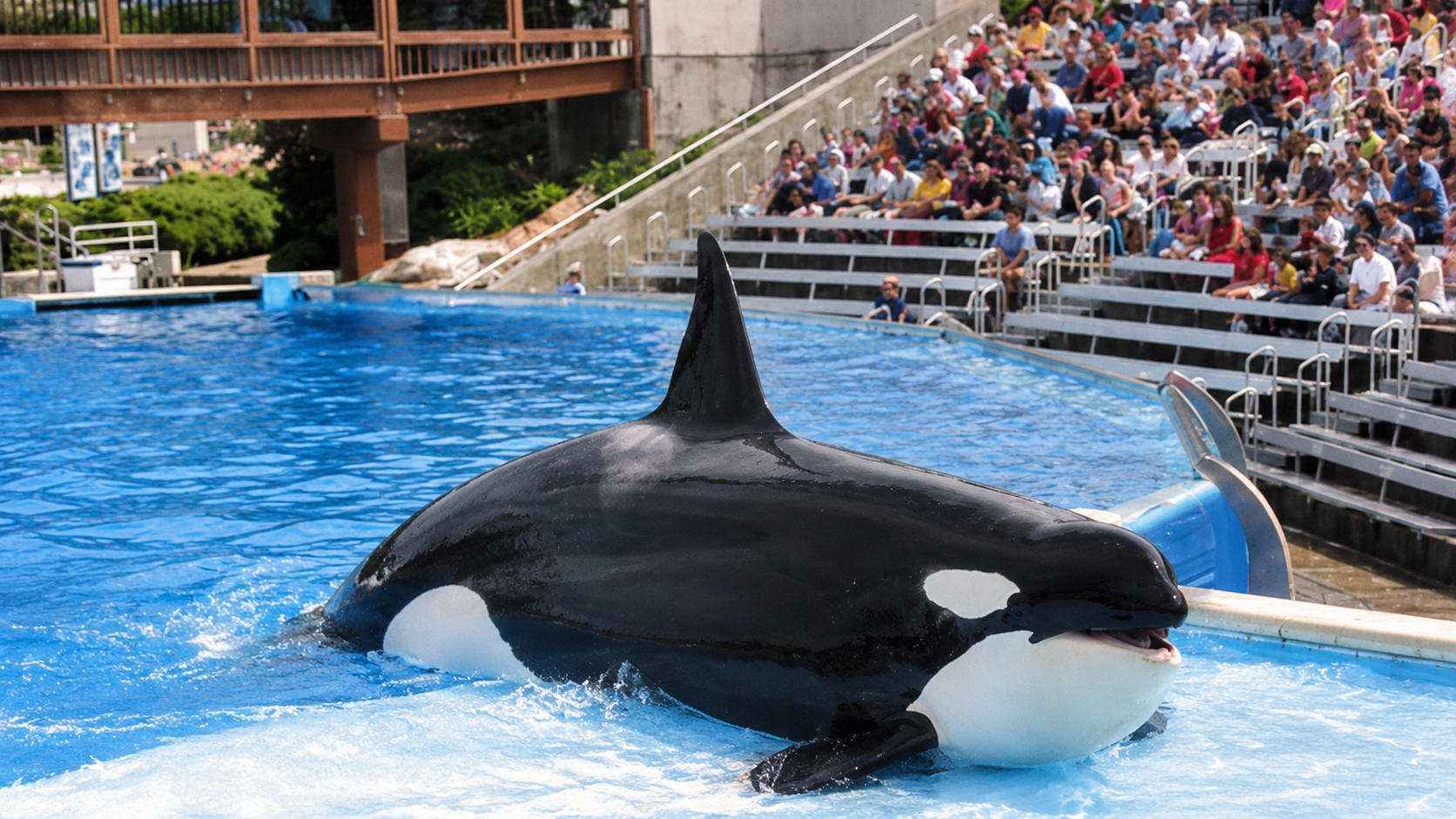
For most people watching the pool that day, there was nothing unusual about the scene.
Corky was swimming inside SeaWorld San Diego.
She had been living around humans for decades.
The concrete walls, trainers, artificial pools and sounds of a marine park had become the environment surrounding almost her entire adult life.
But beside the pool sat something that did not belong there.
A recording.
It had been made hundreds of miles away, in the cold coastal waters of British Columbia.
And according to the researcher who brought it south, the voices on that tape belonged to whales Corky had not been with since 1969.
No one could know what she would do when the sound began.
No one could even prove what those voices would mean to her after so much time.
Then someone pressed play.
Corky Had Been Taken From British Columbia in 1969
Corky II was a young wild killer whale when she was captured near Pender Harbour, British Columbia, in December 1969.
She was one of several whales taken during a period when live capture of Pacific Northwest orcas was supplying marine parks with animals for public display.
Corky was transferred to Marineland of the Pacific in California.
Years later, she moved to SeaWorld San Diego.
The ocean she had known as a young whale was replaced by pools.
The family group she had travelled with disappeared from her daily life.
And as the years accumulated, Corky became one of the longest-lived captive orcas from that era.
By 1993, nearly a quarter of a century had passed since her capture.
That length of time raised an extraordinary question.
Could an orca remember the voices of animals she had not heard since she was young?
Researchers Believed They Knew Which Family Corky Came From
By the early 1990s, scientists studying killer whales around Vancouver Island had learned that individual orcas could often be identified.
Their dorsal fins differed.
Their saddle patches differed.
Their family relationships could be followed across years.
And researchers had also discovered something even more remarkable.
Different groups of resident killer whales used distinctive vocal patterns.
Those differences were sometimes described as dialects.
The calls produced by one family group could sound different from those of another.
Researcher Paul Spong, founder of OrcaLab in British Columbia, believed Corky had originally belonged to the A5 pod of Northern Resident killer whales.
He also believed surviving relatives of Corky were still living in those waters.
That transformed Corky’s story.
She was no longer simply an orca whose exact past had disappeared when she was captured.
There was now a possibility that researchers could identify the whales she had once travelled with.
And perhaps even record them.
Orcas Live in a World of Sound
Sight matters to killer whales.
But sound is essential.
Underwater, orcas communicate through whistles, pulsed calls and clicks.
For resident killer whales that spend their lives in stable family groups, vocal traditions can persist across generations.
A young whale grows up surrounded by those sounds.
They are part of daily travel.
Part of social contact.
Part of hunting.
Part of maintaining connection when animals cannot see one another underwater.
That made Corky’s separation different from simply moving an animal from one location to another.
She had also been removed from a specific acoustic environment.
The voices around her had changed.
For 24 years, the calls of her original group were no longer part of her everyday world.
Then, in 1993, technology made something possible that would have been difficult to imagine at the time of her capture.
Those voices could be brought back to her.
The Debate Over Corky’s Future Was Already Growing
By then, Corky had become the center of a growing dispute.
Paul Spong and other advocates argued that she should eventually be returned to British Columbia, initially through a controlled rehabilitation process rather than simply being released immediately into the open ocean.
SeaWorld strongly disagreed.
Its representatives argued that Corky had spent too many years in human care for such a release to be considered safe.
There were questions about whether she could successfully hunt.
Questions about disease and parasites.
Questions about whether a whale separated for decades could simply return to a wild social group.
There was also no established blueprint for returning an orca after such a long period in captivity.
Both sides looked at the same animal and reached very different conclusions.
For advocates, Corky represented a whale who still had a possible connection to a living family.
For SeaWorld, releasing her presented serious welfare risks.
Then television brought that debate to a much larger audience.
ABC Went North to Record the Whales
A crew from ABC’s Prime Time Live became involved in Corky’s story.
Reporter Judy Muller travelled with Paul Spong in British Columbia.
There, they encountered the A5 pod.
Instead of merely filming the animals, they recorded their vocalizations.
Those recordings were then taken south.
That detail is what makes the story so unusual.
Corky herself was not transported anywhere.
Her supposed family was not brought to California.
Instead, one element of her former world was carried back to her:
sound.
A tape could cross the distance that separated Corky from British Columbia in a way the whales themselves could not.
And eventually, that tape arrived beside the SeaWorld pool.
A Tape Recorder Was Placed Beside the Pool
Corky was not alone.
She shared the pool with other killer whales.
Near the water, the recording equipment was prepared.
This was not a sophisticated laboratory experiment designed to conclusively test long-term memory.
It was a television moment taking place in the middle of a highly controversial debate.
That distinction matters.
There was no way to ask Corky what she was experiencing.
No scientist could translate a movement into a human sentence.
No one could prove that a particular reaction meant:
I remember them.
But they could observe what happened.
The recording started.
Calls made by wild Northern Resident killer whales came from the speaker beside the pool.
For the first time in decades, Corky was exposed to sounds that Spong believed belonged to the family group from which she had been taken.
Then the whales in the pool began to react.
All Four Orcas Raised Their Heads
According to an account published by the Animal Welfare Institute after the broadcast, all four killer whales in the pool lifted their heads from the water and appeared to listen as the A5 recordings played.
That detail is important.
Corky was not the only whale responding to an unfamiliar sound.
The other orcas could hear it too.
For a few moments, the scene remained ambiguous.
Large black-and-white bodies rested near the surface.
The recording continued.
Nothing needed to explode out of the water.
There was no dramatic chase.
No trainer entered the pool.
No barrier broke.
The strange power of the scene came from how little appeared to be happening.
A speaker played distant whale calls.
Four captive orcas listened.
And somewhere among those sounds were vocalizations that researchers believed had originated from Corky’s own family group.
Then Corky did something that became the defining image of the broadcast.
Then Corky’s Body Shuddered
After several moments, accounts of the footage describe a powerful shudder moving through Corky’s body.
She then went below the surface while the other whales remained near the recording.
For viewers, the implication was almost impossible to ignore.
Had Corky recognized something?
Had a sound from 24 years earlier reached a memory that had somehow survived decades of captivity?
That interpretation quickly became part of Corky’s story.
But there was another explanation.
SeaWorld veterinarian James McBain disputed the emotional conclusion drawn from the footage.
He said the movement viewers saw was something staff called head-bobbing, a behavior he said occurred frequently among the whales as part of normal communication.
That disagreement is crucial.
The footage exists.
The reaction happened.
But the meaning cannot be established simply by watching Corky’s body move.
A powerful human interpretation is not automatically the same thing as scientific proof.
And perhaps that uncertainty is exactly why the moment still resonates.
Did Corky Actually Recognize Her Family?
There is no reliable way to know.
Orcas are capable of extraordinarily complex social relationships and vocal learning.
Family groups can maintain distinctive call traditions.
But that does not allow us to look at one movement from Corky and state with certainty what she remembered or felt.
The recording was also not a controlled memory experiment.
The other whales reacted to the sound as well.
SeaWorld disputed the emotional interpretation.
Those facts should not be hidden.
Yet neither do they make the moment meaningless.
Corky had been removed from British Columbia in 1969.
Researchers later identified what they believed to be her original family group.
Recordings from those whales were brought to California.
And when they were played beside her pool almost 24 years later, Corky visibly reacted.
That much is real.
The unanswered part is the most haunting one.
What did those sounds mean to her?
Perhaps Corky was responding only to unfamiliar killer-whale vocalizations.
Perhaps the behavior observers saw was routine.
Or perhaps somewhere inside a brain shaped by family life before captivity, those calls were not unfamiliar at all.
No camera could answer that question.
No television narration could answer it.
And Corky could not tell us.
More than three decades after that recording was played, Corky remains at SeaWorld San Diego. SeaWorld currently identifies her as the oldest killer whale in any of its parks.
The tape lasted only a few moments.
The question it created has lasted far longer.
