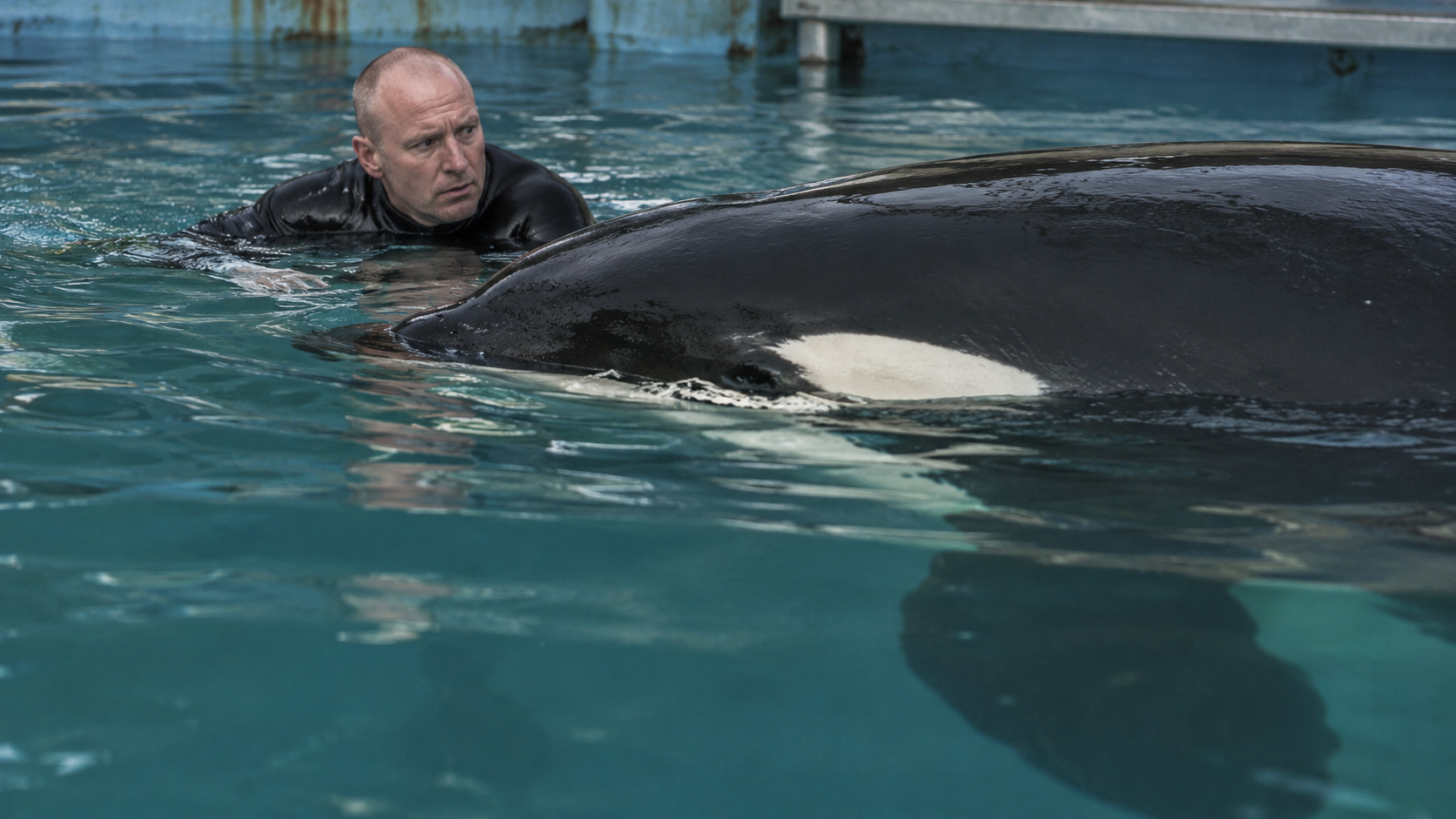
The show was almost over.
Hundreds of people were still watching from the stands at SeaWorld San Diego.
In the pool, veteran trainer Ken Peters was working with an orca he knew extremely well.
Her name was Kasatka.
This was not a new trainer meeting an unfamiliar animal.
Peters had spent years working around killer whales.
Kasatka had spent decades performing in human care.
And the routine they were preparing to perform was something they had done before.
Nothing about the first few moments told the audience that this performance would later become one of the most closely examined trainer-orca incidents in SeaWorld history.
But somewhere beneath the surface, the routine stopped unfolding the way it was supposed to.
And once that happened, Peters faced a problem that training alone could not immediately solve.
Ken Peters Was One of SeaWorld’s Most Experienced Trainers
By November 2006, Peters was 39 years old and had approximately 16 years of animal-training experience, including about 12 years working at Shamu Stadium in San Diego.
That detail matters.
When something unusual happens around a powerful animal, it is easy to assume that the person involved made an obvious beginner’s mistake.
Peters was not a beginner.
He understood the animals.
He understood the pool.
He understood the behavioral cues trainers watched for.
And he understood Kasatka.
SeaWorld officials would later credit his experience and composure as major reasons the incident did not end differently.
But experience with an orca does not make the animal predictable in every moment.
Even SeaWorld officials acknowledged after the incident that killer whales remained capable of unexpected behavior despite thousands of successful interactions between trainers and animals.
That uncertainty was about to become very real.
Kasatka Was Not a Small Animal
Kasatka was an adult female killer whale.
Contemporary reports described her as approximately 17 feet long and weighing well over 5,000 pounds.
She had spent most of her life at SeaWorld San Diego.
She was experienced.
So was Peters.
Together, they had performed demanding routines that required extremely close coordination between trainer and whale.
From the stands, that relationship could make the interaction look almost effortless.
A signal.
A dive.
A powerful animal moving exactly where the trainer expected.
Then both returned to the surface.
But underneath that choreography was a basic physical reality.
In the water, Kasatka possessed nearly every natural advantage.
She was larger.
Faster.
More powerful.
She could change depth in seconds.
And a human being could only stay underwater for so long.
As long as whale and trainer followed the same routine, those differences could appear almost invisible.
The moment the routine changed, they became everything.
The Finale Was Supposed to Be Spectacular
The incident happened during the final show of the day on November 29, 2006, at Shamu Stadium in SeaWorld San Diego.
The planned finale involved Peters and Kasatka descending deep into the pool together.
The pool was approximately 36 feet deep.
From the bottom, Kasatka was supposed to accelerate upward toward the surface.
Peters would then dive away from her nose as they emerged.
It was the kind of maneuver designed to end a show with a burst of speed and energy.
And according to contemporary reporting, Peters and Kasatka had successfully performed it many times before.
So when the two disappeared beneath the surface, the audience had no immediate reason to panic.
Going underwater was part of the routine.
For a moment, what was happening below could still be understood as part of the performance.
But they did not return the way they were supposed to.
This Was Not the First Warning In Their History
Years before the 2006 incident, Kasatka had already been involved in troubling moments with trainers.
SeaWorld officials acknowledged an incident in 1993, when she attempted to bite another trainer.
Then, in 1999, Kasatka made another move toward Peters during a public show.
A contemporary Associated Press report described her as attempting to “nip” him, prompting Peters to quickly get out of the water.
He was not injured.
A later California report described the history more strongly, saying Kasatka had made threatening moves toward Peters in both 1993 and 1999.
Yet she remained an experienced performer.
That may seem surprising now.
At the time, SeaWorld emphasized that individual incidents did not necessarily mean an animal could no longer participate in shows.
Kasatka had completed the same kinds of behaviors successfully many times.
And on November 29, 2006, Peters entered the water with her again.
The show continued.
Until it didn’t.
The Audience Could Tell Something Had Changed
From the stands, the first clue was time.
The trainer and whale remained underwater longer than expected.
Then they returned toward the surface.
But the interaction still did not look finished.
Witnesses later described staff trying to get Kasatka’s attention from around the pool.
The crowd gradually realized they were no longer watching a planned routine.
That transition is part of what makes footage of the incident so unsettling.
There is no obvious cinematic moment when a show becomes an emergency.
At first, the trainer is simply underwater.
The whale is beside him.
The audience waits.
Then a few extra seconds pass.
People around the pool begin reacting differently.
And suddenly every movement means something else.
The same water that moments earlier formed the stage for a performance becomes the environment Peters needs to escape from.
Staying Calm Became Part of the Strategy
Panic would have consumed oxygen quickly.
Peters appears to have understood that.
Years later, when footage of the incident became public, he testified that he believed remaining calm would help him survive the situation and that Kasatka would eventually release him.
That composure is visible in descriptions of what happened.
Rather than wildly striking at the whale, Peters attempted to interact with her.
Contemporary reports say he stroked or patted her while underwater.
From the outside, that may look strangely calm.
But Peters was dealing with an animal he had known for years.
The normal relationship between trainer and whale had not vanished simply because the situation had become dangerous.
He still had to communicate with Kasatka.
He still had to avoid escalating the interaction.
And he still had to conserve enough energy to reach safety if an opportunity appeared.
Eventually, that opportunity came.
But it did not come quickly.
Then Kasatka Took Control of the Dive
What had actually happened underwater became clear afterward.
Kasatka had grabbed Peters by one foot.
Instead of completing the planned ascent, she took him toward the bottom of the approximately 36-foot pool.
Reports at the time said she kept him underwater for close to a minute before bringing him back toward the surface.
That alone would have been enough to turn the performance into an emergency.
But it was not finished.
When they surfaced, Peters tried to calm Kasatka by stroking her.
Then she took him underwater again.
Contemporary reports described a second submersion lasting roughly another minute or somewhat less, depending on the account.
This is the part that changes how the earlier footage looks.
Peters was not simply swimming beside the whale.
He was not riding her.
And the long underwater sequences were not an extended version of the show.
For significant stretches of time, Kasatka controlled where he could go.
And Peters could not simply swim away.
When She Finally Released Him, There Was Still One More Problem
Eventually, Kasatka released Peters.
He surfaced.
After spending so much time underwater, the obvious destination was the edge of the pool.
So Peters began swimming.
For a moment, the most dangerous part appeared to be finished.
Other trainers deployed a net in the water as part of the emergency response.
Peters moved toward safety.
Then the footage shows another moment that later became one of the most memorable parts of the entire incident.
Kasatka turned.
And she began moving toward him again.
A CBS report describing the released footage says Peters was rushing toward the side when he saw the orca coming after him; he ultimately managed to get out of the water.
That is where a short reconstruction should stop.
Not because the ending is unknown.
But because the moment before the ending explains the danger better than almost anything else.
A trainer who had already been taken deep underwater twice was finally swimming toward the wall.
And the whale was moving again.
Peters Survived—But He Did Not Leave Uninjured
Ken Peters made it out of the pool.
He survived.
He was taken to UC San Diego Medical Center with a broken left foot, and later reporting also described puncture injuries associated with the incident.
His survival immediately became part of the discussion about the event.
SeaWorld praised his experience, calmness and relationship with Kasatka.
Critics of captive orca performances saw the same incident very differently.
Animal-welfare advocates argued that placing trainers in the water with animals of such size and power created an unacceptable risk.
SeaWorld rejected broader claims that the incident proved captive killer-whale programs should end, while acknowledging that killer whales retained an element of unpredictability.
The argument would continue for years.
But one thing was difficult to dispute:
training had helped Peters manage the emergency.
It had not prevented the emergency from beginning.
The Video Became More Important Years Later
The incident occurred in 2006.
But much of the public did not see the most striking footage until years afterward.
Video recorded by SeaWorld cameras was later shown during government legal proceedings connected to the 2010 death of SeaWorld Orlando trainer Dawn Brancheau.
The footage became public in 2012.
By then, the debate around killer-whale trainer safety had changed dramatically.
The video of Peters and Kasatka was no longer viewed as one isolated incident.
It became part of a broader examination of how much control trainers truly had when they entered the water with killer whales.
The footage was especially powerful because Peters survived.
Viewers could watch the situation evolve almost step by step.
A familiar routine.
A change underwater.
Long submersions.
A release.
A swim toward the edge.
Then the whale turning toward him again.
It showed how quickly the line between performance and emergency could disappear.
What Happened Afterward?
SeaWorld investigated the incident.
Kasatka’s behavior, the routine and the events leading up to the submersions were reviewed by experienced trainers from multiple SeaWorld parks.
Later reporting said waterwork with Kasatka was restricted following the incident.
At the time, the wider question was no longer simply what Kasatka had done.
It was what humans should reasonably expect when working in the water with a powerful, non-domesticated predator.
A later California report summarized the risk starkly, describing killer whales as animals that remained fundamentally undomesticated despite their close association with trainers.
Kasatka continued living at SeaWorld San Diego for years afterward.
Ken Peters survived the encounter that made both of their names part of a much larger safety debate.
And the footage remains difficult to watch for a simple reason.
It begins with something that looks controlled.
A trainer.
A whale he knows.
A routine they have done before.
Then, underwater, control quietly changes hands.
