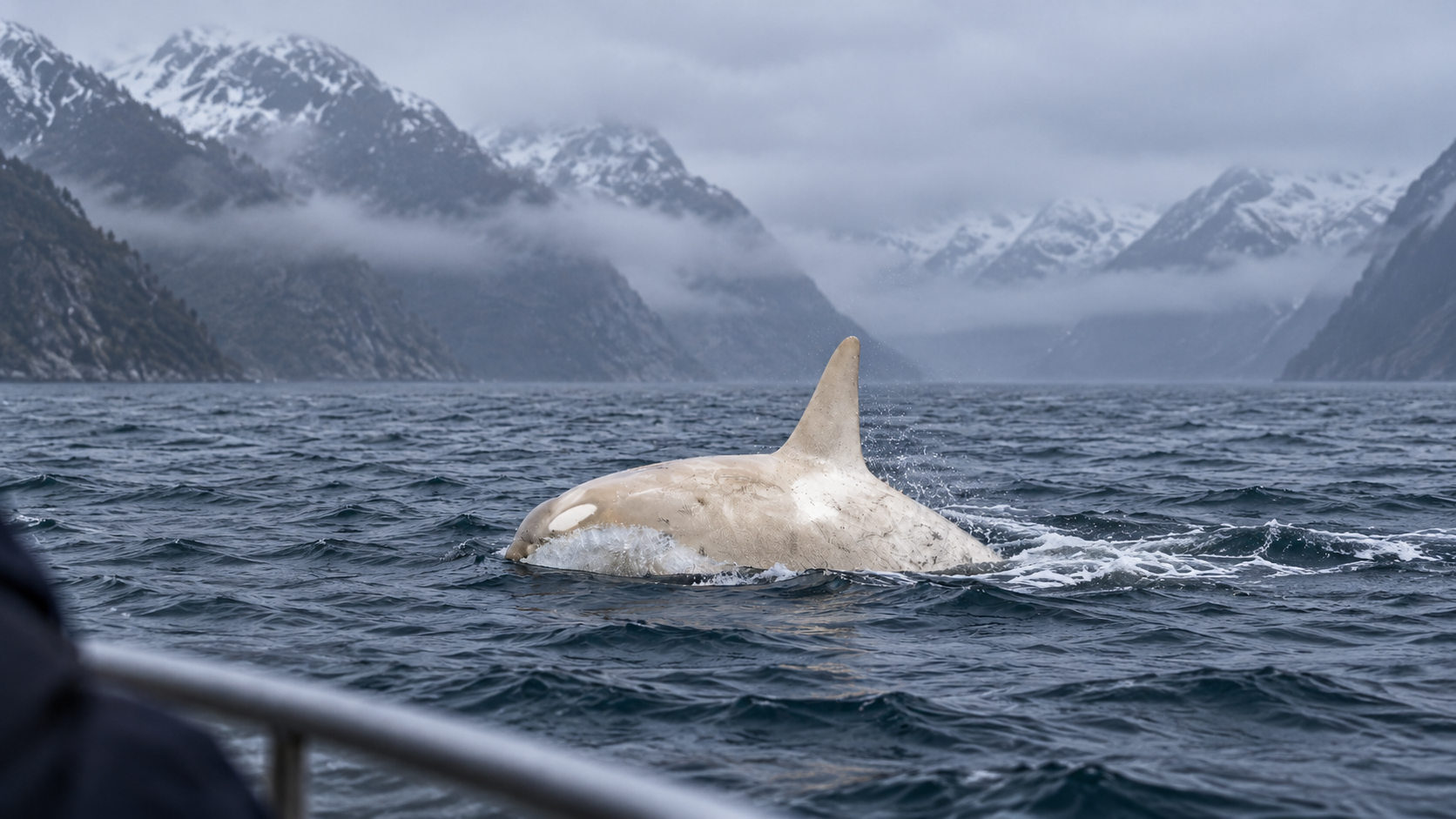
The morning air over the sub-Antarctic waters was freezing and thick with heavy grey fog.
Aboard an offshore marine tracking vessel, researchers were scanning the glass-like surface of the sea.
Hydrophones lowered into the deep were transmitting steady acoustic signals—the distinct clicks and whistles of a nearby traveling pod.
Without warning, the dark blue surface ruptured just fifty yards from the boat’s starboard side.
As the cold ocean water churned, a colossal silhouette rose gracefully into the air.
Gasps echoed across the deck.
The creature breaking the surface was not wearing the iconic jet-black and stark-white pattern of an apex predator.
It was entirely, brilliantly white.
Gliding smoothly through the dark waves, the phantom-like orca illuminated the murky water beneath it like a glowing beacon.
For the research crew, the sighting was nothing short of miraculous.
They were standing face-to-face with a phenomenon so rare that fewer than a dozen confirmed sightings have ever been recorded in modern maritime history: a fully leucistic “ghost” orca.
A One-in-Ten-Thousand Anomaly
To understand the sheer shock of witnessing a white killer whale in the wild, one must understand the evolutionary perfection of standard orca coloration.
For millions of years, killer whales have evolved countershading.
They possess a black back that blends with the dark ocean depths when viewed from above, and a stark white underside that blends with the bright sky when viewed from below.
This natural countershading makes them practically invisible to seals, salmon, and tuna until it is too late.
An orca born without this natural camouflage faces an immediate, life-threatening disadvantage.
A white killer whale stands out against the dark sea like a searchlight.
Prey can spot them from vast distances, making solitary hunting nearly impossible.
Furthermore, genetic mutations that cause true albinism or leucism often come with underlying health vulnerabilities.
These include reduced eyesight, sensitive skin prone to sunburn, and compromised immune systems.
Because of these extreme hurdles, marine biologists historically believed that leucistic calves rarely survived past their first year in the wild.
The Ghost of the Pacific: The Legend of “Iceberg”
The most famous white killer whale in scientific literature was an adult male cataloged by researchers off the coast of Kamchatka, known affectionately as “Iceberg.”
First photographed in 2010, Iceberg stunned the scientific community because he possessed a fully developed, two-meter-tall dorsal fin.
He was not a weak, struggling juvenile. He was a fully grown, healthy bull living within a social pod.
However, after several years of monitoring, Iceberg vanished from tracking logs.
For nearly a decade, marine biologists feared the legendary white bull had succumbed to old age or disease in the harsh northern seas.
When high-definition footage of a pristine white orca recently surfaced off the fog-draped fjords, the global ocean community immediately asked the same question:
Had the legendary ghost returned, or was the ocean revealing a brand-new miracle?
The Secret to Survival: The Power of the Pod
How does a white orca manage to grow into adulthood when its very skin breaks every rule of oceanic camouflage?
The answer lies not in individual physical prowess, but in the extraordinary social structure of orca society.
Killer whales are among the most cooperative hunters on the planet.
Pods operate as tightly-knit family units where food is shared equally among members, regardless of who made the final strike.
Biologists reviewing the latest footage noticed that the white orca was never swimming alone.
It was flanked closely by two normally pigmented adult females who adjusted their swimming speed to mirror its movements.
During coordinated hunting maneuvers, the pod uses acoustic echolocation to herd schools of fish into tight bait balls.
In these team-based hunts, the white orca does not need to rely on stealth.
Its family does the heavy lifting, driving prey directly into its path and sharing the harvest afterward.
This deep social empathy allows visually distinct or vulnerable individuals to thrive in conditions that would otherwise prove fatal.
Analyzing the Footage: What the Cameras Revealed
High-resolution frame-by-frame analysis of the recent sighting revealed critical details about the animal’s physical condition.
Unlike true albino individuals—which possess pink eyes and fragile skin—this individual displayed subtle, slate-grey shadows along the leading edge of its dorsal fin.
This confirms leucism, a rare genetic condition where pigment cells fail to develop properly, leaving the skin alabaster white while retaining normal dark eyes.
The animal’s dorsal fin showed no signs of collapse, infestation, or scarring, indicating exceptional overall health.
Hydrophone recordings captured a rich tapestry of pod-specific calls echoing through the fjord as the white orca surfaced.
The acoustic signatures matched a known resident pod that migrates along deep coastal trenches, confirming that the individual was fully integrated and accepted by its peers.
A Living Symbol of Ocean Mysteries
As the tracking vessel drifted silently alongside the pod, the white orca raised its massive head one last time before slipping beneath the surface.
The brilliant white dorsal fin glided through the dark blue water like a blade before disappearing into the deep, leaving only gentle ripples on the fog-covered sea.
The 15-second encounter left researchers on deck in awe.
In an era where satellite imagery, GPS tracking, and underwater drones map almost every corner of our planet, the appearance of a phantom orca serves as a humbling reminder.
The oceans still hold deep secrets that defy human expectations.
Whether this breathtaking creature is a surviving legend from past tracking logs or a new generation inheriting the arctic waters, its presence proves that nature’s capacity for wonder is far from exhausted.
Research teams continue to monitor acoustic frequencies along the fjord, waiting for the moment the white ghost breaks the surface once more.
